

[EN] Early game strategy, or how not to get overwhelmed
 VolusFM_
(356 ratings)
Jul 23, 2023 @ 8:25am38,389987
Gameplay BasicsWalkthroughsEnglish
Game rules
I usually play on the default settings, default Prince difficulty, with disabled score victory. No particular advantage or handicap.
That doesn't mean you should do the same, it's just to let you know the conditions I play in.
I also will not be covering any particular choice of civilization. You can roll with whatever you like. If you see that some tips I provide do not apply to your civilization choice (e.g. Mvemba a Nzinga from Kongo cannot found Religions) you can just ignore them.
For this guide, I will use some screenshots from a recent game with Gilgamesh.
That doesn't mean you should do the same, it's just to let you know the conditions I play in.
I also will not be covering any particular choice of civilization. You can roll with whatever you like. If you see that some tips I provide do not apply to your civilization choice (e.g. Mvemba a Nzinga from Kongo cannot found Religions) you can just ignore them.
For this guide, I will use some screenshots from a recent game with Gilgamesh.
Capital city and exploration
How well you fare in a Civ VI game will absolutely not be decided by how your first city looks like.
In fact, it is fairly common that your first city ends up behind city A in terms of population, behind city B in terms of production, etc. And even with a bad start, you can still recover.
That being said, having a good start is going to help you tremendously in the early game. A good first city depends on two things: where it is placed and how well you sequence your first productions.
As much as possible, you want to have immediate access to water by placing your first city near a river or on a coast. This will favor growth and you will not have to build an Aqueduc later on (unless you want protection from droughts).
And of course, you want your city to be near resources as well. You will not see any strategic resources at the beginning, so you needn't worry about them right now. But you can still see bonus and luxury resources, and you want your city to have access to some of those, as they will improve yields and/or amnesties.
Usually a good first city has:
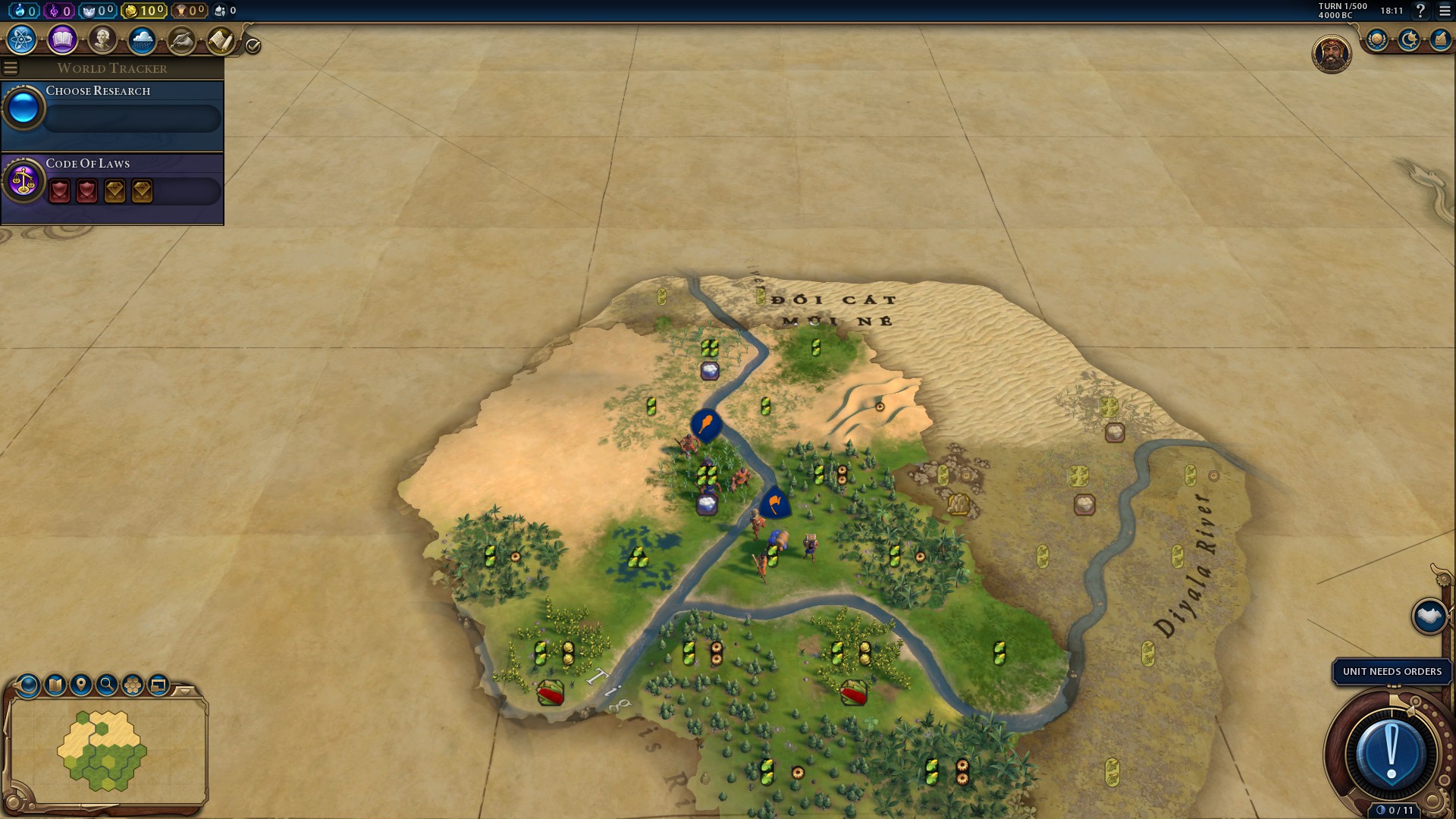
It is fine if you take 1-3 turns to move your Settler to a better location than the one where it spawns.
On this screen, my settler spawned in the wood and I moved it one tile below on the left. You want to avoid removing a wood, as you would lose some production down the line.
Once you have established your first city, it's time to decide what it will produce.
Usually it is best to start with a Scout. You don't want to explore too far with your starting Warrior unit as it is much slower, and you want it to be handling barbarians instead.
One notable (and very rare) exception is when the first tribal village you explore gives you a free recon unit. In that case, you can pause the training of your Scout and launch the next production.
Our second production is going to be a Monument building. This is because it's going to increase the rate at which your city takes control of new tiles. Since you don't have a lot of gold to purchase tiles in the early game, this is very useful.
Once both Scout and Monument are done, you usually have new options thanks to your scientific research, such as Granary which is an excellent early building as it provides food and shelter without any big requirements. That said, you usually want to make a Builder first to start improving your tiles, priorizing food (farms and bonus resources) and other resources (strategic or luxuary).
It is pretty much useless to go for a Builder earlier for two reasons:
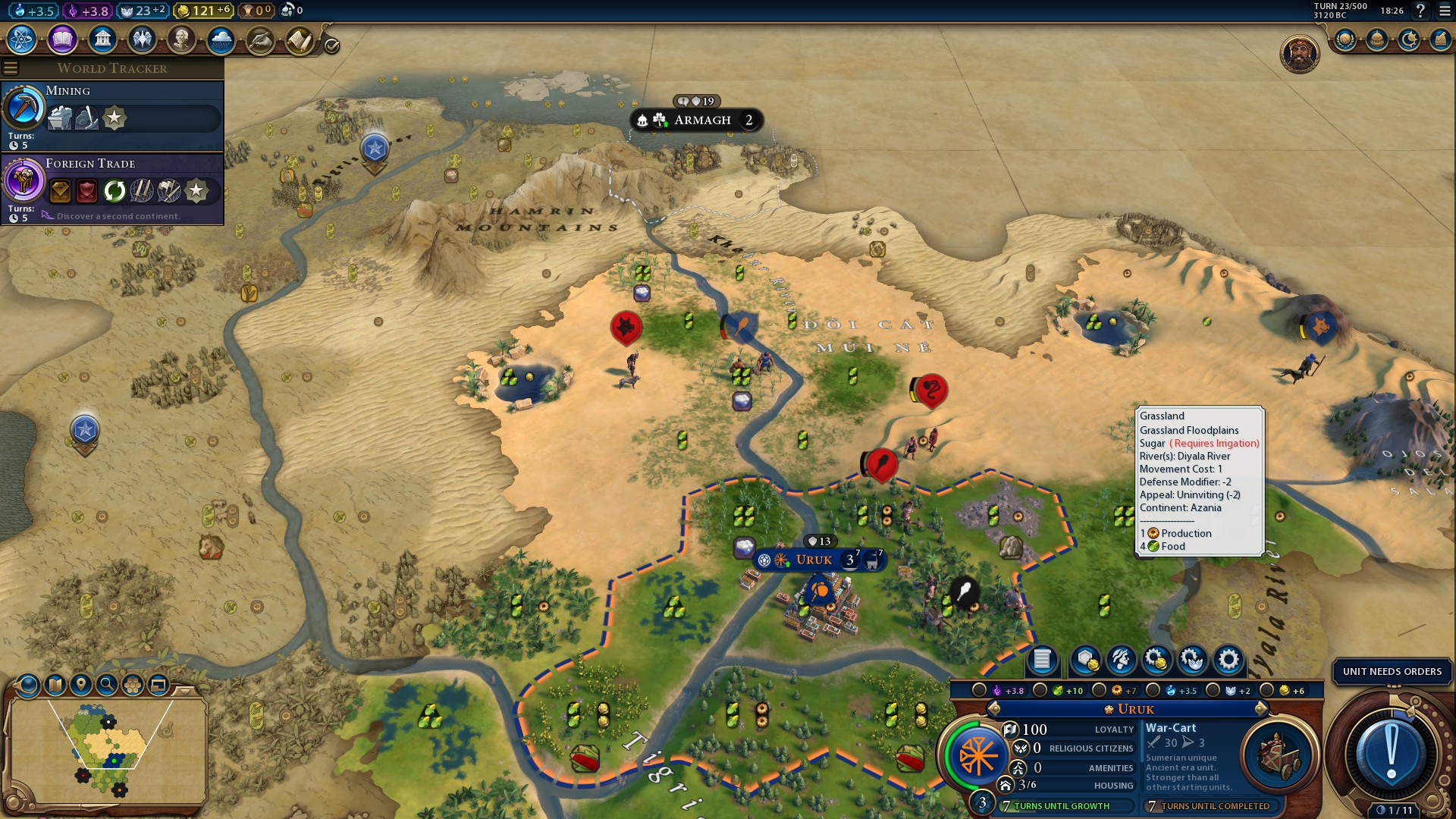
This is what my town looks like after getting my first builder. You can see there are 4 tiles I can improve. It is a bit tricky as barbarians are near, however I can upgrade the tiles south as a City State warrior unit is blocking the barbarians' path.
Once your first builder is created, you can start building a little more freely. Granary is a good option, but you can also choose to build more military units to handle barbarians, or a Trader to make routes with city states and your futur cities.
Once you have your first Scout, you want to start exploring around your first city. Your warrior unit can still help with that, but keep it somewhat close to your capital in case barbarian units come in close. We'll deal with barbarian in details later.
Your Scout unit is your prime target to find and collect tribal villages, which can give you pretty nice boosts such as resources, tech or civic boosts, population, free recon units, etc. Try to get as many of them as you get the lay of the land, but don't get greedy. A Scout is a pretty weak combat unit and any barbarian will dispatch it with ease (unless it's another Scout).
In fact, it is fairly common that your first city ends up behind city A in terms of population, behind city B in terms of production, etc. And even with a bad start, you can still recover.
That being said, having a good start is going to help you tremendously in the early game. A good first city depends on two things: where it is placed and how well you sequence your first productions.
Placement of the capital
As much as possible, you want to have immediate access to water by placing your first city near a river or on a coast. This will favor growth and you will not have to build an Aqueduc later on (unless you want protection from droughts).
And of course, you want your city to be near resources as well. You will not see any strategic resources at the beginning, so you needn't worry about them right now. But you can still see bonus and luxury resources, and you want your city to have access to some of those, as they will improve yields and/or amnesties.
Usually a good first city has:
- access to water
- immediate access (first 6 tiles) to 2 bonus or luxury resources
- further access (via border growth) to more resources
It is fine if you take 1-3 turns to move your Settler to a better location than the one where it spawns.
On this screen, my settler spawned in the wood and I moved it one tile below on the left. You want to avoid removing a wood, as you would lose some production down the line.
Production in the capital
Once you have established your first city, it's time to decide what it will produce.
Usually it is best to start with a Scout. You don't want to explore too far with your starting Warrior unit as it is much slower, and you want it to be handling barbarians instead.
One notable (and very rare) exception is when the first tribal village you explore gives you a free recon unit. In that case, you can pause the training of your Scout and launch the next production.
Our second production is going to be a Monument building. This is because it's going to increase the rate at which your city takes control of new tiles. Since you don't have a lot of gold to purchase tiles in the early game, this is very useful.
Once both Scout and Monument are done, you usually have new options thanks to your scientific research, such as Granary which is an excellent early building as it provides food and shelter without any big requirements. That said, you usually want to make a Builder first to start improving your tiles, priorizing food (farms and bonus resources) and other resources (strategic or luxuary).
It is pretty much useless to go for a Builder earlier for two reasons:
- a lot of resources (such as Bananas, Stone, Silver, etc.) need special improvements that your Builders will not be able to make until a specific technology (such as Irrigation or Mining) has been researched
- even if a tile is improved, it needs to be worked by a citizen to yield anything, and your first city will likely be at 1-2 population only if you create a Builder earlier, so you'd end up improving tiles that will not be worked anyway.
This is what my town looks like after getting my first builder. You can see there are 4 tiles I can improve. It is a bit tricky as barbarians are near, however I can upgrade the tiles south as a City State warrior unit is blocking the barbarians' path.
Once your first builder is created, you can start building a little more freely. Granary is a good option, but you can also choose to build more military units to handle barbarians, or a Trader to make routes with city states and your futur cities.
Exploration
Once you have your first Scout, you want to start exploring around your first city. Your warrior unit can still help with that, but keep it somewhat close to your capital in case barbarian units come in close. We'll deal with barbarian in details later.
Your Scout unit is your prime target to find and collect tribal villages, which can give you pretty nice boosts such as resources, tech or civic boosts, population, free recon units, etc. Try to get as many of them as you get the lay of the land, but don't get greedy. A Scout is a pretty weak combat unit and any barbarian will dispatch it with ease (unless it's another Scout).
Scientific research
Once your first city has been founded, you will be able to research technologies. You pretty much can and will research everything in order to progress in the game, but once again, the sequencing is going to be important.
What you usually want to research first is Animal husbandry, because it gives you access to two upgrades (Camp and Pasture) that are going to be very useful to improve tiles.
After this, you want to go for Pottery to get access to Granary early. It's a very good building to boost growth in the early game.
After this, there's a bit more choice. Here are some good options :
You will end up researching them all anyway, so feel free to experiment. From all my games, I found that Animal Husbandry => Pottery => Irrigation or Astrology works very well.
What you usually want to research first is Animal husbandry, because it gives you access to two upgrades (Camp and Pasture) that are going to be very useful to improve tiles.
After this, you want to go for Pottery to get access to Granary early. It's a very good building to boost growth in the early game.
After this, there's a bit more choice. Here are some good options :
- Irrigation. You get access to the plantation which is another fairly common improvement you need, and the Hanging Gardens which are an amazing wonder.
- Astrology. You get access to Holy Site and Stonehenge (you need Stone), which can both be used to found a religion (see the related section below).
- Writing. Gives access to Campus to generate more science, which will speed up your whole research process.
- Mining. Pretty much needed early to build quarries and mines.
- Sailing. Very useful if you have coastal resources.
You will end up researching them all anyway, so feel free to experiment. From all my games, I found that Animal Husbandry => Pottery => Irrigation or Astrology works very well.
Government
First policies and early civics
Within 10-16 turns after founding your first city, you will automatically get the Code of laws, 4 policies and 2 slots to use them.
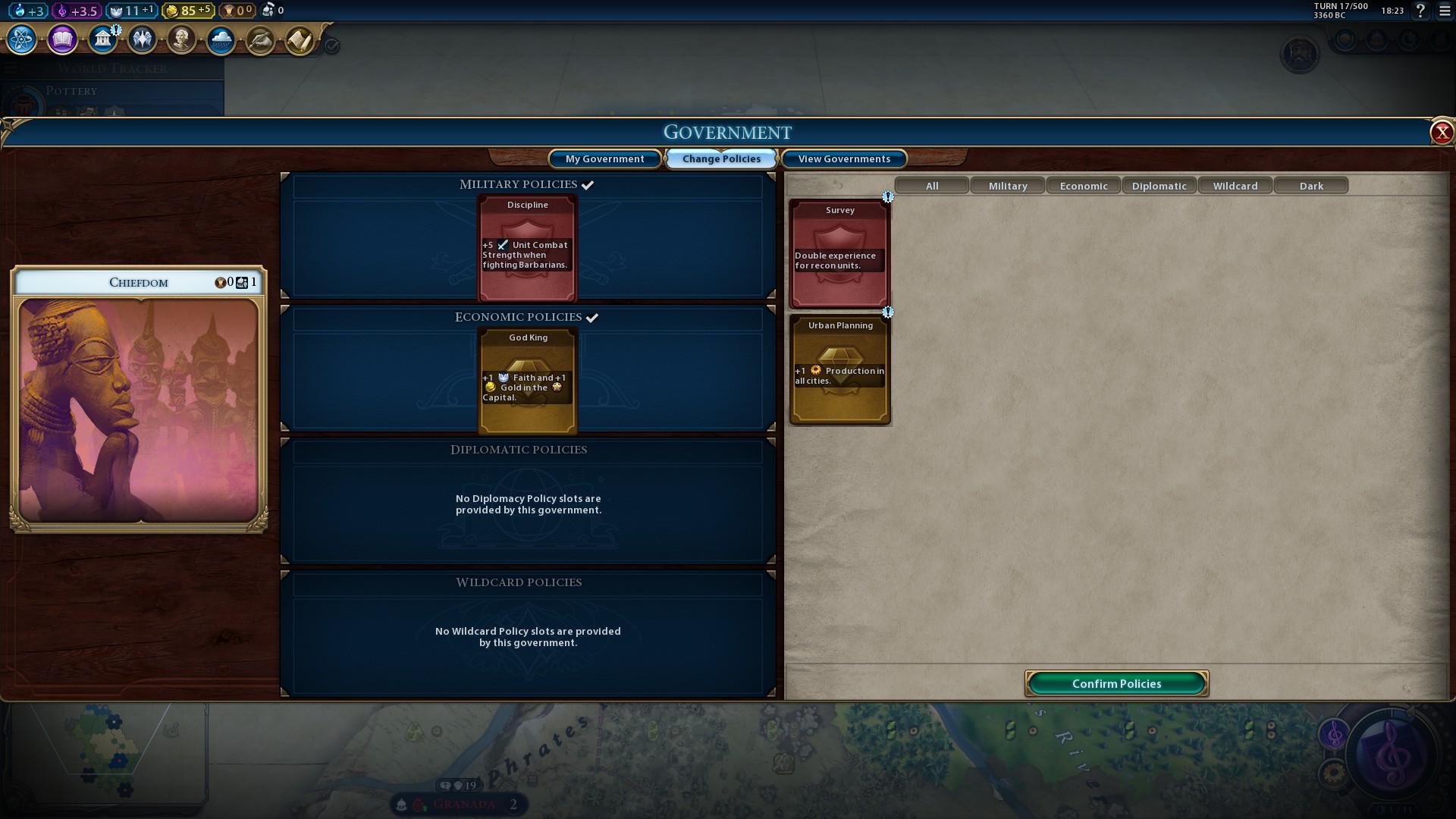
You always want to go for Discipline and God King here. The first one is going to massively help you deal with barbarians in the early game, while the extra faith yielded by God King will allow you to found a Pantheon in maximum 20 turns.
After that, you usually want to go for Foreign Trade. By the time this is completed, your will have created your first builder and made 3 improvements, so you'll get the boost on Craftsmanship which is the next civic to go for.
Then you can go for Early Empire or State Workforce, whichever you like best first. The idea here is to rush Political Philosophy to get a 4-policies governement as fast as possible.
Governement choice
Usually I go for Classical republic, since I don't really need any military policies at this point (until I unlock the next tier government). That said, Autocracy is good if you want to boost production and growth, and Oligarchy if you're going tor a military victory.
As for your first diplomacy policy, you can go for Charismatic leader to increase Envoy generation for city states. In the long run, having city state allies is going to be very useful.
Pantheon and religion
Good pantheon choices
Withing approximately 20 turns, you should have reached 20 faith, which will enabled you to found a pantheon. Keep in mind that each pantheon bonus is only available for one civilization. The later you found your pantheon, the less bonuses will be available.
A very good choice here is Religious settlements. Not only does it give you a faster border expansion rate, but you also get a free Settler with no population cost, which enables you to get a second city quickly.
You can also opt for Fertility rites, to get a 10% growth rate in all cities and a free Builder.
Depending on your starting location and available resources, you can also choose something that improves yields or adjacency bonuses.
Once you have your Pantheon, founding a religion is next.
Getting a religion
Getting a religion is going to be a bit more complicated. You either need to accumulate Great Prophet points via a Holy Site, or to build the Stonehenge wonder near a Stone resource.
Bear in mind that there are a limited number of Great Prophets available in one game. Each civilization can get at most one, and there are less prophets than there are civilizations in a game. So, if you want to found a religion (and you should, considering there are nice bonuses to it), you can't wait for too long.
Fortunately, you should have two cities by the time you found your Pantheon, so you can choose to build a Holy Site/Stonehenge in one of them, without sacrificing utility production (Builders, military units, etc.).
Good religion choices
Name and icon do not really matter here, the bonuses you choose do.
You can only select the first two beliefs. After that, you will need to use an Apostle to choose each remaining belief (2) of the religion.
Main belief
Here are some choices I like:
Feed the world is an amazing belief to help city growth and housing.
Religious community can be a nice boost of income.
Work ethic is a nice production boost, but you usually don't make that many holy sites, unless going for a religious victory.
Jesuit education is a pretty good boost for the Science and Culture victories.
I don't really like the others, I find them too situational or easily obtained by other means.
Secondary belief
I usually like to choose either the boost of of yields (like Tithe, +3 gold for each city following the religion) or getting an extra religious building (the Mosque is amazing to get more value out of Missionaries and Apostles)
Founding new cities
In general you want to follow the same principles for your capital and your new cities: near a source of water, useful resources, and reasonably close to the rest of your empire.
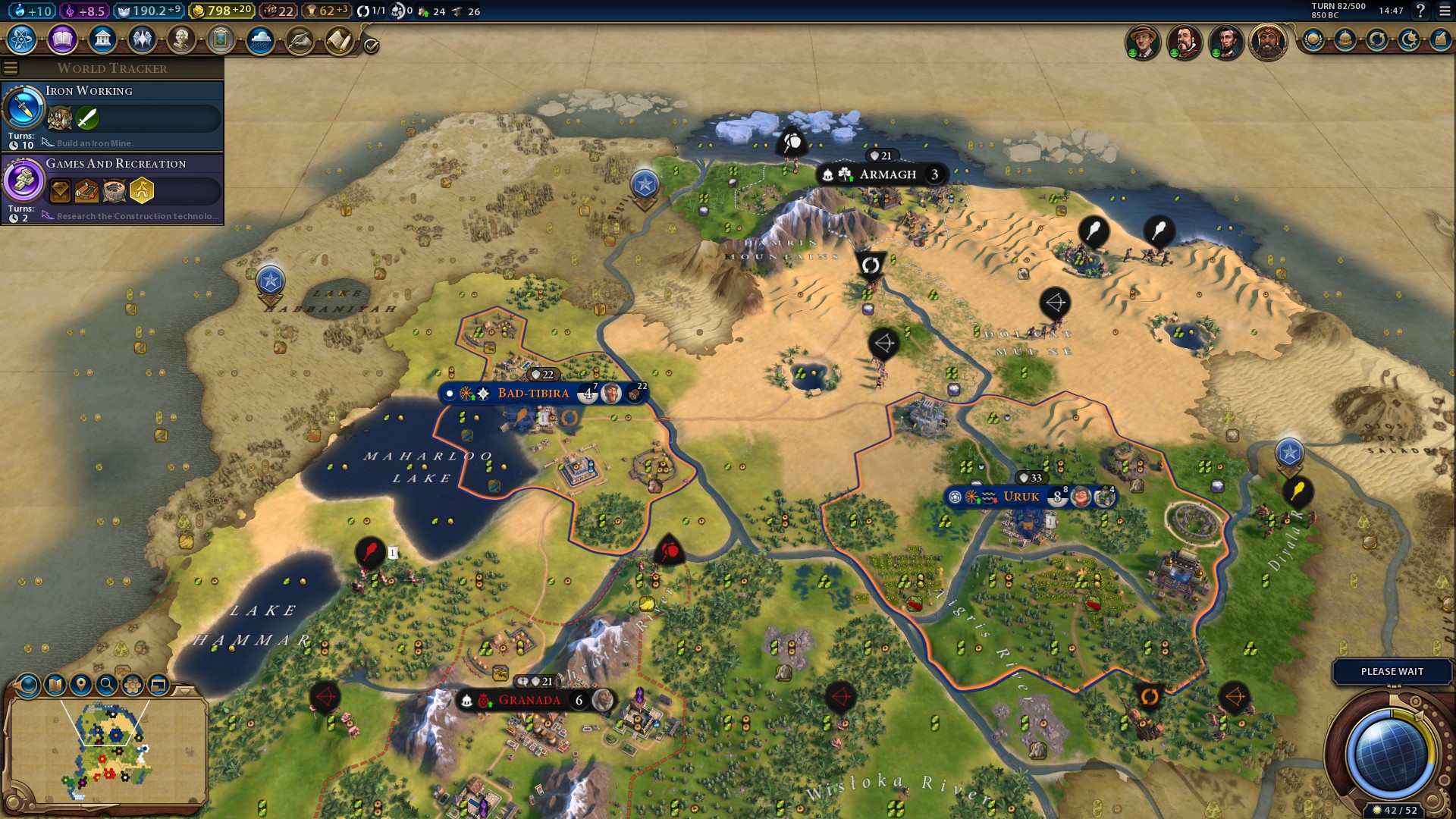
You can use map tacks to mark good locations for future cities, like I did here:
Building the Governmentt Plaza district is going to nicely help founding new cities, as you can build the Ancestral Hall building that gives a free builder to new cities and boosts Settler production in the city housing the district.
Having Governor Magnus in that same city with the Provision promotion will also be a nice help, as you won't lose population when creating a Settler.
You can use map tacks to mark good locations for future cities, like I did here:
Building the Governmentt Plaza district is going to nicely help founding new cities, as you can build the Ancestral Hall building that gives a free builder to new cities and boosts Settler production in the city housing the district.
Having Governor Magnus in that same city with the Provision promotion will also be a nice help, as you won't lose population when creating a Settler.
Early production
Trade routes
You want to get trade routes going early for two reasons:
- the income (gold, production, food, etc.) it yields ;
- the routes it creates on the map
You can always make at least one trader once you have discovered trade. To build more, you will need to research Currency and build Markets.
A good trick when creating domestic trade routes is to make it go from your weakest city (in terms of food/production) to your capital (or strongest city), and not the other way around. You have a button to quickly teleport a Trader from one city to another.
You can also send traders to City states, especially if they have a quest for that (you will get an Envoy). That said, I think it's better to prioritize the creation of roads between your cities. Once a road has been completed, you can always redirect the Trader to a city state.
Wonders
Wonders are usually long to produce and will mobilize the production effort of an entire city for dozens of turns. That said, some of them are fantastic to have especially in the early-game:
Pyramids: Grants a free Builder and improves your Builders for the rest of the game. Very hard to build, as it requires desert and the AI will rush it.
Hanging Gardens: Grants a boost to growth in all cities.
Stonehenge: Grants faith and a free Great Prophet.
Apadana: Wonderful to get a lot of Envoys and influence city states.
Building wonders is a tricky choice. They grant amazing benefits overall, but you shouldn't build them at the expense of other critical development needs, such as Builders (if you need to improve some times urgently) or specialty districts.
Handling barbarians
Your biggest problem in the early game is likely to be barbarians. They won't be able to destroy your cities or anything of the sort, but they can cripple your early development by stealing Builders, pillaging tiles, even killing units.
The first thing you want to know is where the barbarian camps close to your cities are. This is the role of your Scout(s). As soon as a Scout spots a barbarian camp, makes sure to keep him away from them as he doesn't really stand a chance. Also, you should avoid attacking barbarians until you get your first policies (and select the bonus combat strength against barbarians).
A barbarian camp is always going to spawn with a Spearman unit inside. This is annoying as they're a bit more powerful than your Warriors, but they tend to be very passive, which you can use to your advantage.
If you spot a barbarian camp early and there's no additional troups to support the Spearmen (Scouts do not count), you can send you Warrior unit to dispatch it. The first attack will likely be a minor defeat, but then you can heal your warrior next to the camp. Usually the Spearman does not move.
If the camp starts generating units, however, you have to back off before getting outnumbered. Usually taking a good defensive position (like behind a river or on a hill) will be enough to hold on. Let the extra barbarians units come to you and kill them one by one. If there are two Warrior units and you only have one (or they have one Warrior and one Slinger), you should get back to your city.
It's usually worth it to buy a Slinger or Warrior with gold (140-160 gold, you should have it at this point) if you're struggling to keep the barbarians away. When I start cleaning up several barbarian camps, I usually buy a Slinger and start producing a Warrior in my capital at the same time to ensure I have enough strength to fend them all off.
Do not let barbarians capture your civilian units. Create an escort formation if you have to.
Note that barbarian camps on the coast are extra annoying as they're likely to spawn a lot of pirate ships that you won't be able to kill very efficiently, so if you spot one and can kill it, you should do it quickly.
The first thing you want to know is where the barbarian camps close to your cities are. This is the role of your Scout(s). As soon as a Scout spots a barbarian camp, makes sure to keep him away from them as he doesn't really stand a chance. Also, you should avoid attacking barbarians until you get your first policies (and select the bonus combat strength against barbarians).
A barbarian camp is always going to spawn with a Spearman unit inside. This is annoying as they're a bit more powerful than your Warriors, but they tend to be very passive, which you can use to your advantage.
If you spot a barbarian camp early and there's no additional troups to support the Spearmen (Scouts do not count), you can send you Warrior unit to dispatch it. The first attack will likely be a minor defeat, but then you can heal your warrior next to the camp. Usually the Spearman does not move.
If the camp starts generating units, however, you have to back off before getting outnumbered. Usually taking a good defensive position (like behind a river or on a hill) will be enough to hold on. Let the extra barbarians units come to you and kill them one by one. If there are two Warrior units and you only have one (or they have one Warrior and one Slinger), you should get back to your city.
It's usually worth it to buy a Slinger or Warrior with gold (140-160 gold, you should have it at this point) if you're struggling to keep the barbarians away. When I start cleaning up several barbarian camps, I usually buy a Slinger and start producing a Warrior in my capital at the same time to ensure I have enough strength to fend them all off.
Do not let barbarians capture your civilian units. Create an escort formation if you have to.
Note that barbarian camps on the coast are extra annoying as they're likely to spawn a lot of pirate ships that you won't be able to kill very efficiently, so if you spot one and can kill it, you should do it quickly.
Ancient era score
As the Ancient Era is relatively short, you don't get a lot of time to gain era score. This is going to be determined by how good your exploration is (tribal villages and natural wonders found, other civilizations met).
Some civilizations have unique units and/or improvements that are available from the start and give +4 era score. However, you should build it if you need it, not just to boost your era score.
You need an era score of 11 to avoid a dark age in the Classical era, and an era score of 25 to get a golden age. Getting a golden classical age is very difficult and usually will not happen (you need a good part of luck as well), but you should try to avoid a dark age. If however you get one, it's not too big of an issue, and you might even bounce back with a heroic age (get a golden era score during a dark age) in the medieval era.
Some civilizations have unique units and/or improvements that are available from the start and give +4 era score. However, you should build it if you need it, not just to boost your era score.
You need an era score of 11 to avoid a dark age in the Classical era, and an era score of 25 to get a golden age. Getting a golden classical age is very difficult and usually will not happen (you need a good part of luck as well), but you should try to avoid a dark age. If however you get one, it's not too big of an issue, and you might even bounce back with a heroic age (get a golden era score during a dark age) in the medieval era.
Comitting to a victory type
Once you're past 100-150 turns, once your early development is well on its way, it's time to decide which victory you're going for - if that's not already set.
The easiest, in my opinion, are the Science and Diplomatic victory. Both do not require you to interact too much with other civilizations, and you can get so many diplomatic points with wonders and competition events I often get a Diplomatic victory without even meaning to.
Usually any civilization can go for any victory type (unless you try to go for a Religious victory with Mvemba a Nzinga... that's not going to go too well), and while certain civs are obviously tailored for certain victory types (Science for Babylon, Culture for Japan or Greece, etc.), you don't necessarily need to play into that. What matters is choosing a victory type and building into it. If you spend the first 250 turns building exclusively science buildings and then try to switch to a Culture victory, it's unlikely to work.
The easiest, in my opinion, are the Science and Diplomatic victory. Both do not require you to interact too much with other civilizations, and you can get so many diplomatic points with wonders and competition events I often get a Diplomatic victory without even meaning to.
Usually any civilization can go for any victory type (unless you try to go for a Religious victory with Mvemba a Nzinga... that's not going to go too well), and while certain civs are obviously tailored for certain victory types (Science for Babylon, Culture for Japan or Greece, etc.), you don't necessarily need to play into that. What matters is choosing a victory type and building into it. If you spend the first 250 turns building exclusively science buildings and then try to switch to a Culture victory, it's unlikely to work.
Thoughts? Suggestions?
Let me know in the comments below.