

CivMD's Antiquity Age Guide to Silla (Civ 7)
 CivMD
CivMDDec 10, 2025 @ 5:50pm2024
Gameplay BasicsEnglish
Introduction
The Three Kingdom Period (삼국시대; 50 BC - 660 AD) was one of the most colorful times on the Korean Peninsula. Early times were dominated by Goguryeo (고구려), famed for their ferocious horseback raiders and sturdy fortresses, and Baekje (백제), known for their luscious fields of grain and complex trade networks.
As the smallest of the Three Great Kingdoms, Silla (신라) had to differentiate itself with shrewd diplomacy and military ingenuity. A well-educated populace was key to their strategy: their elite soldiers, the Hwarang (화랑), were some of the best administrators, scholars, and diplomats, all at the same time. As the tides of power shifted over time on East Asia, Silla would ally with many different powers, inside and outside of the Korean Peninsula. Ultimately the alliance between the Tang Dynasty of China and Silla would defeat both Goguryeo and Baekje, providing Silla with the territory and natural resources they sought out for centuries. The Silla Kingdom would stand the test of time for another 300 years, until the Koryo dynasty succeeded them (935 AD).
It is now up to you, as a leader of your own people, to restore the legacy of Silla—the Milennial Kingdom. Choose your alliances wisely and may the Grand Buddha Statues smile upon you.
As the smallest of the Three Great Kingdoms, Silla (신라) had to differentiate itself with shrewd diplomacy and military ingenuity. A well-educated populace was key to their strategy: their elite soldiers, the Hwarang (화랑), were some of the best administrators, scholars, and diplomats, all at the same time. As the tides of power shifted over time on East Asia, Silla would ally with many different powers, inside and outside of the Korean Peninsula. Ultimately the alliance between the Tang Dynasty of China and Silla would defeat both Goguryeo and Baekje, providing Silla with the territory and natural resources they sought out for centuries. The Silla Kingdom would stand the test of time for another 300 years, until the Koryo dynasty succeeded them (935 AD).
It is now up to you, as a leader of your own people, to restore the legacy of Silla—the Milennial Kingdom. Choose your alliances wisely and may the Grand Buddha Statues smile upon you.
At a glance
Silla (신라)- Antiquity Civilization
Attributes- Diplomatic, Economic
Starting bias- Grassland (5), Rough/Hills (15)
Recommended Leaders- Benjamin Franklin, Himiko- Queen of Wa, Xerxes the Achaemenid
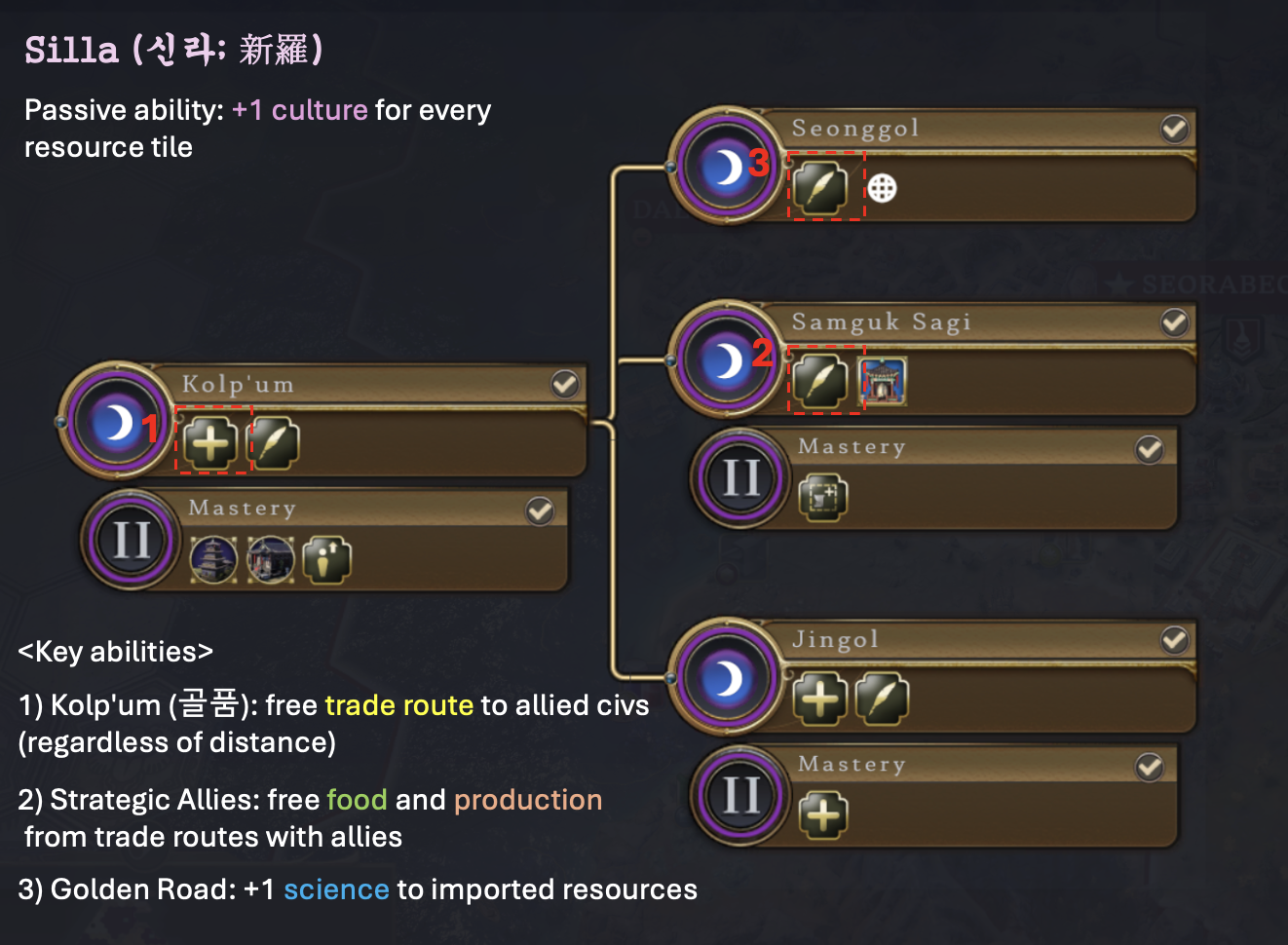
<Default Passive Ability>
Maripgan (마립간)- +1 Culture on Resources
<Passive Abilities Unlocked with Civics>
Kolp'um (골품)- When forming an Alliance, each leader receives a free Trade Route from the other leader's Capital. You gain the resources, as well as +2 gold per the number of resources. These Trade Routes do not go away when the Alliance ends.
Jingol (진골)- +1 Resource Capacity in Towns.
<Passive Abilities Unlocked with Civic Masteries>
Kolp'um II (골품 II)- Defeating a Unit with a Hwarang provides Culture qual to 25% of its Combat Strength
Samguk Sagi II (삼국사기 II)- +1 Social Policy slot.
Jingol II (진골 II)- +5 land Trade Range in all Settlements.
<Traditions>
Strategic Allies- All Trade Routes between you and your Allies award Food and Production equal to the Trade Route's Gold award.
The Golden Road- +1 Science for each imported Resource.
Beopseong (법성)- Towns with a Happiness Building receive +2 Happiness on Resources.
Seorabeol (서라벌)- +1 Gold and Influence on Resources slotted into Trade Outpost or Factory Towns.
Recommended Civics Progression path:
<Unique Buildings and Quarters>
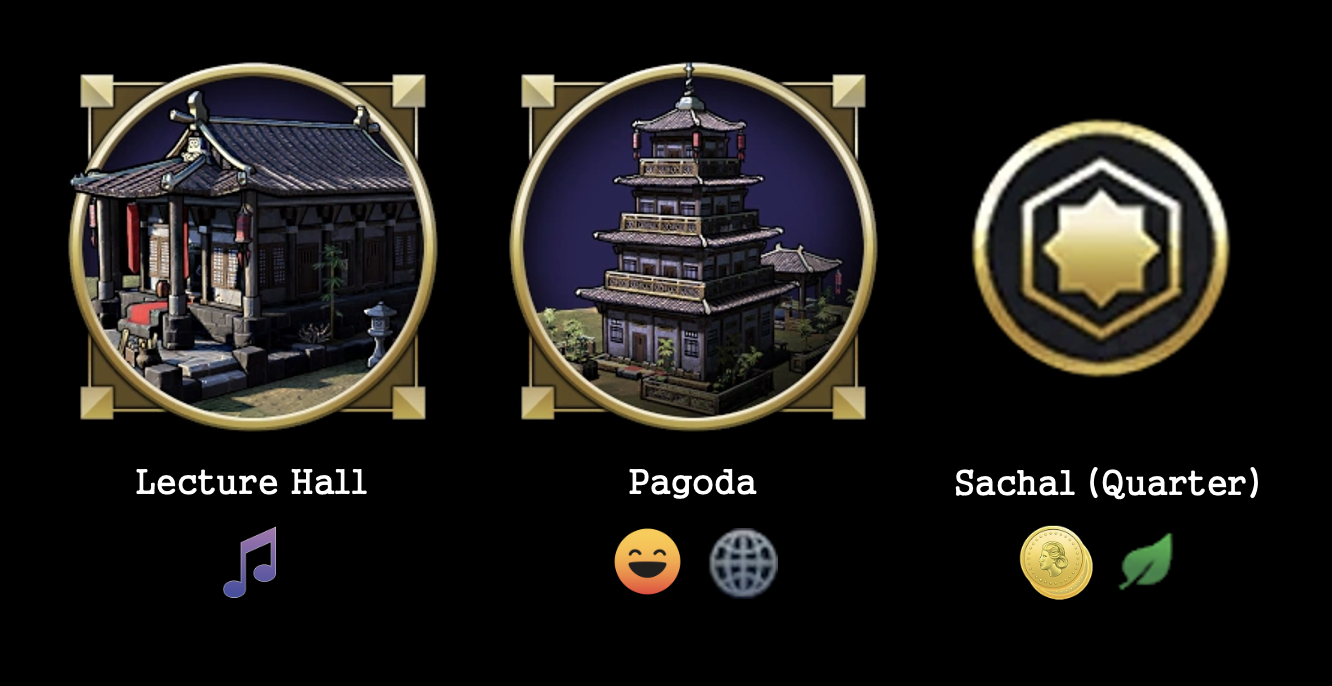
Lecture Hall- Culture base (+3), Culture adjacency for Wonders. +1 Resource Capacity if built on Rough terrain.
Pagoda- Happiness base (+3), Diplomacy adjacency for Wonders and Mountains.
Sachal (사찰)- Unique Quarter; +1 Gold for every Resource you have slotted in this City.
<Unique Units>
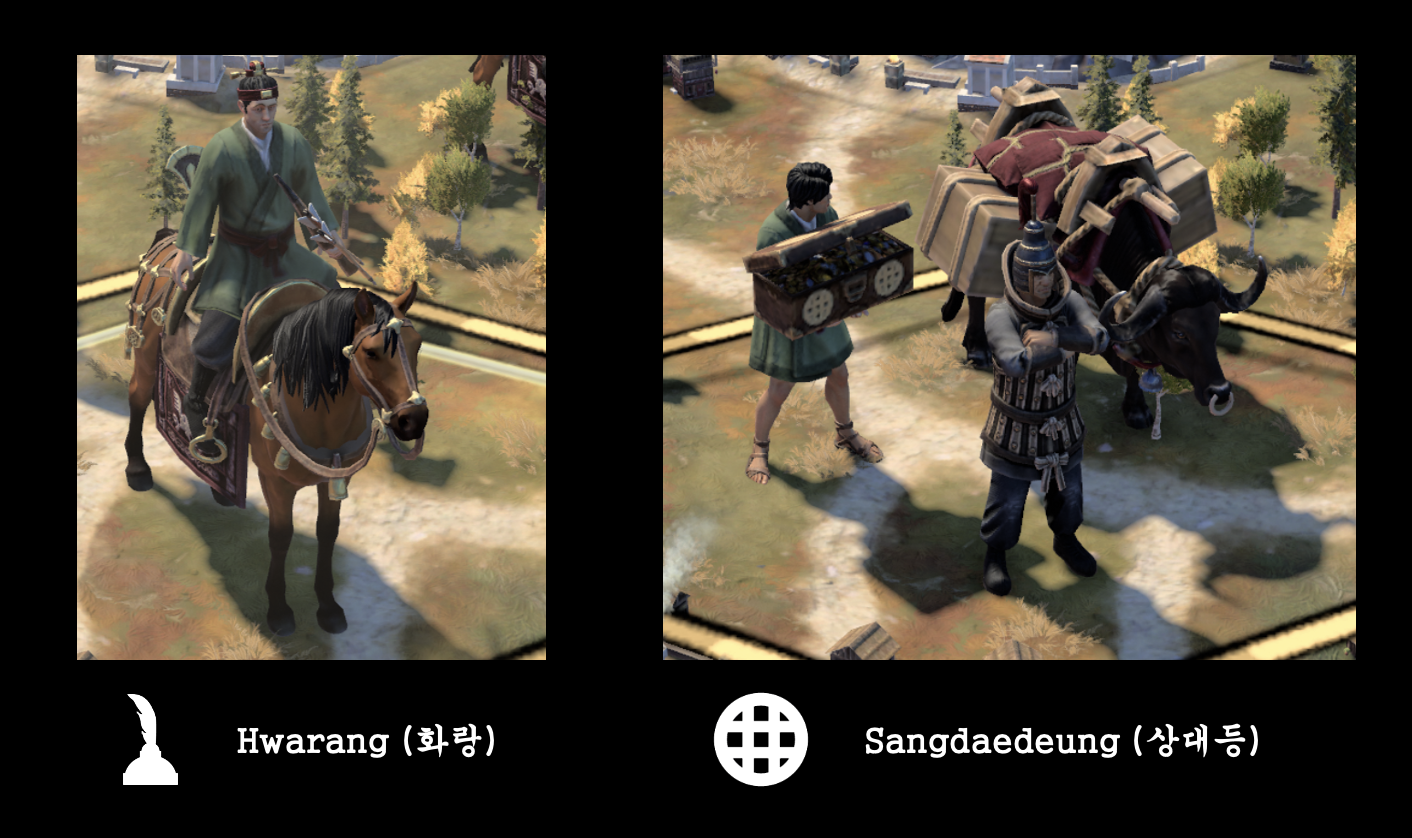
Hwarang (화랑)- Mounted range unit. All bonuses (commander promotions, leader abilities, mementos, etc) to mounted units as well as ranged units apply.
- +3 combat strength compared to ranged units of the same era. Higher production cost (~50%). Upgrade cost is the same as Slinger -> Archer.
- The Kolp'um II (골품 II) civic mastery allows you to earn culture with kills from the Hwarang.
Sangdaedeung (상대등)- Unique merchant unit. Earn +5 gold times the relationship level (max 500) when creating a trade route.

<Associated World Wonder>
Emile Bell (에밀레종)- +1 Diplomatic Attribute Pointe, +2 Influence, gain the unique endeavor "Ginseng Agreement" that provides food in both capitals. Relationship changes from Ginseng Agreement is double that of normal endeavors (+10 with accept, +25 with support-- instead of +5 and +12 respectively).
Attributes- Diplomatic, Economic
Starting bias- Grassland (5), Rough/Hills (15)
Recommended Leaders- Benjamin Franklin, Himiko- Queen of Wa, Xerxes the Achaemenid
<Default Passive Ability>
Maripgan (마립간)- +1 Culture on Resources
<Passive Abilities Unlocked with Civics>
Kolp'um (골품)- When forming an Alliance, each leader receives a free Trade Route from the other leader's Capital. You gain the resources, as well as +2 gold per the number of resources. These Trade Routes do not go away when the Alliance ends.
Jingol (진골)- +1 Resource Capacity in Towns.
<Passive Abilities Unlocked with Civic Masteries>
Kolp'um II (골품 II)- Defeating a Unit with a Hwarang provides Culture qual to 25% of its Combat Strength
Samguk Sagi II (삼국사기 II)- +1 Social Policy slot.
Jingol II (진골 II)- +5 land Trade Range in all Settlements.
<Traditions>
Strategic Allies- All Trade Routes between you and your Allies award Food and Production equal to the Trade Route's Gold award.
The Golden Road- +1 Science for each imported Resource.
Beopseong (법성)- Towns with a Happiness Building receive +2 Happiness on Resources.
Seorabeol (서라벌)- +1 Gold and Influence on Resources slotted into Trade Outpost or Factory Towns.
Recommended Civics Progression path:
Kolp'um (the "first one") -> Samguk Sagi (the "middle branch") -> Seonggol (the "top branch") -> Kolp'um II (the "first one's mastery") -> Jingol (the "bottom branch") -> rest of the masteries
<Unique Buildings and Quarters>
Lecture Hall- Culture base (+3), Culture adjacency for Wonders. +1 Resource Capacity if built on Rough terrain.
Pagoda- Happiness base (+3), Diplomacy adjacency for Wonders and Mountains.
Sachal (사찰)- Unique Quarter; +1 Gold for every Resource you have slotted in this City.
<Unique Units>
Hwarang (화랑)- Mounted range unit. All bonuses (commander promotions, leader abilities, mementos, etc) to mounted units as well as ranged units apply.
- +3 combat strength compared to ranged units of the same era. Higher production cost (~50%). Upgrade cost is the same as Slinger -> Archer.
- The Kolp'um II (골품 II) civic mastery allows you to earn culture with kills from the Hwarang.
Sangdaedeung (상대등)- Unique merchant unit. Earn +5 gold times the relationship level (max 500) when creating a trade route.
<Associated World Wonder>
Emile Bell (에밀레종)- +1 Diplomatic Attribute Pointe, +2 Influence, gain the unique endeavor "Ginseng Agreement" that provides food in both capitals. Relationship changes from Ginseng Agreement is double that of normal endeavors (+10 with accept, +25 with support-- instead of +5 and +12 respectively).
Overall Strategy

Silla's gameplan revolves around making Allies as quickly as possible. We'll discuss each of these elements in each section.
Making Friends and Friendship Levels
 ^If you click on the profiles of any opponent civs, the diplomacy panel will pop up. You can click the heart icon to access the relationship panel. Check this constantly.
In general, people in the real world make friends by sharing their interests with others, while avoiding conflicts. It's the same in Civ 7 diplomacy.
Things that increase relationship levels:
-Good first impressions (important! easy way to get +20 levels)
-Endeavors: +5 to +12
-Sending trade routes: +20
-Satisfying leader agendas (check the agenda tab by looking at the head with the question mark icon)-Endeavors: +5 to +12
-Sending trade routes: +20
-Having the same government type
-Once you make allies, an additional +30.
Things that decrease relationship levels:
-Settling within 10 tiles(hexes) of the opponent capital Count your hexes!!!
-Opponent civ settling within 10 tiles from your capital (not much you can do about this)-Borders touching
-Won the race to become the suzerain of a city-state
 ^Source: civwiki
Your goal is to get +60 relationship points.
You'll need to get good first impressions by choosing the friendly greeting option when you first meet them (+20), and then anywhere between 4-8 endeavors. If you get lucky and have a neighbor who has an easy agenda to satisfy (for example, Pachacuti-- just don't claim mountain tiles), you can get an extra +5 to +20 relationship points. There are a few more things to say about endeavors and sending trade routes, so I'll walk through each method in the subsections below.
—Choosing Endeavors
There's mainly two things to discuss here:
-You initiating endeavors that benefit you
-You choosing endeavor requests from other civs that you should support
By default you are able to initiate two different endeavors each time (with exceptions of leaders like Benjamin Franklin or Lafayette). You can initiate both of them to the same leader to make friendship levels rise faster, or you can initiate each endeavor to different leaders.
The type of endeavor will match your leader's attributes. For example, a Diplomatic and Scientific leader like Benjamin Franklin will be able to initiate the Local Festival (happiness) and Research Collaboration (science) endeavors. Typically you'll want to prioritize science and culture in the very early game, so Scientific and Culture leaders tend to benefit the most out of this.
Just as a reference, here are the default 6 endeavors and their effects. ^https://civilization.fandom.com/wiki/List_of_diplomatic_actions_in_Civ7#Endeavors
Note that Open Borders and Improve Trade Relations are considered Treaties, so you are not going to increase relationship levels with it. So don't waste your precious influence in these in the early game.
You supporting other civs' endeavors are as important and you initiating them. Simply accepting an endeavor only increases friendship points by +5, but supporting them increases by +12. Combined with your requests, this method of exchanging endeavor support is the fastest way to earn allies.
The one tricky thing about supporting requests is that you don't know when the other civilization is going to send those requests. Leaders who benefit greatly from endeavors like both Himiko forms tend to send the requests earlier, where as militaristic leaders tend to take it slow. Therefore it is critical to keep around enough influence points (60 influence in standard speed) to support whatever endeavor when it comes. If you need to prioritize, again the culture and science endeavors would be the best ones.
-You initiating endeavors that benefit you
-You choosing endeavor requests from other civs that you should support
<Your Endeavor Requests to Other Civs>
By default you are able to initiate two different endeavors each time (with exceptions of leaders like Benjamin Franklin or Lafayette). You can initiate both of them to the same leader to make friendship levels rise faster, or you can initiate each endeavor to different leaders.
The type of endeavor will match your leader's attributes. For example, a Diplomatic and Scientific leader like Benjamin Franklin will be able to initiate the Local Festival (happiness) and Research Collaboration (science) endeavors. Typically you'll want to prioritize science and culture in the very early game, so Scientific and Culture leaders tend to benefit the most out of this.
Just as a reference, here are the default 6 endeavors and their effects.
^https://civilization.fandom.com/wiki/List_of_diplomatic_actions_in_Civ7#EndeavorsNote that Open Borders and Improve Trade Relations are considered Treaties, so you are not going to increase relationship levels with it. So don't waste your precious influence in these in the early game.
<Other Civs' Endeavor Requests for you to Support>
You supporting other civs' endeavors are as important and you initiating them. Simply accepting an endeavor only increases friendship points by +5, but supporting them increases by +12. Combined with your requests, this method of exchanging endeavor support is the fastest way to earn allies.
The one tricky thing about supporting requests is that you don't know when the other civilization is going to send those requests. Leaders who benefit greatly from endeavors like both Himiko forms tend to send the requests earlier, where as militaristic leaders tend to take it slow. Therefore it is critical to keep around enough influence points (60 influence in standard speed) to support whatever endeavor when it comes. If you need to prioritize, again the culture and science endeavors would be the best ones.
—Sending Trade Routes and the Unique Merchant (상대등)
If friendly greeting (+20) plus a bunch of endeavors (+5/+12 each) are somehow not enough, sending trade routes (+20) is an additional way to get more friendship points.
Recall that these are the default trade route distances:
Now your next question would be: I thought you told us not to settle within 10 hexes from the opponent capital, so how am I supposed to send trade routes during the Antiquity Age when the land trade route distance is only 10?
 Your efforts to make trade routes will not only result in more friendship level points and extra resources, but also a bulk sum of money with Silla's Unique Merchant, Sangdaedeung (상대등). This unit will grant you +5 gold per relationship level. Doing some simple math—if you send a trade route to an ally (typically relationship levels ranging from 60 to 90), you are going to receive a bulk sum of money, anywhere between +300 to +450 gold. This is a lot of gold in the Antiquity Age. This gold is typically best used in developing new cities, purchasing production buildings outright, etc.
Recall that these are the default trade route distances:
Antiquity
Exploration
Modern
Land Connection:
10
15
20
Sea Connection:
30
45
60
Now your next question would be: I thought you told us not to settle within 10 hexes from the opponent capital, so how am I supposed to send trade routes during the Antiquity Age when the land trade route distance is only 10?
- As Silla, you will be getting automatic trade routes with the opponent capital when you make allies, so there is no reason to send a trade route to the capital before this automatically occurs.
- On the other hand, there is a good chance that one of your towns or satellite cities are close enough to an opponent's town. You should send trade routes there.
- There are also ways to increase the trade route distance: when your town reaches population 7, you are able to assign a specialty to it, and you can choose the Trading Outpost option. This will increase the trade route range coming from the town by +5.
- Silla has an additional method to increase trade routes by unlocking the Jingol II civic mastery (the bottom brach of the Silla civic tree). All trade route ranges are now increased by +5. This one is a somewhat of a big culture investment in the very early game, so I recommend not prioritizing this method, keep it as a last resort.
Your efforts to make trade routes will not only result in more friendship level points and extra resources, but also a bulk sum of money with Silla's Unique Merchant, Sangdaedeung (상대등). This unit will grant you +5 gold per relationship level. Doing some simple math—if you send a trade route to an ally (typically relationship levels ranging from 60 to 90), you are going to receive a bulk sum of money, anywhere between +300 to +450 gold. This is a lot of gold in the Antiquity Age. This gold is typically best used in developing new cities, purchasing production buildings outright, etc.
—Choosing Allies Carefully
This is the tricky part. Ideally everyone could get along with each other and become one big happy family. Unfortunately, the bleak truth is that the world is full of strife and peace will never last forever.
At the beginning of the game, you should first try to become allies with your closest neighbor. While they are allies with you they cannot declare war on you, so this is like a "blanket check" security for your vulnerable early game.
Sometimes your allies will fight one another and you may be forced to make a decision on who to support.
 ^Can't be friends with everyone...
If you were also holding off on settling within 10 hexes from other civilizations (as described in Section 1), you are now also able to settle much closer if you are allies with them and face no consequences. Even if this decreases your relationship level quite a bit, the alliance itself provides +30 relationship points and you'll be spamming endeavors and trade routes, so you are typically able to stay as allies with the other civ for a while.
At the beginning of the game, you should first try to become allies with your closest neighbor. While they are allies with you they cannot declare war on you, so this is like a "blanket check" security for your vulnerable early game.
Sometimes your allies will fight one another and you may be forced to make a decision on who to support.
- If a nearby civ and a faraway civ goes under war, typically it is better to support the nearby civ. This way you will get even closer with the nearby civ (you get extra relationship level points when you are in a joint war).
- The other option is to support neither civilization. Then you will have to break off the ally status with both civilizations. For other civilizations this can be a good option, but as Silla you get so much benefit from maintaining allies, so it is better to choose one of the civs and bully the other.
^Can't be friends with everyone...If you were also holding off on settling within 10 hexes from other civilizations (as described in Section 1), you are now also able to settle much closer if you are allies with them and face no consequences. Even if this decreases your relationship level quite a bit, the alliance itself provides +30 relationship points and you'll be spamming endeavors and trade routes, so you are typically able to stay as allies with the other civ for a while.
Unique Silla Civics (and How to Reap Yields from Allies)
It's important to adopt Silla Civics relatively early in the game, after you unlock a few basic civics like Mysticism and Discipline. They are all designed to maximize benefits from being allies with other civilizations. Of course there is no general right or wrong methods to adopt these civics, but in my opinion the order of adoption should be:
Going through them is easy due to Silla's default ability of +1 culture per resource tile. This might not be a lot, but in the very early game where you are developing your capital and adopting early civics, every +1 to +2 culture boost matters. For example, Silla is usually the first civ to adopt a Pantheon because they can unlock Mysticism rather quickly.
 ^Extra culture just by expanding onto resource tiles.
Now let's go through the main components of the Silla Civics Tree in this chapter.
Kolp'um (the "first one") -> Samguk Sagi (the "middle branch") -> Seonggol (the "top branch") -> Kolp'um II(the "first one's mastery") -> Jingol (the "bottom branch") -> rest of the masteries
Going through them is easy due to Silla's default ability of +1 culture per resource tile. This might not be a lot, but in the very early game where you are developing your capital and adopting early civics, every +1 to +2 culture boost matters. For example, Silla is usually the first civ to adopt a Pantheon because they can unlock Mysticism rather quickly.
^Extra culture just by expanding onto resource tiles.Now let's go through the main components of the Silla Civics Tree in this chapter.
—Civic (1): Kolp'um (골품) "the first one"

You unlock two things here:
1) +passive ability: free trade route to allied civilizations' capital (regardless of distance)
2) The Beopseong policy (Tradition): Towns with a Happiness Building receive +2 Happiness on Resources.
The Beopseong policy is usually irrelevant early in the game, because you will not have enough money to spare to purchase Altars in towns yet.
The most important gain is the free trade route.

 ^27 hexes between capitals? No problem.
 When you unlock this ability, trade routes will be automatically established with all current allies. Also, all future allies will receive the trade routes as soon as they ally themselves with Silla. The powerful part is that the distance doesn't matter. 30 hexes, 40 hexes.... doesn't matter. There will now be a road with established traders.
The another important to note here is that you are exchanging trade routes with the other civ. So you get a trade route to their capital and they get a trade route to yours as well. What this means is that not only you get a copy of the resources in their capitals, you will also be selling your own resources to them, so you are getting gold out of this (+2 gold per resource).
In the above example playing as Ben Franklin, I developed 3 resources (sheep, horse, and fur), so I am receiving +6 gold from this trade route.
Note, these trade routes also do not go away if you break of being allies with the other civ. It will disappear, however, if you are at war.
Summary
Kolp'um is a powerful ability. Develop allies as quickly as possible to establish free trade routes. This ability forms a combo with the Strategic Allies policy, which we will explore next.
—Civic (2): Samguk Sagi (삼국사기) "the middle branch"

With this civic, you unlock:
- The Strategic Allies policy (Tradition): All Trade Routes between you and your Allies award Food and Production equal to the Trade Route's Gold award.
- The Emile Bell Wonder
The Strategic Allies tradition is key to Silla gameplay. Now those gold you where receiving from the automatic trade route becomes food and production to your capital. The more allies you have, the more free food/production you will get.
In the above Ben Franklin example, I was getting +6 gold from the Aksumite trade route to my capital, so my Silla capital is now getting +6 food and +6 production as well, with the Strategic Allies tradition. But if you are good at the diplomatic game and find multiple allies, you start to get something like this....
 ^with three allies providing +18 food and +18 production total, your capital starts to look like this (it's only turn 56!). This is before my satellite towns have been sending food to the capital.
 So depending on your ability to make allies, you can get a hyper-capital that pumps out infrastructure, units, and wonders. Note that your allies get the same benefits from our trade routes to their capital. For instance, Aksum's capital has developed 4 resources, so they are getting +8 gold, +8 food, and +8 production. This seems like you are helping your To-Be-Rivals a little too much, but remember that the other civs do not get the luxury of stacking this bonus in your capital.
Note the food and production bonus applies to all other trade routes between you and your allies. Try to develop as many resources in your towns, so that your settlements become a very attractive target to send trade routes to. You will receive the same food, production, and gold bonus to those settlements.
Summary
Now you can turn gold trade income into food and production. Stack as many allies as possible.
—Civic (3): Seonggol (성골) "the top branch"

The Seonggol civic unlocks:
- The Sangdaedeung (Unique Merchant Unit): see section 1.2 for this
- The Golden Road policy (Tradition): +1 Science for each imported Resource.
Now you can establish more trade routes with the Sangdaedeung unit, a bit earlier than normal when you would normally have to research the Code of Laws civic to unlock Merchants.
Moreover, you get the Golden Road policy for extra science. This complements the culture bonus in Silla's toolkit nicely. Typically capitals will have 3-4 resources, so you will get some science bonuses relatively early in the game. The more merchants you send, you will get even more science. Very useful when key technologies like Currency start to take a while to research.
Summary
Continue working on creating many trade routes, and you'll get some science bonuses.
—Other Civics
Kolp'um II (골품 II) Civic Mastery:
- Unlocks both unique buildings + Sachal quarter (see more in Unique Buildings section)
- Passive ability: defeating a unit with a Hwarang unit provides culture equal to 25% of the opponents' combat strength.
Unless you are playing aggressively intending for a domination game, the passive ability is somewhat weak and should not be prioritized. The unique buildings you want to unlock reasonably early, so this civc mastery is probably next after the three important ones above.
Jingol (진골) Civic-- the "bottom branch":
- Unlocks the Seorabol (서라벌) tradition: +1 Gold and Influence on Resources slotted into Trade Outpost or Factory Towns.
- Passive ability: +1 Resource Capacity in Towns
A small amount of Gold and Influence bonus from towns. If you have surplus resources that are going to towns (especially food resources), this civic will give you an extra boost.
Other Civic Masteries
Jingol II (진골 II): +5 Land Trade Route length
Samguk Sagi II (삼국사기 II): +1 Social Policy slot
- Unlocks both unique buildings + Sachal quarter (see more in Unique Buildings section)
- Passive ability: defeating a unit with a Hwarang unit provides culture equal to 25% of the opponents' combat strength.
Unless you are playing aggressively intending for a domination game, the passive ability is somewhat weak and should not be prioritized. The unique buildings you want to unlock reasonably early, so this civc mastery is probably next after the three important ones above.
Jingol (진골) Civic-- the "bottom branch":
- Unlocks the Seorabol (서라벌) tradition: +1 Gold and Influence on Resources slotted into Trade Outpost or Factory Towns.
- Passive ability: +1 Resource Capacity in Towns
A small amount of Gold and Influence bonus from towns. If you have surplus resources that are going to towns (especially food resources), this civic will give you an extra boost.
Other Civic Masteries
Jingol II (진골 II): +5 Land Trade Route length
Samguk Sagi II (삼국사기 II): +1 Social Policy slot
Unique Quarter: Sachal (사찰)
The two unique buildings and the unique quarter are nice additions to Silla gameplay, but the overall strategy typically does not revolve around them.
 Lecture Hall- Culture base (+3)
- Culture adjacency for Wonders.
- +1 Resource Capacity if built on Rough terrain.
 Pagoda- Happiness base (+3)
- Diplomacy adjacency for Wonders and Mountains.
 Sachal (사찰)- Unique Quarter
- +1 Gold for every Resource you have slotted in this City.
Unique Buildings and What They Do
Lecture Hall- Culture base (+3)- Culture adjacency for Wonders.
- +1 Resource Capacity if built on Rough terrain.
- A nice additional culture boost. The rough terrain bonus is similar to the Greek counterpart, Parthenon. Easy to do given Silla's Hill starting bias (+15).
Pagoda- Happiness base (+3)- Diplomacy adjacency for Wonders and Mountains.
- If you have a lot of mountains in your vicinity, this building can give you a lot of influence points. It does compete with good Monument/Amphitheater locations, so keep that in mind.
Sachal (사찰)- Unique Quarter- +1 Gold for every Resource you have slotted in this City.
- Extra gold, especially powerful in your capital. If you stack Jade resources, you can multiply this boost exponentially.
Summary
The unique buildings are nice additions to Silla gameplay, but your priority should be on making allies and sending trade routes, not building these.
Unique Unit: Hwarang (화랑)
 ^A mid-Antiquity Age Hwarang rush can be devastating.
 The Hwarang is a rather expensive unit: a Tier 1 Hwarang takes 50 production to make, whereas a Slinger only needs 30 production. A Tier 2 Hwarang takes 70 production to make, whereas an Archer needs 50 production.
The increased combat strength and movement speed compensates for this increased cost. +3 combat strength allows you to fend off invasions from Independents very quickly, and the 3 movements per turn allow you to reposition your units or quickly relocate to a different settlement.
The Hwarang is a Mounted Range Unit, which means that it benefits from both Mounted unit bonuses as well as Ranged unit bonuses. You will be able to stack benefits from multiple combat strength bonuses. Mementos like Agincourt Arrowhead (+1 movement to range units) and Leader Abilities like Genghis Khan's (+5 combat strength to cavalry units when within a commander radius) apply. In the above Mongolia example, I am essentially using a Field Cannon (35 total combat strength) against my Antiquity Age foes.
The only reason domination games are tough for Silla is because of the Silla civics do not provide you with increased settlement limits, meaning that you will have to raze a lot of your razed settlements and rely on unlocking expensive civics like Entertainment and Organized Military.
Summary
The Hwarang unit is intended to be a fast defensive ranged unit to fend off invasions. But with enough investment into various combat strength bonuses, it can be formidable in offense as well.
Unique World Wonder- Emile Bell (에밀레종)
 ^Emile Bell when constructed
 The Emile Bell is unlocked relatively early as you go through Silla's unique civic tree.
 - The +1 Diplomatic Attribute point can be used to unlock the Tier 2 bonuses like cheaper influence costs for supporting endeavors, or for befriending city-states.
- The extra Endeavor "Ginseng Agreement" is especially strong in Silla's hands where every endeavor is an opportunity to boost relationship points with your neighbors. The food bonus itself from this endeavor is also helpful.
Leader Synergies
There are three types of leaders that go along well with Silla:
1) Leaders who enable Silla to start their game plan
2) Leaders who benefit from Silla's playstyle and further strengthen Silla's bonuses mid-game
3) Charlemagne
 Benjamin Franklin is one of the best leaders that synergize with Silla's toolkit.
 Himiko, Queen of Wa is also another leader that synergizes smoothly with Silla's toolkit, for similar reasons as Benjamin Franklin.
 Lafayette is another leader who can use Silla's toolkit very effectively.
 Machiavelli is the suggested leader for Silla per the game, but his synergy with Silla is not as strong as the above examples.
 Xerxes, the Achaemenid is the game's premiere economic leader and he helps Silla to make the most out of her toolkit.
 If you are looking for a more aggressive way of playing Silla, Genghis Kan is here.
 Charlemagne has a fascinating bonus to Cavalry units that combines almost perfectly with Silla.
1) Leaders who enable Silla to start their game plan
2) Leaders who benefit from Silla's playstyle and further strengthen Silla's bonuses mid-game
3) Charlemagne
(1) Leaders who help Silla to initiate the game plan
Benjamin Franklin is one of the best leaders that synergize with Silla's toolkit. - Because he allows each available endeavor to be used twice, you essentially start with 4 endeavors from the beginning of the game (6 with the Emile Bell wonder's additional endeavor). You will have plenty of chances to build friendships with multiple civilizations at the same time, thereby getting plenty opportunities to get all of your free imported resources, gold, food, production, and science.
- The fact that he is a scientific leader who can initiate Research endeavors also complements Silla's naturally great culture output as well.
Himiko, Queen of Wa is also another leader that synergizes smoothly with Silla's toolkit, for similar reasons as Benjamin Franklin. - No one really dose diplomacy like Himiko does. She can support other civilizations' endeavors without using any influence points, so there really is no limitation to how many. All of these supported endeavors count towards building friendships.
- Himiko, Queen of Wa unlocks a special endeavor, "Friend of Wei", which increases science by 25% but only available between allies. As you play Silla you will naturally make a lot of allies, so it is easy to benefit from this endeavor early.
Lafayette is another leader who can use Silla's toolkit very effectively. - Just like Benjamin Franklin, Lafayette gets extra endeavors in the form of "Reform", which grants you and the other leader 1 extra social policy slot. Having the option of 3 endeavors instead of 2 in the early game helps you build friendships faster, and the social policy slot bonus can be quite versatile.
- Lafayette can also support a Hwarang rush by increasing their combat strength for every tradition slotted. The extra slot from Reform helps a lot.
Machiavelli is the suggested leader for Silla per the game, but his synergy with Silla is not as strong as the above examples. - Machiavelli provides +3 influence per turn in the capital. The extra influence can be poured into supporting many endeavors. It can be a godsend when you often start to run out of influence after suggesting your own endeavors to other civs.
- Machiavelli earns extra 50 gold per every endeavor of yours that are accepted, so even if the civs don't support your ideas, you'll get at least some benefit out of it.
(2) Leaders who further strengthen Silla's bonuses
Xerxes, the Achaemenid is the game's premiere economic leader and he helps Silla to make the most out of her toolkit. - Xerxes provides +1 trade route limits and +10 trade route distances. What this means is that you can attempt to unlock Sangdaedeungs (Unique Merchants) early with the Seonggol civic (top branch) and use those trade routes for additional relationship points.
- Because you will be making lots of trade routes as Xerxes, you will trigger his +50 culture and +100 gold bonus with every trade route very often. This helps you finish the necessary Silla civics quickly and move on back to the main civics tree. You will also have plenty of money to convert lots of your towns to cities as well.
If you are looking for a more aggressive way of playing Silla, Genghis Kan is here.- Genghis Khan provides a straightforward combat strength bonus to your Hwarangs, +3 by default and +5 if in a Commander's radius.
- Typically rushing Bronze Working (that unlocks Spearmen and Tier 2 Hwarangs) is much faster than unlocking the Wheel, because you unlock Libraries on the way to Bronze Working. The fact that you can strengthen your Hwarangs as if they are mobile catapults means that you can have an army with higher firepower against city walls with far less science requirements.
- Genghis Khan's commanders can also convert nearby independent units to your control, once per commander. Note that slingers obtained this way will upgrade to Tier 2 Hwarangs (although with a bit more money). If you have lots of gold by trading with one of your allies, this is one way to increase your army size by a little bit.
- Last but not least, all of your Hwarangs that you own will become Keshigs, if you choose Mongolia as your Exploration Age civ (and which you should, why else would you be playing as Genghis Khan?)
(3) Charlemagne
Charlemagne has a fascinating bonus to Cavalry units that combines almost perfectly with Silla. - Hwarangs are considered cavalry units as well as being ranged units. This means that if you unlock Animal Husbandry first, you'll start creating 2 free Hwarangs as early as Turn 10 on Standard Speed.
- Now you can ignore the Wheel technology and rush Bronze Working and create an army of Spearmen and Tier 2 Hwarangs. The only thing you need to produce is Spearmen (or upgrade from Warriors).
- Again, the Bronze Working rush is much faster than unlocking the Wheel, because you unlock Libraries on the way to Bronze Working. As Charlemagne you want to build libraries early anyway, so this fits perfectly. This also goes well with the Despotism Government type as well. Now you can just focus on creating infantry and ranged units.
- The +5 bonus strength on Cavalry units during celebrations now apply to Hwarang units as well. You don't need catapults anymore.
- Getting a celebration as Silla is also easy given their unique buildings. The extra influence also helps with War Support. If you've focused early on making allies, you can drag them into your war as well.
Final Remarks
Hope you enjoyed reading this guide! I plan to write more short guides like these for both individual civilizations and leaders. There is a LOT more to cover.