Old World Blues - Wasteland Survival Guide
 The Arbiter᠌™
(100 ratings)
Jul 1, 2025 @ 11:33pm5,441322
Gameplay BasicsModding or ConfigurationWalkthroughsEnglish
Introduction
Old World Blues (shortened to OWB) is a total overhaul mod for Hearts of Iron IV that is set in the Fallout post-apocalyptic RPG series. Not to be confused with the Fallout: New Vegas DLC of the same name.
The mod can be found here.
There is good advice to be found in the Old World Blues subreddit and Discord[discord.gg].
I've decided to centralize everything I know into one guide for convenience's sake, without most of the inane ranting, AI-generated nonsense, outdated info, and overdone memes that plague most Steam guides.
My guide is not meant to be an authoritative source. While I do have years of experience playing this mod (as far back as update 1.3 in 2019), I am not a dev, and I am not an expert. If you do things a different way than me, that's great!
I don't just think OWB is the best mod for HOI4, I think it's one of the best mods ever.
It's right up there with the Restoration Mod for Payday 2, the FTL: Multiverse[ftlmultiverse.miraheze.org] mod, the Leader Overhaul mod for Halo Wars , All-Around Enhancement for Black Ops 3 Zombies , basically DLC/game-sized mods that completely outshine their vanilla counterparts.
This guide is suitable for:
And newbies are lucky, because learning OWB as a fish out of water can be easier than vanilla.
This mod, my guide, and Hearts of Iron IV in general, has a lot of unusual slang and lingo, so I have included a glossary at the end.
I hope you enjoy reading!
The mod can be found here.
There is good advice to be found in the Old World Blues subreddit and Discord[discord.gg].
I've decided to centralize everything I know into one guide for convenience's sake, without most of the inane ranting, AI-generated nonsense, outdated info, and overdone memes that plague most Steam guides.
My guide is not meant to be an authoritative source. While I do have years of experience playing this mod (as far back as update 1.3 in 2019), I am not a dev, and I am not an expert. If you do things a different way than me, that's great!
I don't just think OWB is the best mod for HOI4, I think it's one of the best mods ever.
It's right up there with the Restoration Mod for Payday 2, the FTL: Multiverse[ftlmultiverse.miraheze.org] mod, the Leader Overhaul mod for Halo Wars , All-Around Enhancement for Black Ops 3 Zombies , basically DLC/game-sized mods that completely outshine their vanilla counterparts.
This guide is suitable for:
- experienced vanilla players that want to give OWB a shot,
- players that already have some OWB experience and have questions,
- players that are new to HOI4 entirely and want their first experience to be with OWB.
And newbies are lucky, because learning OWB as a fish out of water can be easier than vanilla.
This mod, my guide, and Hearts of Iron IV in general, has a lot of unusual slang and lingo, so I have included a glossary at the end.
I hope you enjoy reading!
Old World Blues
Old World Blues (OWB) generally plays better than vanilla for numerous reasons, while lacking much of the psychotic, out-of-touch nonsense other HOI4 mods are full of.
- The first and most obvious difference is that the mod takes place in 2275 in the Fallout universe. Fallout takes place in a retro-futuristic 50's inspired world, or rather, a vision of what people in the 50's would've thought the future would be like.
A world that preferred vacuum tubes over transistors, leaving all the electronics looking huge and clunky. A world that fixated on the power of the atom. A world where China was the main target of the Cold War instead of the Soviet Union. A cold war that went hot: with the entire world being bathed in nuclear fire in 2077.
- The map is much smaller. It covers the USA, Canada, and even Mexico, down to the tip of Honduras. For example, vanilla HOI4 Nevada is just one state, in OWB it's made of several.
- As such, manpower pools are much smaller and divisions are smaller too. OWB divisions have about 150-600 ish people in them, in vanilla you usually have 10,000 to 20,000 people.
- There are quite a few more mountain passes and river crossings, necessitating careful micro.
- The technology and doctrine tree have more choices for you to make. No two armies are the same.
- There are entirely unique unit types like Power Armor, Robots, Monstrous Creatures, Mutants, etc..
- Each has benefits and drawbacks so there isn't as much of an oppressive meta.
- There is a trade and economy system that gives you currency over time.
- There is a scavenging system and a bazaar system where you can buy equipment from specific organizations.
- Raider/bandit nations can initiate border conflicts and bully tribute out of their neighbors to steal caps.
- There is a focus on story, with well-written events.
- The writing is consistently good across most nations. The writing is consistent with canon and often improves and iterates vastly over areas that may've only gotten a few sentences at most in the Fallout games.
- The writing has something to say. The writing isn't just the author jerking themselves off.
- Immersion-breaking/"silly" moments are relegated to a toggleable Wild Wasteland gamerule.
- The AI actually goes after you. They punish you for expanding into their targets. They don't hide behind guarantees and factions as much as they do in vanilla.
- You can core states. Managing your resistance and compliance is crucial for this reason.
- Logistics-wise, it's somehow easier to manage. Armies are much smaller and thus don't consume as much supply. Almost every nation has advisors and policies that reduce supply consumption. Certain unit types consume a lot of supply, however.
- Trains are replaced by Basic Caravan Equipment. Put at least one factory on them so your divisions don't run out of supply. Eventually you will capture dozens of caravans from capitulated nations and won't need to produce them any more.
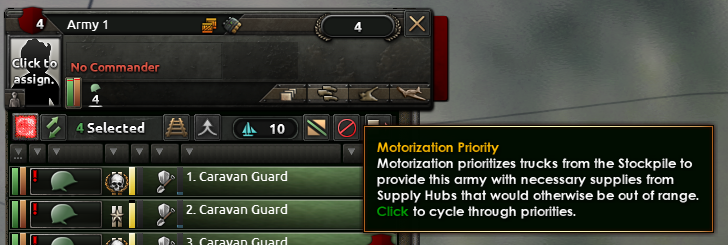
- Same as in vanilla, you can click a button to motorize your supply. This is crucial. You need need need need need to be doing this. It increases the range and ability of nearby supply hubs for an army, but costs vehicles. If you're short on those, you can buy more at the marketplace.
Who should I play as?
So, you've got the mod, but where do you begin?
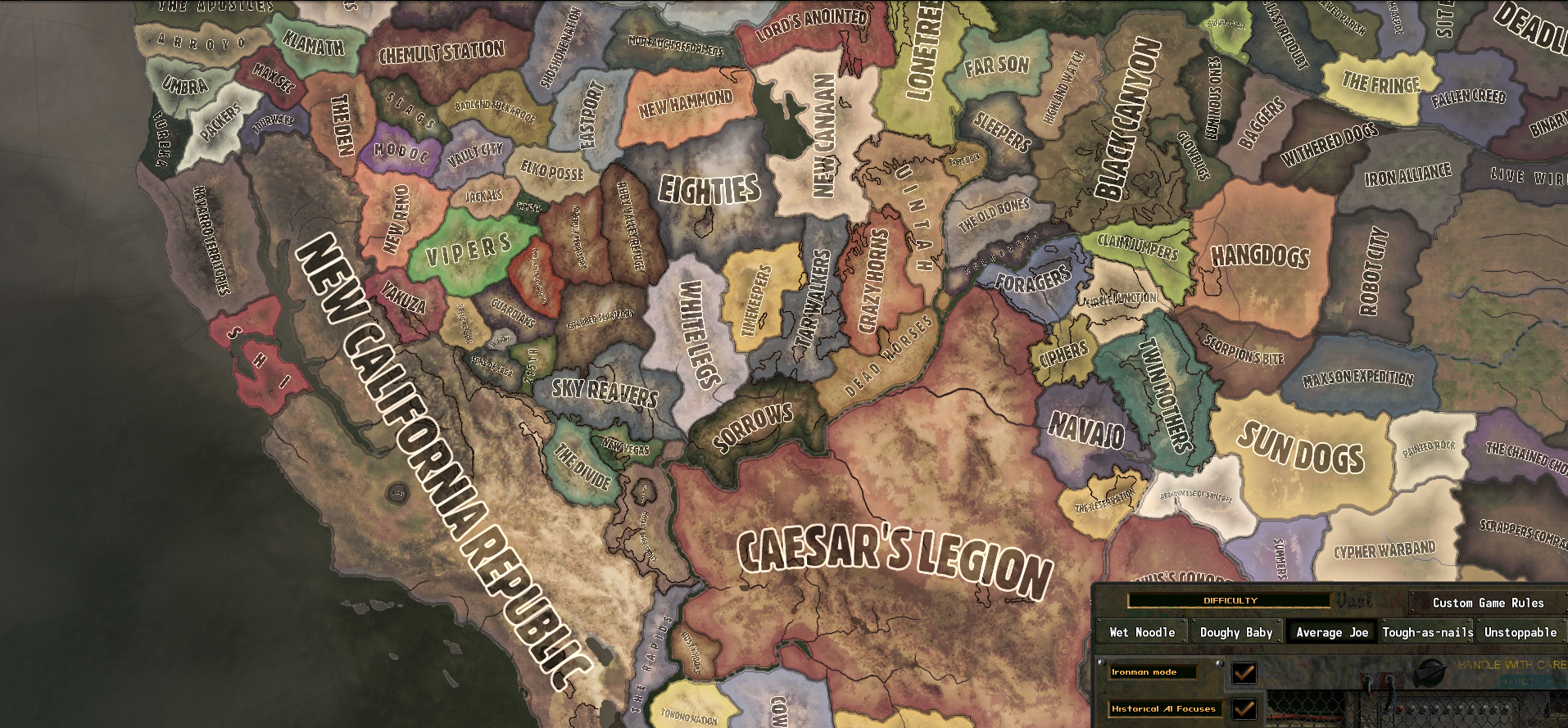
Quite a lot of options at our disposal...
Thankfully, there's an area selection screen, highlighting which areas have the newest content.
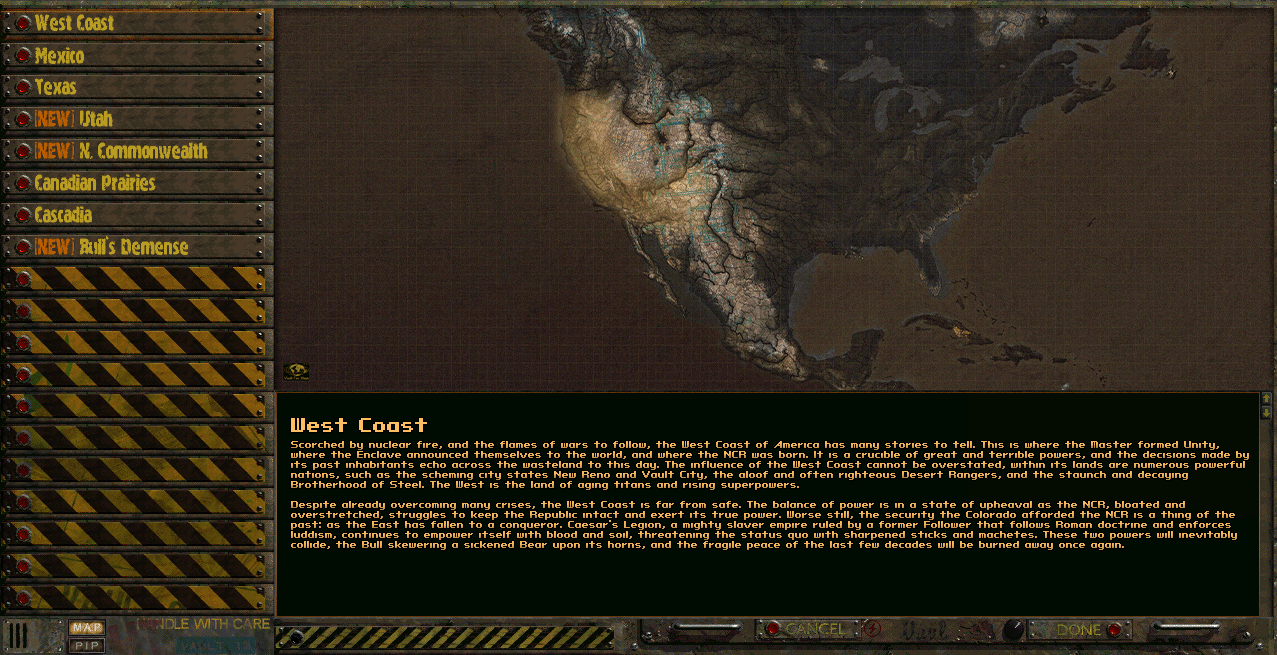
This replaces the vanilla game's 'starting scenario' mechanic. You know, that screen where everyone picks 1936 and never 1939...
Here on the West Coast you can see the two most important nations, the NCR and the Legion.
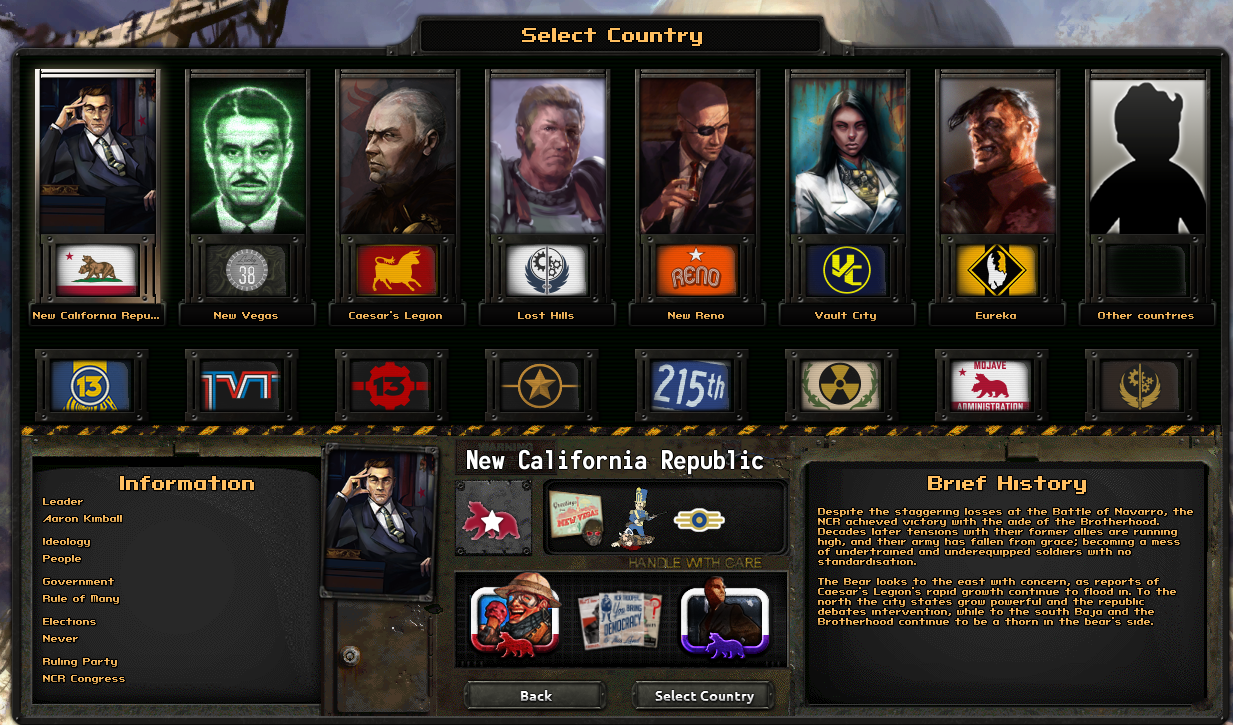
OWB, like Fallout: New Vegas, largely centers around the conflict between the NCR and Caesar's Legion. These two nations have the most land, focuses, and content. Not necessarily the hardest nations (looking at you, TV Town) but not the best first pick either.
If you want nations that are interesting but not too challenging, here are some good picks.
Vault City

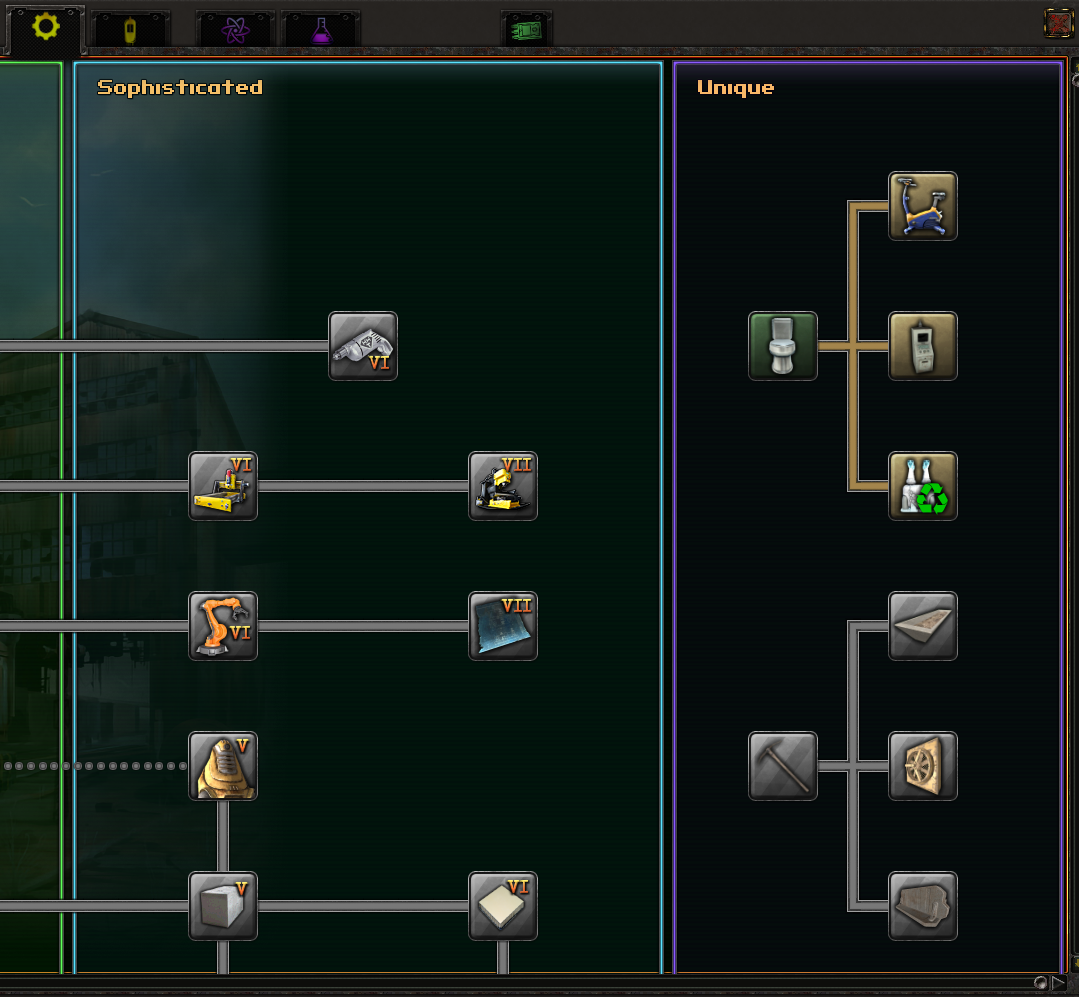
A good introduction to Vault-Tec nations. That mainly means you have access to some unique Industry tech. Don't forget it! Many people do.
Vault City, of course, will be familiar to those who have played Fallout 2.
By July you will hold an election that will determine the course of the rest of your game. The "normal" route is to go with Lynette and create your own faction called the Nevada Pact, then go to war with your neighbors.
Going with Security Chief Maier will improve your military and give you even more war goals.
However, there's not one, but two secret focus trees to find if you get an electoral deadlock instead. Remember that the NCR can decide to support Lynette in the election, so take this into account if you are trying to get a tie.
New Reno

Similar to Vault City, but also introduces you to the Tourist Season mechanic with Vegas, teaching you to keep an eye on your decisions menu. You get a decent number of paths and expansion targets.
The only drawback is that, if played improperly, New Reno can end up getting killed by the NCR.
Or maybe you've got some experience with OWB already, but don't know who to pick?
New Vegas

Can get access to Sophisticated Robotics with House,
or perhaps go with The King instead, who can solve the manpower troubles New Vegas constantly struggles with and create his own faction,
or Benny, who gets a -6.5% consumer goods buff and can throw in his lot with any of the 3 major factions, usually whoever's winning.
Staying on top of the tourism mechanic can earn you tons upon tons of caps.
You start with a non-aggression pact with the NCR but they can end up betraying you later.
You should focus on invading and coring the Sky Reavers ASAP.
Further expansion northward WILL get you in trouble with the White Legs, the Eighties, and/or New Reno.
Caesar's Legion WILL invade you if they cross the Colorado. Keeping them out of New Vegas proper will deny Caesar's access to life-saving surgery.
The Mojave Chapter WILL invade you if they win Operation Sunburst.
Ejercito Mexicano/Santa Anna

Great warmonger nation that can plow over Mexico with robots and naval invasions.
One of the few nations that begins the game with Sophisticated Naval technology. Can later get Sophisticated Robotics, Infantry, Exploitation, Industry, and Construction.
Eventually gains claims on all of Mexico and Texas, putting Santa Anna in a great position for a world conquest.
Sleepers

Starts with 5 research slots and Sophisticated Industry, Electronics, Construction, Exploitation, Infantry, Support, and Special Forces right off the bat, and later Sophisticated Creatures. Can get some of the highest Research Speed in the game.
Want ethics, or unrestrained science? Pick which Balance of Power direction you wanna go early and stick with it.
Defeat the Old Bones early, taking at least one state from them so Ouroboros can't core them, then defeat them. Then, conquer Boulder and go for the rest of the world.
Multiplayer/Factions
Want to map-paint the wasteland with your buddies? There are some things to keep in mind!
Before you even begin a multiplayer game, you should go to the gamerules and set the Faction System to Coop.
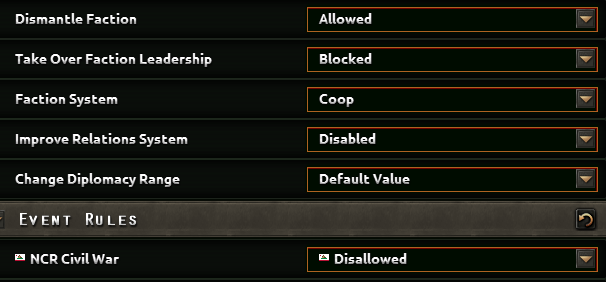 In OWB, usually nations can only join factions through focuses. This game rule this will let human players join the factions of other human players where there would normally be restrictions. This doesn't mess with the AI's ability to join factions through events/decisions normally.
Keep in mind this is still restricted by your Diplomacy Range, so you may want to increase it. Though, past a certain point, there's not much point being in a faction with someone on the other edge of the map, and increasing the Diplomacy Range value is known to cause weird issues.
Turning on 'Allow Tech Advancement' will allow any nation to simply research their way up to Sophisticated Electronics and get Long Range Radio to facilitate longer-range diplomacy with other players.
You also might want to set War Goals to Always Free cuz why not.
You also might want to disallow the NCR/Legion Civil War, because it usually desyncs the game when it happens. Thankfully, it won't prevent the NCR Civil War from occurring when under control of an inept human player. (me)
Before you even begin a multiplayer game, you should go to the gamerules and set the Faction System to Coop.
In OWB, usually nations can only join factions through focuses. This game rule this will let human players join the factions of other human players where there would normally be restrictions. This doesn't mess with the AI's ability to join factions through events/decisions normally.Keep in mind this is still restricted by your Diplomacy Range, so you may want to increase it. Though, past a certain point, there's not much point being in a faction with someone on the other edge of the map, and increasing the Diplomacy Range value is known to cause weird issues.
Turning on 'Allow Tech Advancement' will allow any nation to simply research their way up to Sophisticated Electronics and get Long Range Radio to facilitate longer-range diplomacy with other players.
You also might want to set War Goals to Always Free cuz why not.
You also might want to disallow the NCR/Legion Civil War, because it usually desyncs the game when it happens. Thankfully, it won't prevent the NCR Civil War from occurring when under control of an inept human player. (me)
Nations that can end up in factions together
NCR
- New California Republic
- Mojave Territories
- Shi (Lo Pan path)
- Vault City (Lynette Path)
- Rogue Rangers ('Reforming the Rebel Rangers' Path)
- New Reno (Bishop or Wright)
- Arroyo (Good Karma)
- Eureka
- New Vegas (if led by Benny)
- Free Fighters
- Baggers (takes a while to get a border)
- Black Canyon (takes a while to get a border)
- Eagle Rock
Caesar's Legion
- Caesar's Legion
- Lanius's Cohort (can betray Caesar)
- Two Sun
- Gente Del Sol (can betray Caesar)
- Navajo (can betray Caesar if they are mistreated)
- The Reservation
- Eighties (mutually exclusive with White Legs)
- White Legs (mutually exclusive with Eighties)
- Iron Alliance
- New Vegas (if led by Benny)
- Eagle Rock
Nevada Pact
- Vault City
- New Vegas (if led by Benny)
Daughters of Hecate/Dark Moon Pact
- Ouroboros
- Twin Mothers
- Uintah
- Crazy Horns
- Dead Horses
- Lanius' Cohort (if he is swayed by Diana)
- White Legs (must accept Hecate's influence)
The Western Brotherhood of Steel
- Lost Hills
- Mojave Chapter
- Maxson Chapter
- Guardians
- Shi (Elder Francis path)
- Montana Chapter
- Washington Brotherhood
- Alamo Chapter
Rio Pact
- Republic of the Rio Grande
- Pecos Colony (Guerra path)
- Las Granjas (Guerra path)
- Baudeliio Ranchers (Guerra path)
- Free Fighters (Guerra path)
- Alamo Chapter (Rosado path)
- Texan Brotherhood
- Gente Del Sol
- Eden
- Eagle Rock
Texan Economic Union
- Texan Brotherhood
- Lone Star
- Unity of Austin
- Eden
- Eagle Rock
The Montana Enclave
- MacArthur
- Eagle Rock (The Air Marshal Triumphant path)
- Koover
- Rotpurgers (The Scourge of the Spokane path)
- Pioneer Company (This nation has a difficult start. Gallagher/Enclave path)
Midnight Union
- Ruminators
- Northern Khans (Amgalan Path)
- Marshall Republic
- Montana Chapter (Sisters of Steel path)
- Highland Watch
- Black Canyon (takes a while to get a border)
Black Rock Federation
- Black Canyon
- Iron Alliance
- Highland Watch
- Glowbugs
- Far Son
Kingdom of Manitoba
- Kingdom of Manitoba
- Duchy of Langenburg
- Arborg Junta
- Stoon Dandies (Pierre Path)
Children of the Gate
- Heaven's Gate
- Rotpurgers (The Scourge of the Spokane path)
- Bone Dancers (Listen to the Pilgrims path)
- Seraph Lords
The Denver Defense Network
- WARDEN (play as Hangdogs and pick WARDEN when the civil war begins)
- Robot City
- Blue Rose Society
- The Last Patrol
- Withered Dogs
Ogden Treaty
- New Canaan
- Black Canyon
- White Legs (White Legs must go Mormon, New Canaan must pick Daniel)
- Eagle Rock
Wardens of the White
- The Old Country (Operation: Ascension path)
- Passkeepers
- Safehaven
The Northern League
- The Washington Brotherhood
- Port Maw
- The Old Country
- Bone Dancers
Miscounts
- Middlemark
- Metal Mouths
- Unbound
Song of Steel
- The Chained Choir (Hummingbirds)
- Maxson Chapter (must not be in a different faction. Note that this nation can be rather difficult)
Wasteland Economy
Old World Blues has its own economic system, but it is mercifully quite simple. You can see your currency in the top left, simply click on it to open the Caps Ledger.
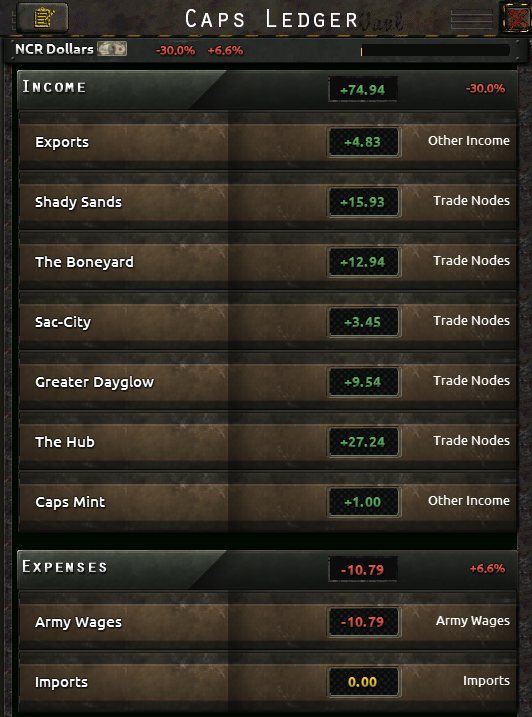
There are a couple Trade Nodes on the map that make their own money, you don't have to micromanage them. When you capture them from an enemy, they will be disabled for 20 or 30 days, then they will come back online and start earning you money.
Exporting (countries buying resources from you) earns you money, but importing resources costs money. Some advisors and ideas can increase your Trade Tariffs, which just increases the money you earn from exports.
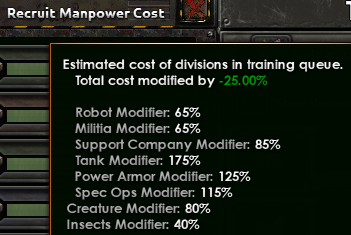
Your army has its own maintenance and training costs based on their type, this usually doesn't amount to much until your army breaks the 100 division mark.
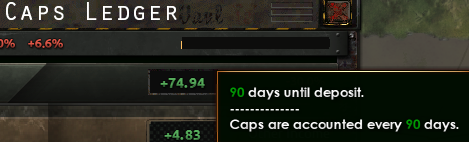
You get your money (or lose it) every 90 days. Check the bar in your caps ledger to see.
There are numerous decisions you can take to spend caps to get certain benefits. You will unlock new ones as the game goes on.
There are a couple Trade Nodes on the map that make their own money, you don't have to micromanage them. When you capture them from an enemy, they will be disabled for 20 or 30 days, then they will come back online and start earning you money.
Exporting (countries buying resources from you) earns you money, but importing resources costs money. Some advisors and ideas can increase your Trade Tariffs, which just increases the money you earn from exports.
Your army has its own maintenance and training costs based on their type, this usually doesn't amount to much until your army breaks the 100 division mark.
You get your money (or lose it) every 90 days. Check the bar in your caps ledger to see.
There are numerous decisions you can take to spend caps to get certain benefits. You will unlock new ones as the game goes on.
Organization Marketplace
You can also spend caps at the Organization Marketplace, replacing the International Market system from vanilla.
Here, countries do not sell equipment, rather, you can just buy stuff from 5 distinct Organizations with a single click of a button. There is a 45 day cooldown on this that is tracked separately for each organization.
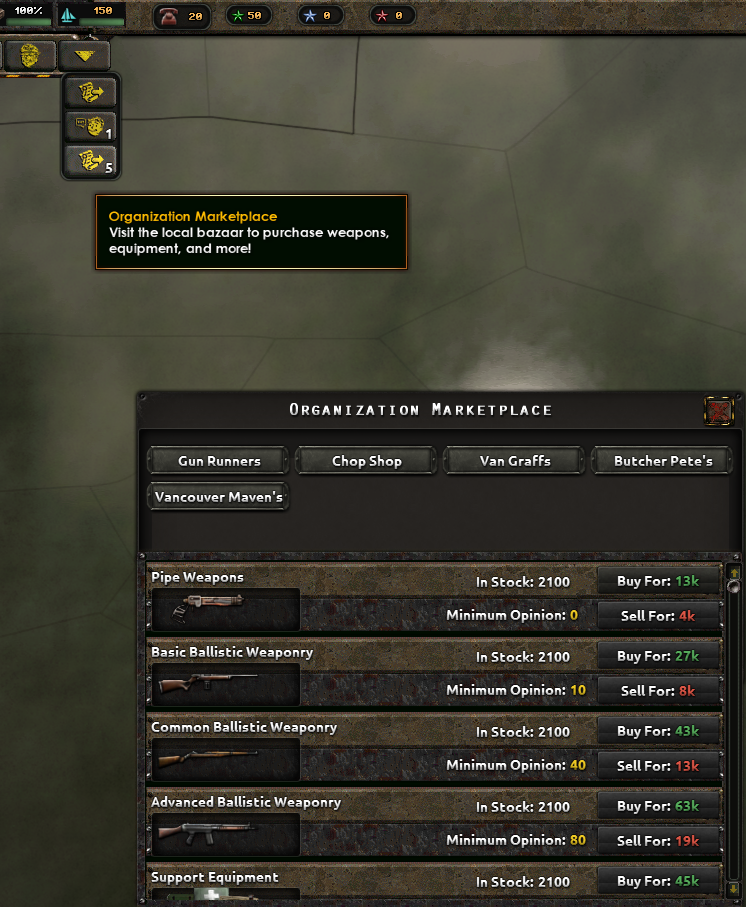
A common beginner mistake is to ignore the Organization Marketplace, often while sitting on a big pile of caps. Spend them!
It takes a huge load off your military industry. In some cases you won't have to produce infantry equipment or vehicles at all if you can just buy them all from the Gun Runners and the Chop Shop.
On the other hand, if you're short on caps, you can just sell some stuff you don't need.
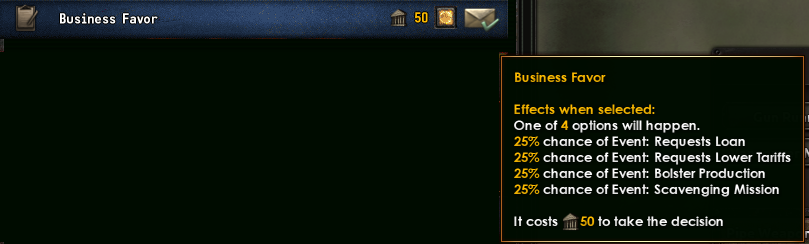
Randomly you can get events where the various organizations request stuff from you, you should almost always accept them. You can also take the "Business Favor" decision for 50 political power to immediately get such an event.
Successful quests and transactions increase your relationship with a given organization, giving you better prices, and letting you spend that influence on a helpful temporary buff in your decisions tab.
Organizations that have a negative opinion of you (or <90 opinion if it's the Vancouver Mavens, or <25 if it's the Van Graffs) won't sell to you at all, but they will buy from you. Try taking a "Business Favor" or selling equipment to them.
Here, countries do not sell equipment, rather, you can just buy stuff from 5 distinct Organizations with a single click of a button. There is a 45 day cooldown on this that is tracked separately for each organization.
A common beginner mistake is to ignore the Organization Marketplace, often while sitting on a big pile of caps. Spend them!
It takes a huge load off your military industry. In some cases you won't have to produce infantry equipment or vehicles at all if you can just buy them all from the Gun Runners and the Chop Shop.
On the other hand, if you're short on caps, you can just sell some stuff you don't need.
Randomly you can get events where the various organizations request stuff from you, you should almost always accept them. You can also take the "Business Favor" decision for 50 political power to immediately get such an event.
Successful quests and transactions increase your relationship with a given organization, giving you better prices, and letting you spend that influence on a helpful temporary buff in your decisions tab.
Organizations that have a negative opinion of you (or <90 opinion if it's the Vancouver Mavens, or <25 if it's the Van Graffs) won't sell to you at all, but they will buy from you. Try taking a "Business Favor" or selling equipment to them.
Military Policies
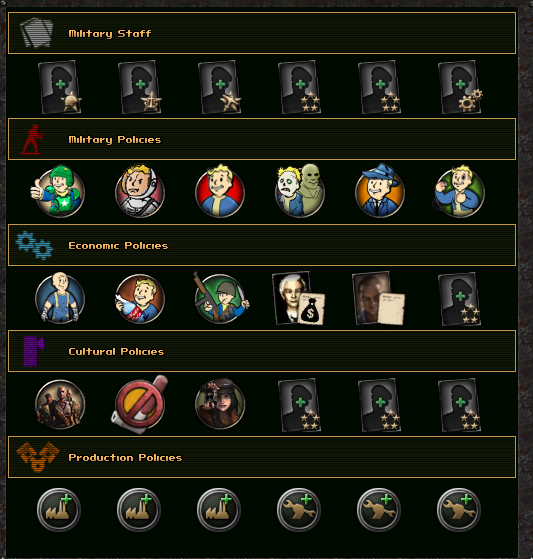
I know some of us (including me) feel the need to fill every last slot here, but a lot of Political Power is needed to core states and take decisions in Old World Blues.
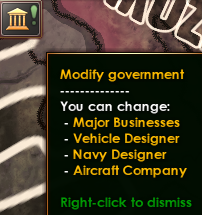
Just right click that annoying notification away...
Your first Political Power buys should be for things that give you Stability and Political Power Gain so these things can pay themselves off over time. Political Power Advisors, Free Press, Golden Gecko Entertainment, etc..
Remember, more stability = more political power gain. So it's a good idea to take those Produce Consumer Goods, Civilian Research Projects, and Expel the Riff Raff decisions. Higher stability also helps lower your Resistance Target.
Military Staff
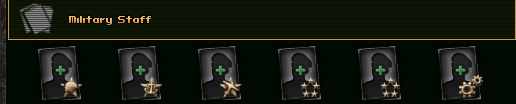 Not much to say here: getting a Military Theorist should be done early on. Typically a nation will also have a Theorist that hints toward the Land Doctrine you are 'intended' to pick (i.e. Caesar's Legion's theorist gives a bonus to Asymmetrical Warfare) but this is not obligatory.
 You should fill the rest out if/when you need the bonuses.
Reinforce Rate, Supply Consumption, Recruitable Population, Army Experience Gain, Max Entrenchment, these are the things that are nice to have.
Military Policies
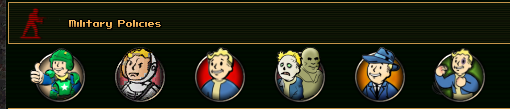
Mobilization Law
Different nations have different Mobilization Laws each with their own benefits and drawbacks.
Typically, you spend more political power to mobilize manpower more quickly and from a larger pool, at the cost of your factory output, construction speed, and training time, and, unique to OWB, your stability and caps income.

You want to be able to produce enough equipment to arm your manpower, and you need enough manpower to utilize your equipment.
By the late game usually you will have this at the highest possible level, your factory output and stockpile will be so ridiculous that the penalties don't matter.
Keep in mind that more expensive unit types (Power Armor, Vehicles, Spec Ops) have higher HP and thus take less manpower losses. Chem Support Companies also help.
Think carefully before throwing several armies of untrained Militia on an Aggressive battleplan, as I have. It's very easy to take more casualties than you can replace.

It is worth noting that a Raider nation's unique conscription law is mostly locked behind how many states you own and lacks many of the downsides other nations get. You actually get speed and reinforce rate buffs.
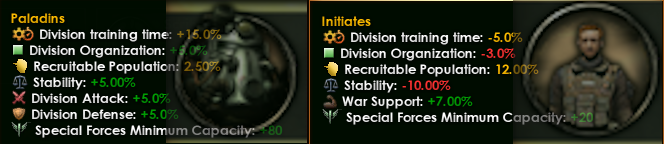
Brotherhood nations lose their Special Forces Cap the more they conscript, but otherwise lack a lot of the usual penalties.
Outsider Recruitment
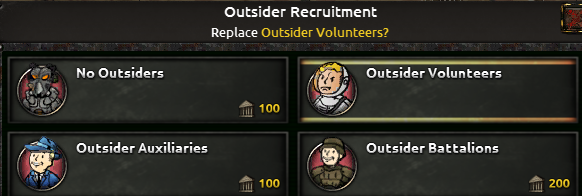
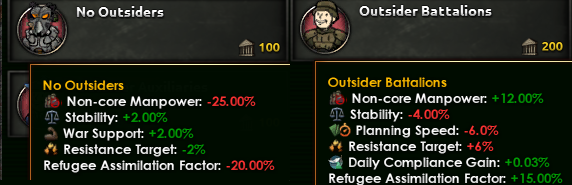
Stability, war support, and lowered resistance, or high non-core manpower and compliance gain?
Typically what I will do is switch to Outsider Battalions as soon as my garrisons can handle the increased resistance. There are not many flat increases to compliance gain out there, and you need all the manpower you can get.
Undesirables Recruitment
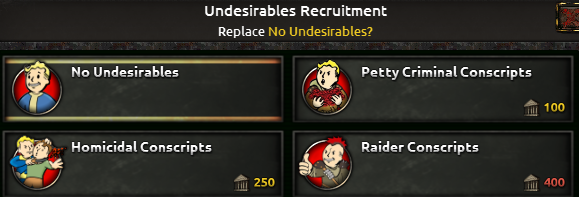
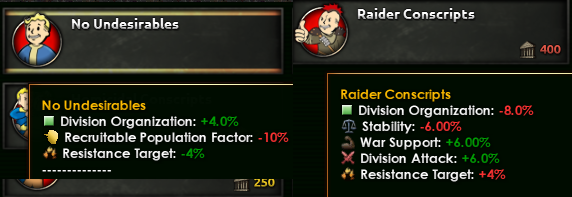
This is a little absurd. You effectively take 8%+ more Resistance Target and -12% less Organization for 10% Recruitable Population Factor, 6% War Support and 6% Attack.
It may be tempting to use this and Mutant Recruitment to scrape extra manpower out of your nation, but this hurts you in the long run. Think of the added manpower you will need for your garrisons once the Resistance spikes. This is a poor use of 400 Political Power compared to coring land or hiring advisors.
Mutant Recruitment
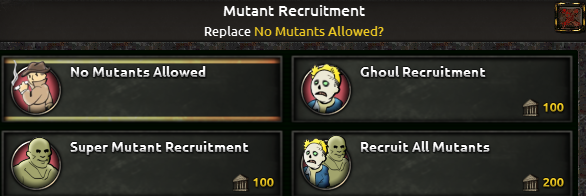
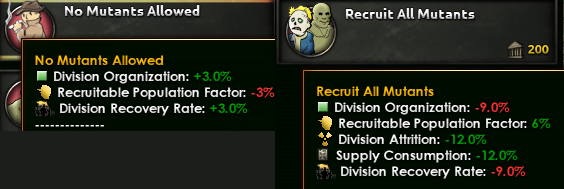
Comparable to Undesirables Recruitment, but cheaper on Political Power and providing some rarer buffs. The Supply Consumption buff is nice for armies that rely on Robots, Power Armor and Vehicles, which mutants oddly don't use.
Officer Training
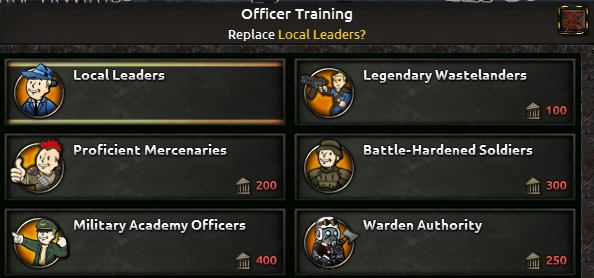
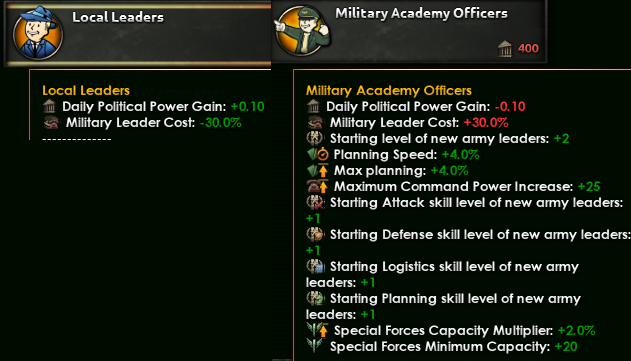
There's nothing wrong with the buffs you get here per se, but the large political power investment + taking away flat daily political power gain hurts.
Army Training
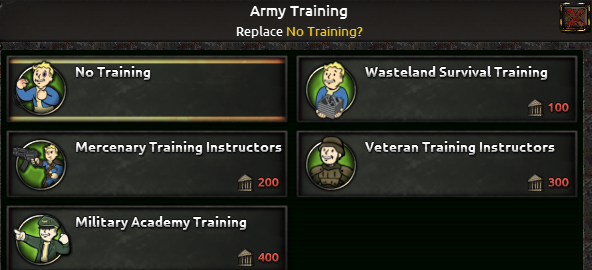
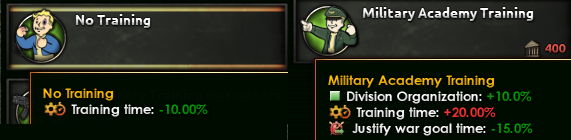
Again, not bad buffs per se, just an inefficient use of Political Power compared to the organization + justify time + training time you would get from hiring advisors.
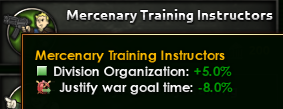
You may just want to go halfway with Mercenary Training Instructors.
Economic Policies
Economy Law
Similar to vanilla, mobilizing your economy more and more is generally a good idea. Your caps income will suffer the more you mobilize, but this is rarely an issue. 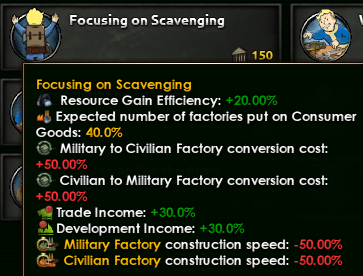
The "Focusing on Scavenging" economy law exists to give you even more caps and a unique 20% Resource Gain Efficiency modifier, but I have never found use for it.
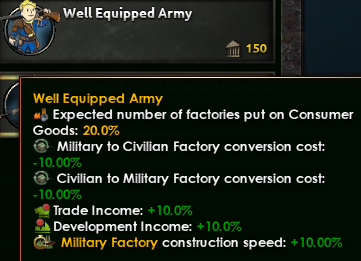
Well-Equipped Army is a good middle ground. You can usually get it within the first few months of the game since it does not have a World Tension requirement.
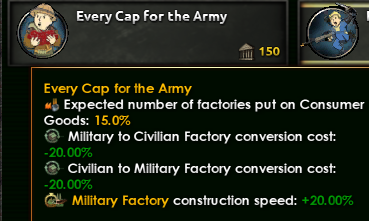
The penultimate law, Every Cap For The Army, does not penalize your manpower, but this is the point where you no longer receive any income bonuses, and there must be 60% World Tension. Once I am able to pick this law, I stick with it for the rest of the game.
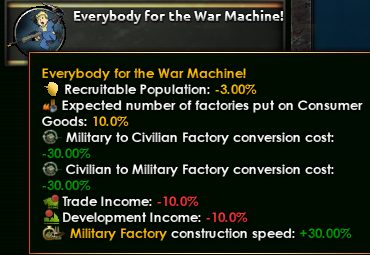
The last economy mobilization law, Everybody for the War Machine! is the equivalent to Total Mobilization, in that it also penalizes your Recruitable Population by -3.00%. So if your total Recruitable Population becomes negative, you will start draining manpower!
Unlike vanilla, there is no Women in the Workforce decision you can take to reverse this -3.00% penalty.
Trade Law
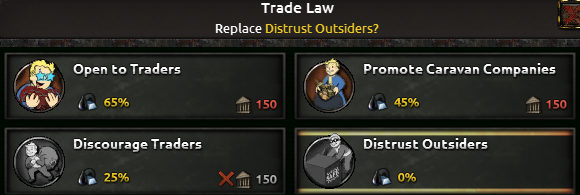
Similar to vanilla. In an ideal world you would be on Open to Traders all the time, but you'll want to adjust your trade law so that your civilian industry can keep up with the resource demand of your military industry.
As you close your economy you lose out on the money from Trade Tariffs (the caps you get from resource trades), both in terms of how many people will buy from you and the amount you make from each resource you export.
To offset this you get a bit of passive caps on the lower laws.
Distrust Outsiders gives you +0.05 Political Power Gain, which is something at least.
Army Wages
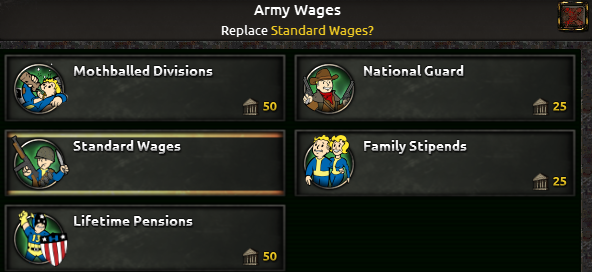
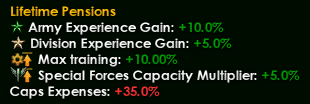
Every division you have in OWB costs caps to maintain. By paying them the max you get some okay buffs, but you may run into problems with your caps once your army grows too big. Generally, the default wage law is okay.
If you have no need of your army, you can mothball them to save quite a bit of money, but you can't change your Army Wages law more than once every 140 days, so be wary of attack.
Economic Advisors
Anybody that lowers consumer goods, or increases stability, political power, or factory output is nice. There are some advisors that make infantry equipment/vehicles cheaper but makes the Trade Organizations like you more by a flat amount.
These are great for bailing you out when you have a negative opinion with an organization.
Land Doctrines
Land Doctrines in OWB are researched over time like they used to be, rather than bought directly with Army XP. Although, you can (and should) spend 25 Army XP to get a boost.
There isn't really a "best doctrine", you're making a decision based on what kinds of templates your country will produce. No matter what, you should start researching your Land Doctrine from day 1.
Each doctrine has its own Army Spirit you may optionally get with it, which requires the No Step Back DLC. I will put these in italics.
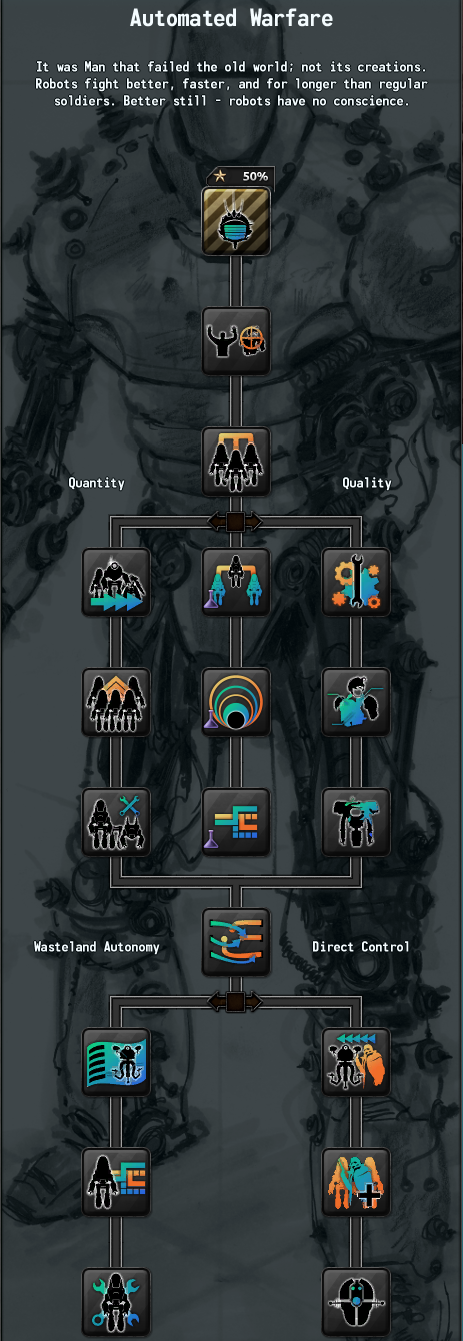
A doctrine that focuses on Robots: armored divisions that take minimal manpower, but consume a lot of fuel, factories and resources.
Spirit of the Academy: Machine Learning A.I. (+5% Army XP Gain and +10% Terrain traits XP Gain)
Spirit of the Army: Mechanical Might (-30% planning speed and -10% max planning, +10% Robot Units Attack)
Spirit of Division Command: Assembly Line Frontline (+2.5% Factory Output, +5% Coordination)
There are techs in the robot tree that make robots cheaper, but penalize all frontline battalion organization by 3 and increase robot organization by 3. This is a net increase of 0 for your robot battalions, since they are also a frontline battalion. Get this tech if you really need the production, not for the org!
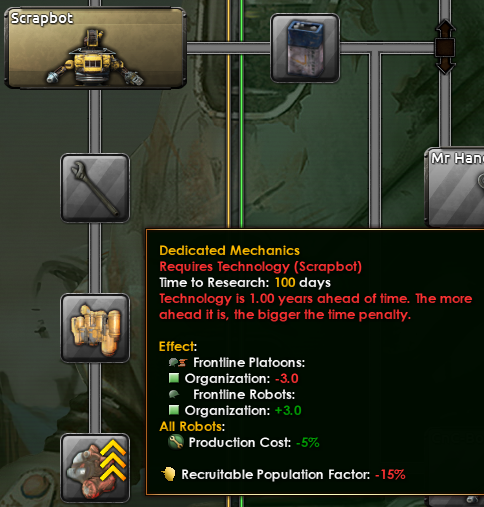
The middle path of Automated Warfare isn't mutually exclusive with anything, however it will lock you out of swapping doctrines, not that you would ever do that. It will penalize the organization of your non-robot units, but lets you put more CNC support battalions in your templates. You should begin this branch as soon as you have a good stockpile of CNC robots.
"But it penalizes my organization!"
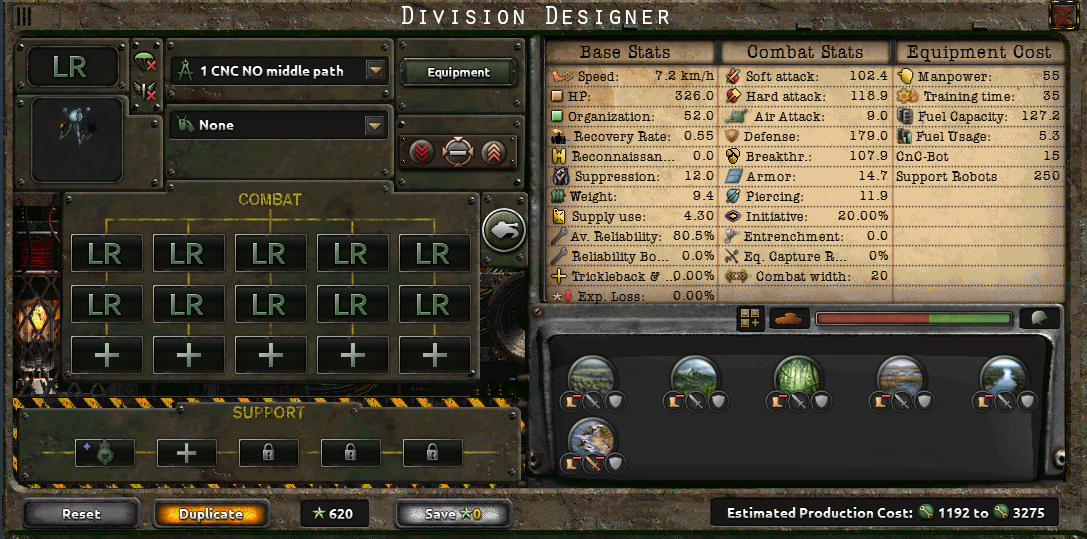
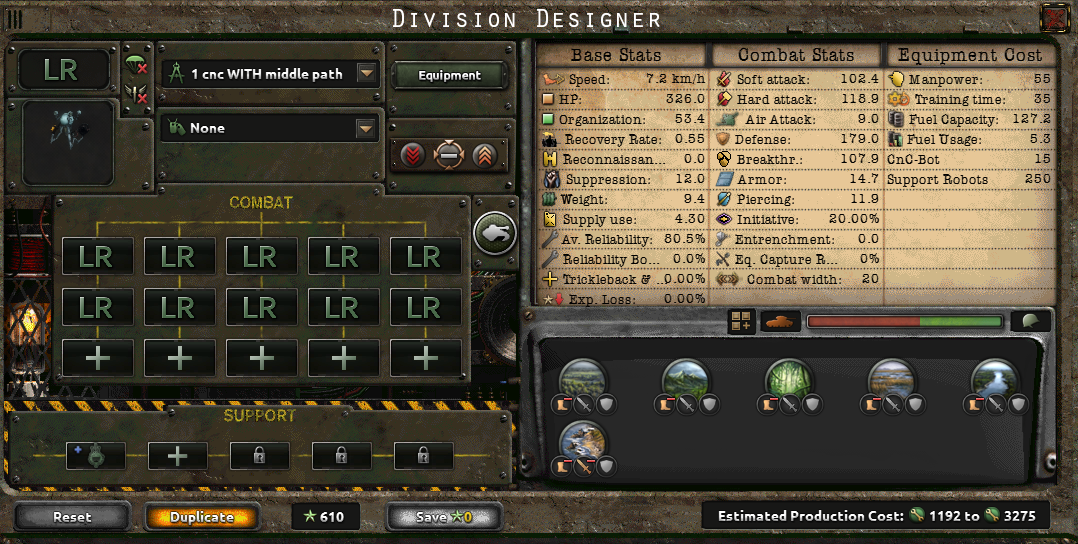
Here's how a 20 width robot division with 1 CNC robot and NO middle path (52.0 org) stacks up against an identical division WITH the doctrine. (53.4 org)
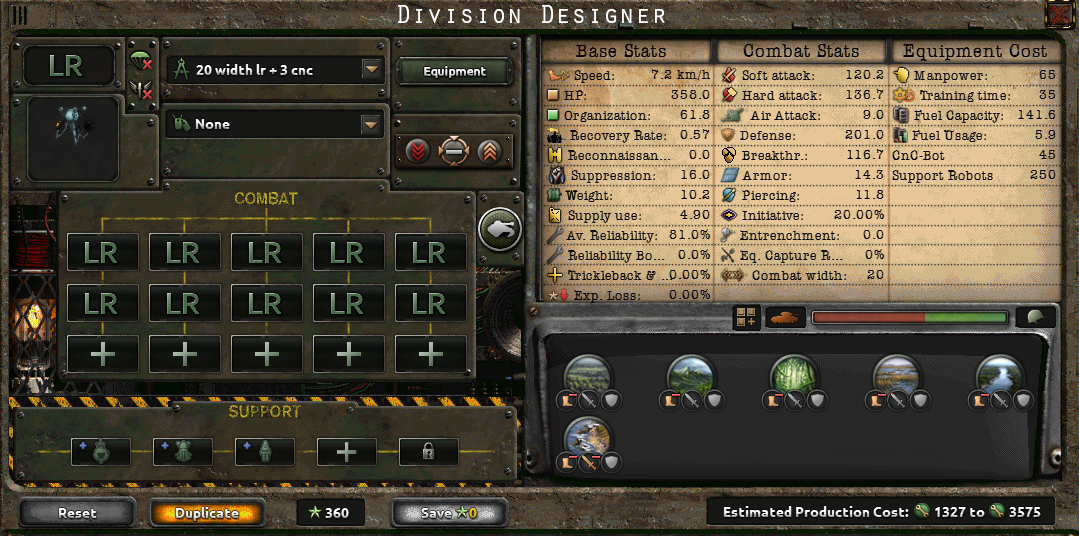
But the middle path lets you take 3 CNC robot companies, so this is how it actually looks. 61.8 org.
Quality:
The production cost of robots is their only drawback, so most people pick Quantity.
Direct Control:
Most people pick Wasteland Autonomy for the factory output.
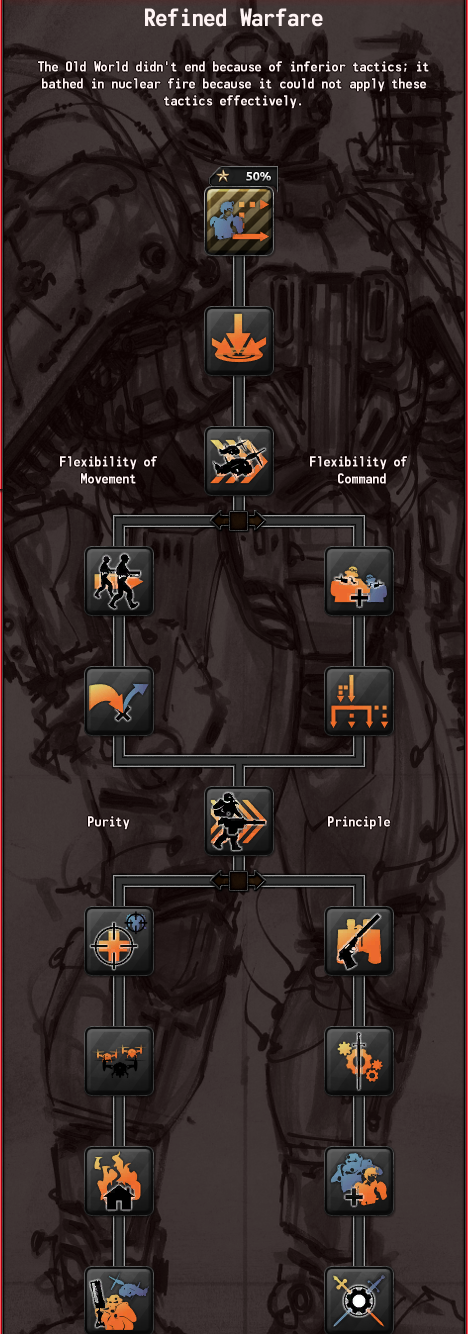
A doctrine that emphasizes quality over quantity, penalizing your recruitable population factor, training time and minimum training level for great bonuses towards your breakthrough, speed and special forces.
Spirit of the Academy: Academy Officers (+50% Leader Cost, +1 starting level of new leaders and +2 planning skill of new leaders)
Spirit of the Army: Steel Before Flesh (-5% speed, +2.5% defense, +5% armor and hardness for PA, light SF equipment and enforcer armor)
Spirit of Division Command: Well Trained Reserves (+10% training time, -15% experienced soldier losses, +5% breakthrough)
Flexibility of Command:
Most players pick Flexibility of Command for the buffs to support companies, which are already very important to have.
Principle:
Principle is usually better than Purity since it lacks the compliance penalty, but these are close.
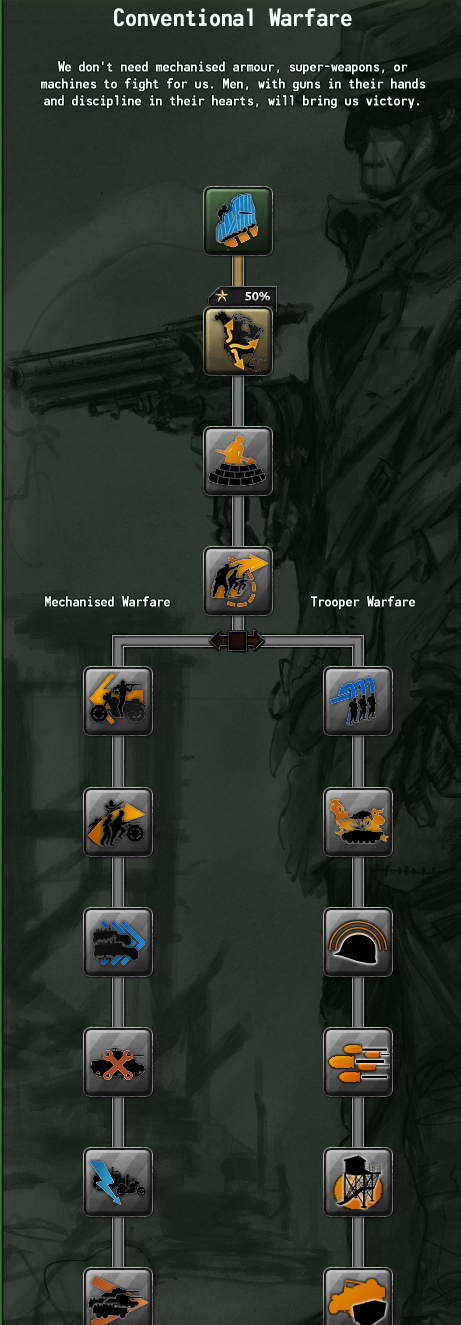
Normalcore doctrine with peerless bonuses to entrenchment and planning.
Spirit of the Academy: Strategy Book Knowhow (+1 starting level of new leaders, +2 logistics skill of new leaders, +10% terrain traits XP gain)
Spirit of the Army: Old School Tactics (+2 reinforce rate, +5% planning speed, +2.5% max planning)
Spirit of Division Command: Barricades and Outposts (+5% entrenchment speed, +10% max entrenchment)
Well, that's simple... do you want fast motorized, or do you want coordinated and entrenched foot infantry?
You will lose -4.0 Max Entrenchment and consume 10% more supply if you go Mechanized, or if you go for Trooper Warfare, you will need to start producing portable radios.
There isn't really a "best doctrine", you're making a decision based on what kinds of templates your country will produce. No matter what, you should start researching your Land Doctrine from day 1.
Each doctrine has its own Army Spirit you may optionally get with it, which requires the No Step Back DLC. I will put these in italics.
Automated Warfare
A doctrine that focuses on Robots: armored divisions that take minimal manpower, but consume a lot of fuel, factories and resources.
Spirit of the Academy: Machine Learning A.I. (+5% Army XP Gain and +10% Terrain traits XP Gain)
Spirit of the Army: Mechanical Might (-30% planning speed and -10% max planning, +10% Robot Units Attack)
Spirit of Division Command: Assembly Line Frontline (+2.5% Factory Output, +5% Coordination)
There are techs in the robot tree that make robots cheaper, but penalize all frontline battalion organization by 3 and increase robot organization by 3. This is a net increase of 0 for your robot battalions, since they are also a frontline battalion. Get this tech if you really need the production, not for the org!
The middle path of Automated Warfare isn't mutually exclusive with anything, however it will lock you out of swapping doctrines, not that you would ever do that. It will penalize the organization of your non-robot units, but lets you put more CNC support battalions in your templates. You should begin this branch as soon as you have a good stockpile of CNC robots.
"But it penalizes my organization!"
Here's how a 20 width robot division with 1 CNC robot and NO middle path (52.0 org) stacks up against an identical division WITH the doctrine. (53.4 org)
But the middle path lets you take 3 CNC robot companies, so this is how it actually looks. 61.8 org.
Quantity (left) or Quality? (right)
Quantity:- +20% Factory Output
- -10% Attrition
- -15% Global Fuel Consumption
- +0.10 Recovery Rate for Frontline Platoons
- +4% Reinforce Rate
- -20% Out-Of-Combat Supply Penalties
- -15% Experienced Soldier Losses
- -2% Army Reliability penalty
Quality:
- -10% Encirclement Penalty
- +100% HP
- -0.15 Supply Consumption
- +20 Organization for Maintenance Support Companies
- +10% Breakthrough for Robots
- +12% Soft Attack for Robots
- +10% Defense for Robots
- +10% Hardness for Robots
- +15% Armor for Robots
The production cost of robots is their only drawback, so most people pick Quantity.
Wasteland Autonomy (left) or Direct Control? (right)
Wasteland Autonomy: - 10% more Factory Output
- +100% HP
- -25% Experienced Soldier Losses
- +8 organization to ALL robots (including CNC bots, the Frontline Robots wording excludes CNC's)
- +5% Max Planning
- +0.10 Recovery Rate for all Frontline Platoons
- -0.05 Supply Use for all Frontline Platoons
- +5% Hardness for All Robots
- +15% Armor for All Robots
Direct Control:
- +10% Daily Command Power Gain Multiplier
- +10% Planning Speed
- +5% Coordination
- +20% Soft and Hard Attack for CNC Robots (they don't have much to begin with)
- +10% Soft and Hard Attack for Combat Robots
- +10 Organization for Frontline Robots
- +15% Breakthrough for Frontline Robots
- -0.10 Supply Use for CNC Robots
- +2% Initiative for CNC Robots
- +2% Initiative for CNC Robots
- -10% Defense Penalty for Frontline Robots
- -60 Organization Penalty for CNC Robots
Most people pick Wasteland Autonomy for the factory output.
Refined Warfare
A doctrine that emphasizes quality over quantity, penalizing your recruitable population factor, training time and minimum training level for great bonuses towards your breakthrough, speed and special forces.
Spirit of the Academy: Academy Officers (+50% Leader Cost, +1 starting level of new leaders and +2 planning skill of new leaders)
Spirit of the Army: Steel Before Flesh (-5% speed, +2.5% defense, +5% armor and hardness for PA, light SF equipment and enforcer armor)
Spirit of Division Command: Well Trained Reserves (+10% training time, -15% experienced soldier losses, +5% breakthrough)
Flexibility of Movement (left) or Flexibility of Command? (right)
Flexibility of Movement:- +10% Breakthrough and +10% Speed for Army
- +10% Speed for Demolitions and Fireteams
- -20% Org Loss When Moving
- +20 Special Forces Minimum Capacity
Flexibility of Command:
- -10% Organization loss when below 25%
- -20% Experienced soldier losses
- +4% Reinforce Rate
- +0.05 Recovery Rate for Army
- +15% Soft and Hard Attack for Fighting Support Units
- +15 Organization and +5% Reliability for Non Combat Support Units
Most players pick Flexibility of Command for the buffs to support companies, which are already very important to have.
Purity (left) or Principle? (right)
Purity:- +15% Breakthrough for Army
- +20% Soft Attack and 10% Hard Attack for Army
- +10% Air Superiority in-battle effect
- +20 Special Forces Minimum Capacity
- +10% Organization After Paradropping
- +24h Special Forces Supply Grace
- -25% Resistance Growth Speed
- -10% Damage to Garrisons
- -20% Compliance Growth Speed Penalty
- -10% Non-core Manpower Penalty
- -10% Recruitable Population Factor Penalty
Principle:
- +10% Decryption
- +10% Planning Speed
- +20 Special Forces Minimum Capacity
- +20% Reconnaissance for Army
- +10% Hardness for Army
- +5% Soft Attack and Air Attack and Hard Attack for Army
- +0.05 Recovery Rate, +5% Soft Attack and +5% Hard Attack and +10 Organization for Infantry (does not include special forces)
- +0.10 Recovery Rate, +5 Organization, +0.10 Recovery Rate, +5% Defense, +15% Soft and Hard Attack for Heavy Special Forces
- -10% Recruitable Population Factor Penalty
Principle is usually better than Purity since it lacks the compliance penalty, but these are close.
Conventional Warfare
Normalcore doctrine with peerless bonuses to entrenchment and planning.
Spirit of the Academy: Strategy Book Knowhow (+1 starting level of new leaders, +2 logistics skill of new leaders, +10% terrain traits XP gain)
Spirit of the Army: Old School Tactics (+2 reinforce rate, +5% planning speed, +2.5% max planning)
Spirit of Division Command: Barricades and Outposts (+5% entrenchment speed, +10% max entrenchment)
Mechanized Warfare or Trooper Warfare?
Well, that's simple... do you want fast motorized, or do you want coordinated and entrenched foot infantry?
You will lose -4.0 Max Entrenchment and consume 10% more supply if you go Mechanized, or if you go for Trooper Warfare, you will need to start producing portable radios.
Land Doctrines pt. II
Asymmetric Warfare
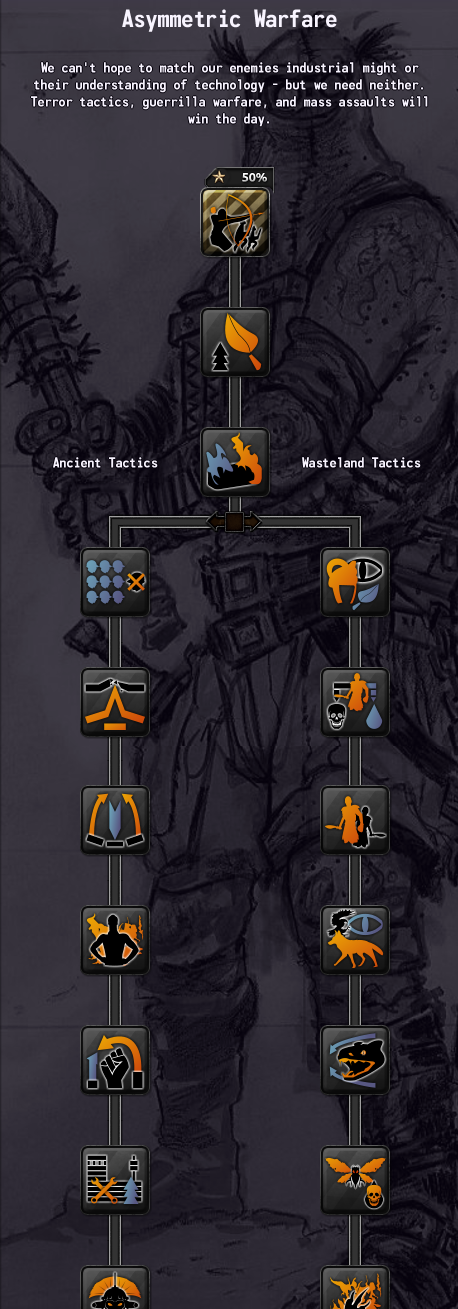
A choice that is well and above being a simple meme doctrine. By the first three techs you get -10% minimum training, letting you deploy troops nearly instantly, and the +10% equipment capture ratio modifier is nice.
Spirit of the Academy: Veteran Warrior Leadership (+1 staring level of leaders, -10% planning speed, +2 starting attack skill of leaders)
Spirit of the Army: Men Over Bullets (+5% equipment capture, +10% infantry XP gain)
Spirit of Division Command: Supply Route Ambushes (+10% Convoy Raid Efficiency, +10% Resistance in states occupied by enemy)
Ancient Tactics or Wasteland Tactics?
Depends! Many, many nations benefit from Ancient Tactics, which ends with an absolutely ludicrous -40% Org Loss While Moving, twice what Mechanized Warfare/Flexibility of Movement give you.But if your country specializes in Militia, Lawkeepers, or Enforcers, Wasteland Tactics may be better.
Outsider Warfare
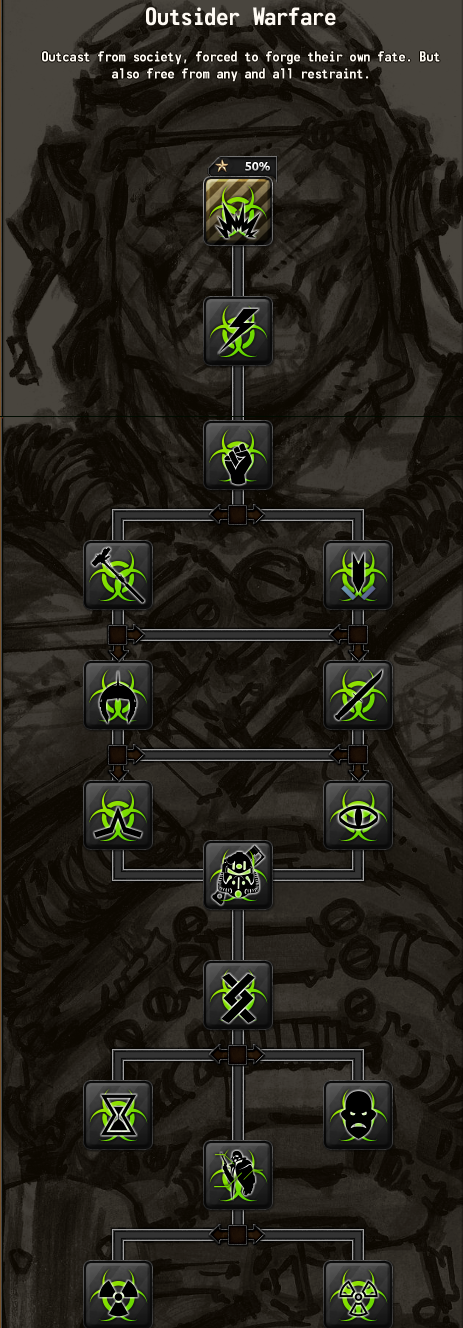
Whereas there is some flexibility with the other doctrines, the majority of Outsider Warfare benefits mutants and monstrous creatures alone. And Faeries.
Note that Ghouls count as Infantry, NOT Mutants.
Insect Swarms? Mirelurks? Feral Ghouls? Hold the f!ck up, who uses Faeries?!
- Faeries: Pleasantdale
- Nightkin: Unity of Austin/Troll Warren/Caesar's Legion/Stoon Dandies (general freedom) (they're basically light special forces)
- Super Mutant Behemoths: Shale's Army. Troll Warren (they're basically heavy special forces)
- Insect Swarms: Roach King, Executives
- Amphibious Platoons (Mirelurks): Mirelurk Tribe, Blighted Woods, Apostles
- Deathclaws: Executives, Sleepers, Pursuant Lodge
- Burrowing Cohorts: Far Son
- Feral Ghouls: Rad Hazards, Luminous Ones, Glowbugs, Glow's Cradle, Withered Dogs
Fun fact... did you know that the 6.0 update of Old World Blues will have a new sixth land doctrine called "Reckless Warfare" for raider nations? You didn't hear it from me...
Support Companies
Support companies are crucial in OWB. Well, they are in vanilla too. But you will get absolutely mauled if you don't use them. (unless you have air support)
On the bright side, they aren't expensive to produce.
Fireteams are excellent defensive support companies. Throw them onto any division template that can afford it. They have good soft attack but their main draw is their defensive benefits.
Fireteam line battalions are okay on defense, but you generally don't need to put those in your templates. I recommend building CAS or special forces instead.
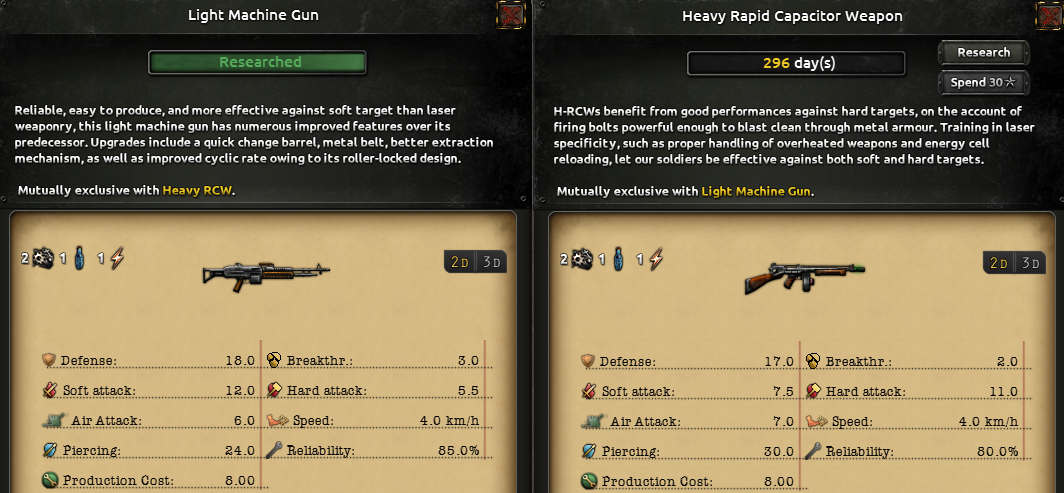
After you research the M-SAW, you must choose between LMG's or H-RCW's.
LMG's provide more soft attack. H-RCW's provide more hard attack and piercing.
Since AT provides all the hard attack you should ever need, you should default to the LMG, unless your targets have a lot of Armor.
There's only a few scenarios where you'd need dedicated anti-air support, i.e. fighting the NCR.
If you looked closely at the LMG/H-RCW comparison you may have noticed that Fireteams actually provide their own Air Attack—it is decent enough to deal with gliders.
AT support is often overlooked, but the piercing it provides is crucial for fighting Power Armor and robots. This is not vanilla, numerous AI nations have armor and they will mess you up!
To a lesser extent, they're useful against enforcers, tanks, and APCS.
A standard AT support division with the earliest tech gives you 18.9 Piercing. The basic Stripped Power Armour has 20 Armor, and T-45d has 40... so you'd better upgrade your AT quickly.
The offensive counterpart to Fireteams, Demolition Teams should also be added onto any division template that can afford it. They are a great source of soft attack.
Demolition line battalions are okay but usually overkill.
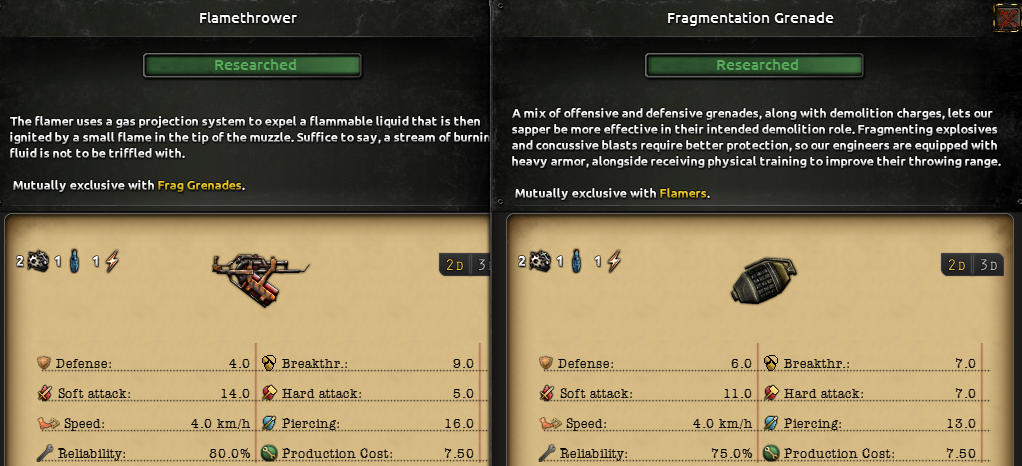
After you research dynamite you'll choose between Flamers or Grenades.
Flamers provide more soft attack and breakthrough. Grenades provide more hard attack and defense.
Sound familiar? Since AT provides all the hard attack you should ever need, you should default to the Flamer, unless your targets have a lot of Armor.
Dogs give speed, defense and damage buffs on several common terrain types, as well as some recon, soft attack and breakthrough.
Dogs provide great attack relative to their cost (4 IC, compared to the 5 of Support Equipment) so they are great for small nations. It only costs Water to produce them. Yes, you produce dogs in factories somehow, do not question it.
Dogs also have high Suppression, so you can put them on a militia/enforcer division and use that to garrison your occupied territories. It saves quite a lot of manpower.

Chem (field hospital) support saves manpower from potential casualties in your divisions. They do NOT preserve manpower losses when used in garrison templates.
This is especially useful in OWB since you have a lot less people to work with.
The EXP trickleback is nice to keep level 5 divisions around, and the war support protection is neat.
They give a minor bonus in Radioactive Wastes terrain, and, if motorized, deserts.
Many minor and generic nations get research/stat bonuses to Chems so you have even more reason to use this company with them.

Recon (the division stat) lets your generals pick better tactics in battles and gives you more army intel if you have La Resistance. Nothing more, nothing less.
Nice to have, but usually outshined by other companies.
Recon companies (not the recon stat) also give movement speed bonuses over many terrain types.
Some nations (i.e. Navajo, Legion) receive buffs to their recon companies so it's a good idea to use them there.

Logistics are much less of a pain compared to vanilla.
Regardless, there are some times where you need a bit more supply to squeeze in some more units. But then, you could use Transport Planes... or motorize your supply... are you doing that? Do that. MOTORIZE YOUR SUPPLY!!!
Logistics do NOT reduce fuel usage of a division like they do in vanilla.
Logistics also boost Initiative and Coordination. You can refer to the glossary for an explanation, but these are more placebo effects, really only useful for naval invasions and defending one tile with many divisions.
Logistics also boost river, amphibious, jungle, and marsh attacks, unless they're motorized.

Gives a bonus to reliability and equipment capture ratio. Reliability ensures you are able to recover equipment lost to attrition, whether from weather, terrain, or resistance.
It's nice in theory to be able to capture equipment, especially for weaker countries, but in practice you end up with a lot of stuff you just can't use due to your doctrine/tech/bonuses.
You can see in the battle ledger how much enemy equipment you capture.
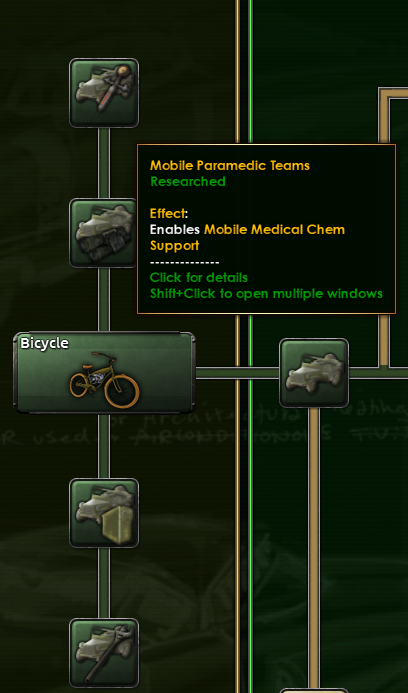
In the vehicle tree you can research motorized variants of these support companies. Once you can, you should.
These motorized variants do consume a little fuel, but they make the relevant company better at what it does.
Note that these companies being motorized has nothing to do with their speed. You do not have to worry about non-motorized recon companies slowing your motorized divisions down to 4kmph like in vanilla.

Just there to add the organization to robot divisions that they'd otherwise lack. Cheap. Not needed on anything else.

Gives fantastic all-around stat buffs, mostly armor. When you capitulate a PA nation you'll end up with a decent amount of captured power armor; it doesn't cost much to get the first PA tech.
And yes, PA support is good to have in full PA divisions.
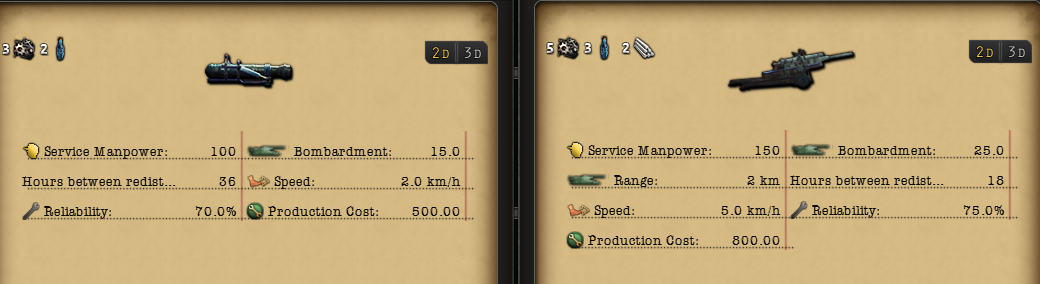
Not a Support Company but I had to put them somewhere. Starting with the humble Brahmin-drawn artillery, these are the OWB equivalent of No Step Back's railway guns.
Great if you plan on coming up against entrenched enemies in forts, or if you have extra resources burning a hole in your pocket.
Their range is severely limited compared to vanilla. Multiple guns won't stack their bonuses.
You should wait until you can build the Howitzer because the first couple techs suck and you can't upgrade old guns.

In most MP games, you will see AT, Demo, Fireteams, and Dogs.

The fifth slot depends on the country and the template. PA Support, or Motorized Logistics/Maintenance/Chems are common.
On the bright side, they aren't expensive to produce.
Fireteams
Fireteams are excellent defensive support companies. Throw them onto any division template that can afford it. They have good soft attack but their main draw is their defensive benefits.
Fireteam line battalions are okay on defense, but you generally don't need to put those in your templates. I recommend building CAS or special forces instead.
After you research the M-SAW, you must choose between LMG's or H-RCW's.
LMG's provide more soft attack. H-RCW's provide more hard attack and piercing.
Since AT provides all the hard attack you should ever need, you should default to the LMG, unless your targets have a lot of Armor.
Anti-Air
There's only a few scenarios where you'd need dedicated anti-air support, i.e. fighting the NCR.
If you looked closely at the LMG/H-RCW comparison you may have noticed that Fireteams actually provide their own Air Attack—it is decent enough to deal with gliders.
Anti-Tank
AT support is often overlooked, but the piercing it provides is crucial for fighting Power Armor and robots. This is not vanilla, numerous AI nations have armor and they will mess you up!
To a lesser extent, they're useful against enforcers, tanks, and APCS.
A standard AT support division with the earliest tech gives you 18.9 Piercing. The basic Stripped Power Armour has 20 Armor, and T-45d has 40... so you'd better upgrade your AT quickly.
Demolitions
The offensive counterpart to Fireteams, Demolition Teams should also be added onto any division template that can afford it. They are a great source of soft attack.
Demolition line battalions are okay but usually overkill.
After you research dynamite you'll choose between Flamers or Grenades.
Flamers provide more soft attack and breakthrough. Grenades provide more hard attack and defense.
Sound familiar? Since AT provides all the hard attack you should ever need, you should default to the Flamer, unless your targets have a lot of Armor.
Dogs
Dogs give speed, defense and damage buffs on several common terrain types, as well as some recon, soft attack and breakthrough.
Dogs provide great attack relative to their cost (4 IC, compared to the 5 of Support Equipment) so they are great for small nations. It only costs Water to produce them. Yes, you produce dogs in factories somehow, do not question it.
Dogs also have high Suppression, so you can put them on a militia/enforcer division and use that to garrison your occupied territories. It saves quite a lot of manpower.
Chems
Chem (field hospital) support saves manpower from potential casualties in your divisions. They do NOT preserve manpower losses when used in garrison templates.
This is especially useful in OWB since you have a lot less people to work with.
The EXP trickleback is nice to keep level 5 divisions around, and the war support protection is neat.
They give a minor bonus in Radioactive Wastes terrain, and, if motorized, deserts.
Many minor and generic nations get research/stat bonuses to Chems so you have even more reason to use this company with them.
Recon
Recon (the division stat) lets your generals pick better tactics in battles and gives you more army intel if you have La Resistance. Nothing more, nothing less.
Nice to have, but usually outshined by other companies.
Recon companies (not the recon stat) also give movement speed bonuses over many terrain types.
Some nations (i.e. Navajo, Legion) receive buffs to their recon companies so it's a good idea to use them there.
Logistics
Logistics are much less of a pain compared to vanilla.
Regardless, there are some times where you need a bit more supply to squeeze in some more units. But then, you could use Transport Planes... or motorize your supply... are you doing that? Do that. MOTORIZE YOUR SUPPLY!!!
Logistics do NOT reduce fuel usage of a division like they do in vanilla.
Logistics also boost Initiative and Coordination. You can refer to the glossary for an explanation, but these are more placebo effects, really only useful for naval invasions and defending one tile with many divisions.
Logistics also boost river, amphibious, jungle, and marsh attacks, unless they're motorized.
Maintenance
Gives a bonus to reliability and equipment capture ratio. Reliability ensures you are able to recover equipment lost to attrition, whether from weather, terrain, or resistance.
It's nice in theory to be able to capture equipment, especially for weaker countries, but in practice you end up with a lot of stuff you just can't use due to your doctrine/tech/bonuses.
You can see in the battle ledger how much enemy equipment you capture.
Motorized Chems/Recon/Logistics/Maintenance
In the vehicle tree you can research motorized variants of these support companies. Once you can, you should.
These motorized variants do consume a little fuel, but they make the relevant company better at what it does.
Note that these companies being motorized has nothing to do with their speed. You do not have to worry about non-motorized recon companies slowing your motorized divisions down to 4kmph like in vanilla.
CNC Bots
Just there to add the organization to robot divisions that they'd otherwise lack. Cheap. Not needed on anything else.
Power Armor Support
Gives fantastic all-around stat buffs, mostly armor. When you capitulate a PA nation you'll end up with a decent amount of captured power armor; it doesn't cost much to get the first PA tech.
And yes, PA support is good to have in full PA divisions.
Railway Guns
Not a Support Company but I had to put them somewhere. Starting with the humble Brahmin-drawn artillery, these are the OWB equivalent of No Step Back's railway guns.
Great if you plan on coming up against entrenched enemies in forts, or if you have extra resources burning a hole in your pocket.
Their range is severely limited compared to vanilla. Multiple guns won't stack their bonuses.
You should wait until you can build the Howitzer because the first couple techs suck and you can't upgrade old guns.
SO WHAT SUPPORT COMPANIES DO I PICK?!
In most MP games, you will see AT, Demo, Fireteams, and Dogs.
The fifth slot depends on the country and the template. PA Support, or Motorized Logistics/Maintenance/Chems are common.
Division Templates
Copying templates does not matter so much as understanding the thought that goes into them.
Almost anyone that plays OWB will tell you to do 20 width divisions for good reason. Click any of the tiles on the map and check the combat width of the terrain—notice something? All the terrain types (yes, all of them) have a combat width of 80, which is cleanly divisible by 20. If you attack from multiple angles, it adds another 20.
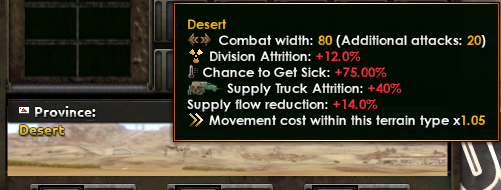
This also applies to 10 widths, but you may find yourself bottlenecked by their lower stats and by how Reinforce Rate works. I would only recommend 10 widths for nations that are limited by their size, manpower, or Power Armor reserves. (i.e. Lost Hills)
The following screenshots only had the first 4 techs for Conventional Warfare researched and mostly the best Basic infantry/support techs.
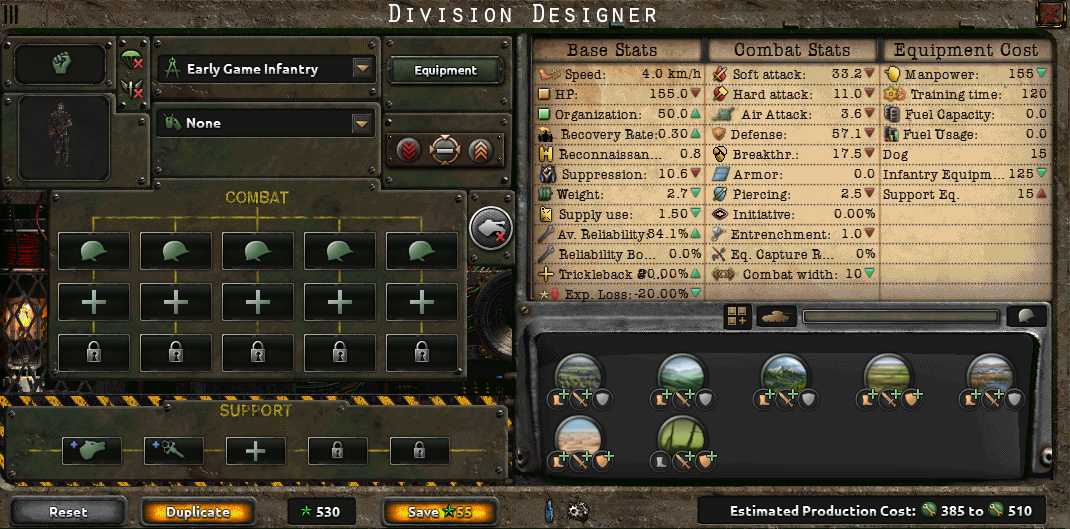 For those that can't do better, or just need to garrison their ports.
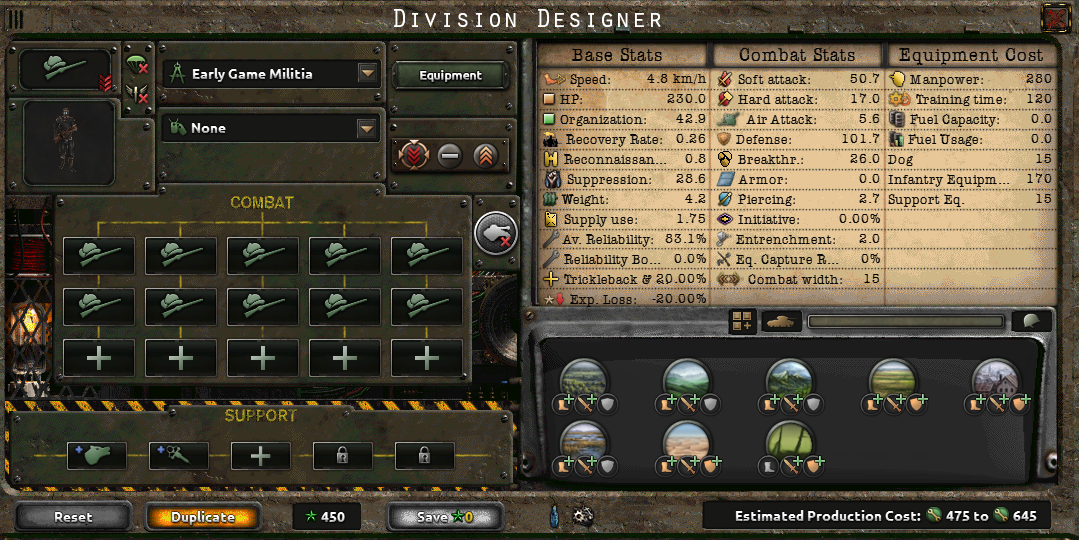 I kinda feel bad putting a frontline militia template in this guide... just look at those stats. Twice the battalions as the one above yet so little improvement.
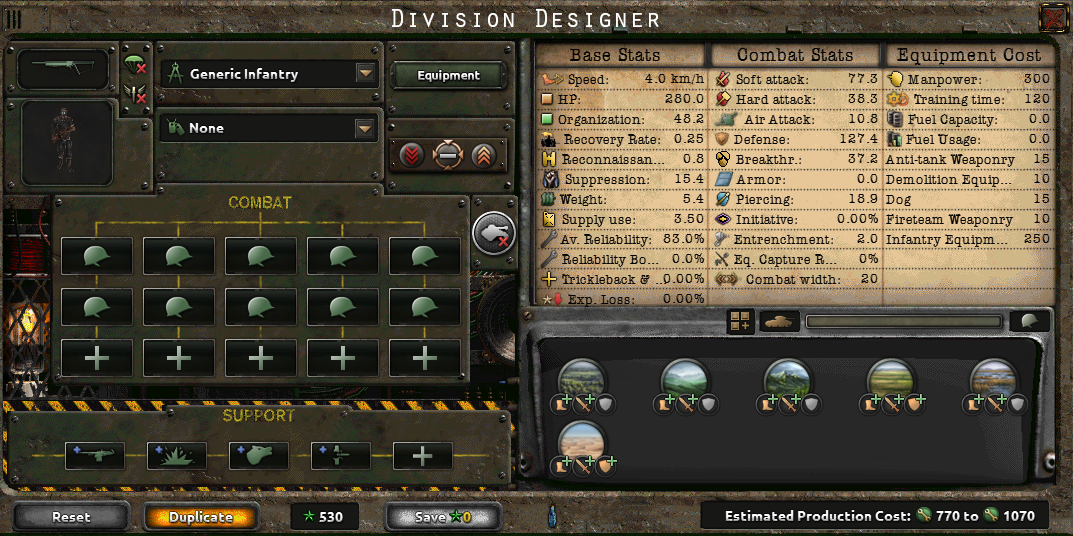 Bread and butter. Just there to hold the line. More than capable of pushing when given Fireteam/Demo equipment of sufficient quality.
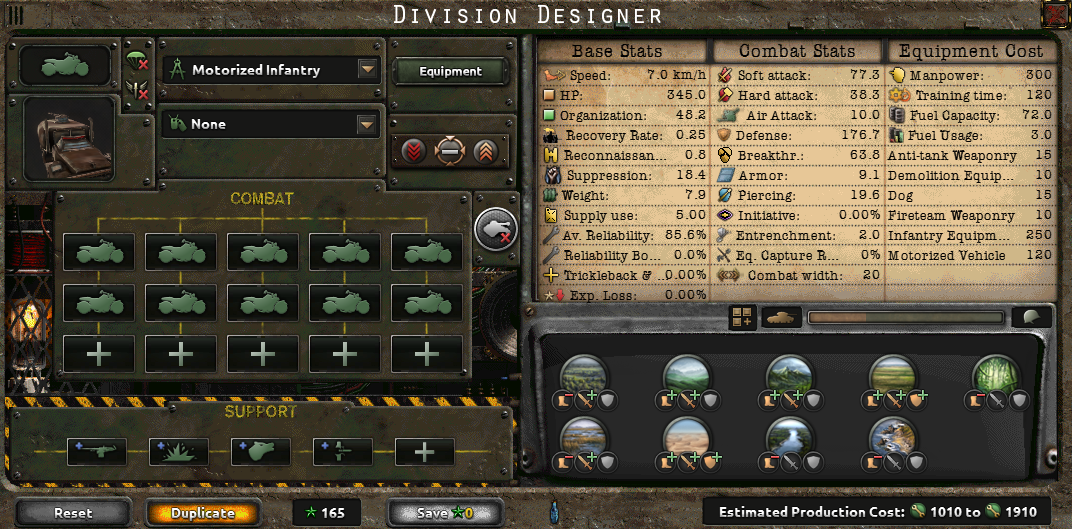
Equipped with Scrap Trucks in screenshot.
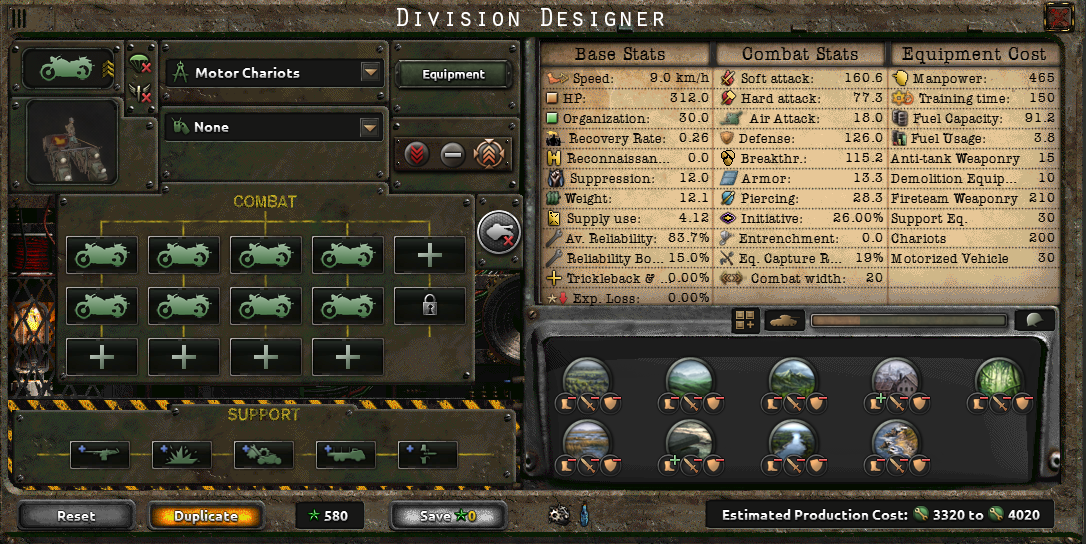
Unique tech for Caesar's Legion. Chariots are disproportionately strong and fast in the early game but do not scale into the late game, just look at that 13 Armor.
Chariots can't get much entrenchment and have severe penalties on rough/urban terrain. They also do not require Infantry Equipment, but they do take quite a bit of Fireteam Equipment.
Because chariots are poor on defense and expensive to replace, nations like Lanius can very quickly run out of steam if they take a lot of losses.
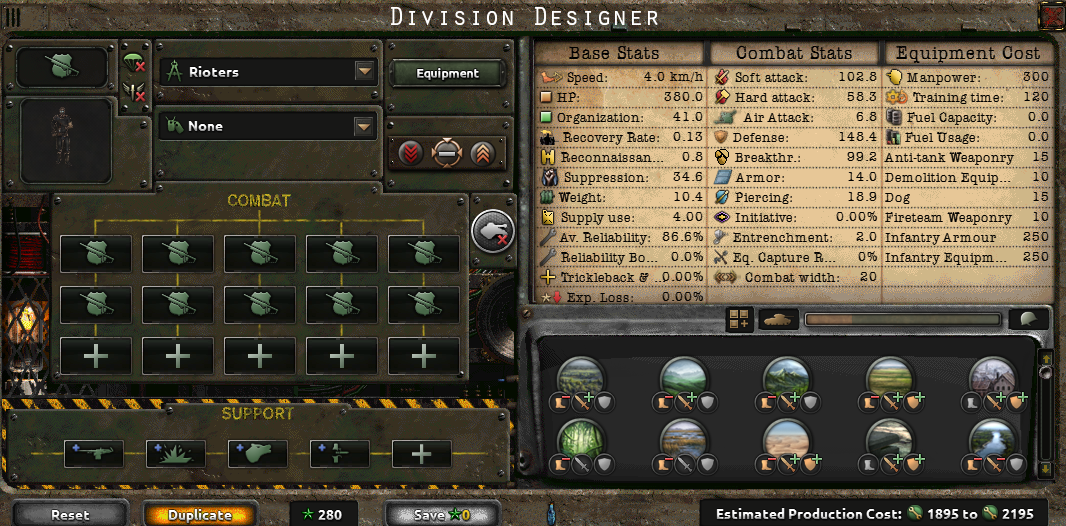
Armored infantry. Not the best choice unless you went Asymmetric Warfare, particularly with Wasteland Tactics, as that buffs your Recovery Rate. Because Enforcers have worse Recovery Rate than regular infantry.
But hey, any helpless nation without AT won't be able to touch you!
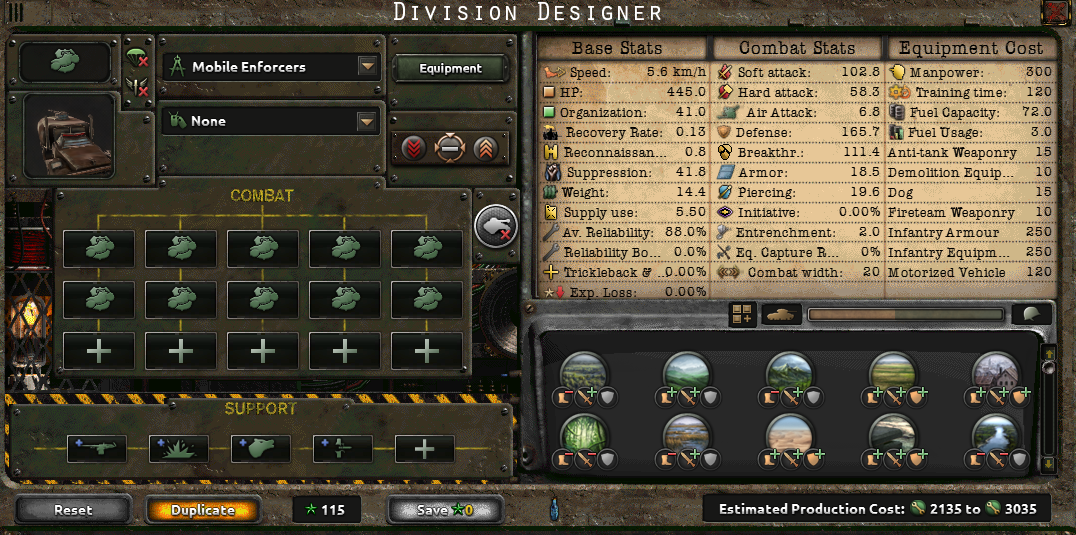
Late game Asymmetric Warfare. Rather expensive to produce, but not nearly as much as Robots.
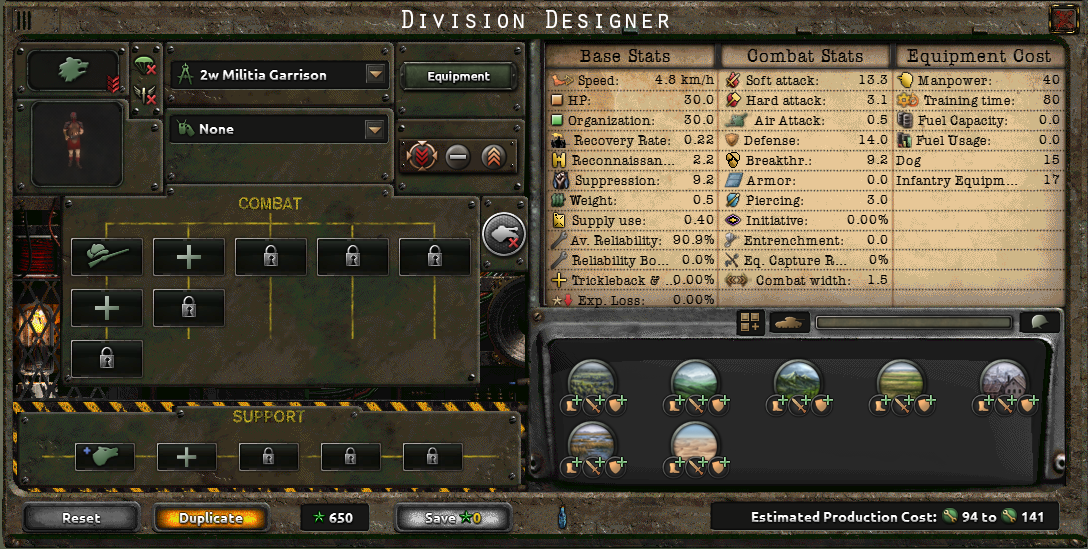
Once you have the Army XP to spare you can upgrade this to 30 width Enforcers to save even more manpower.
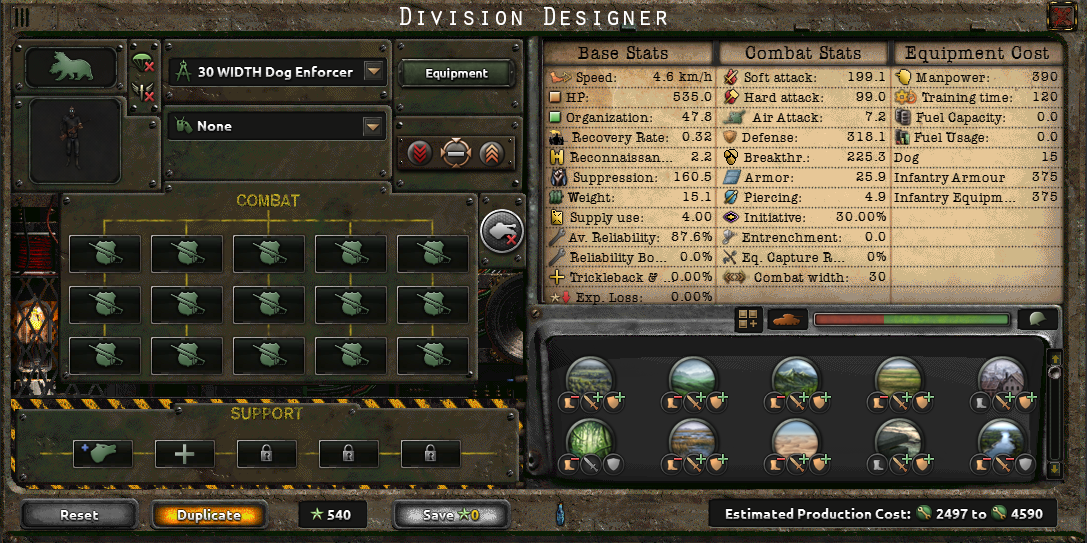
You can save a little more manpower with the inclusion of CNC Support Companies.
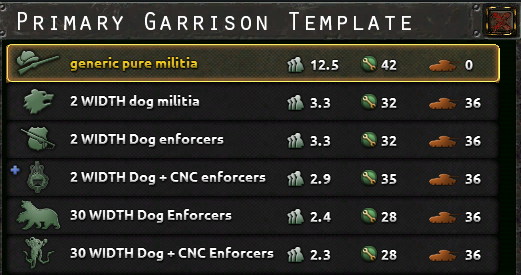
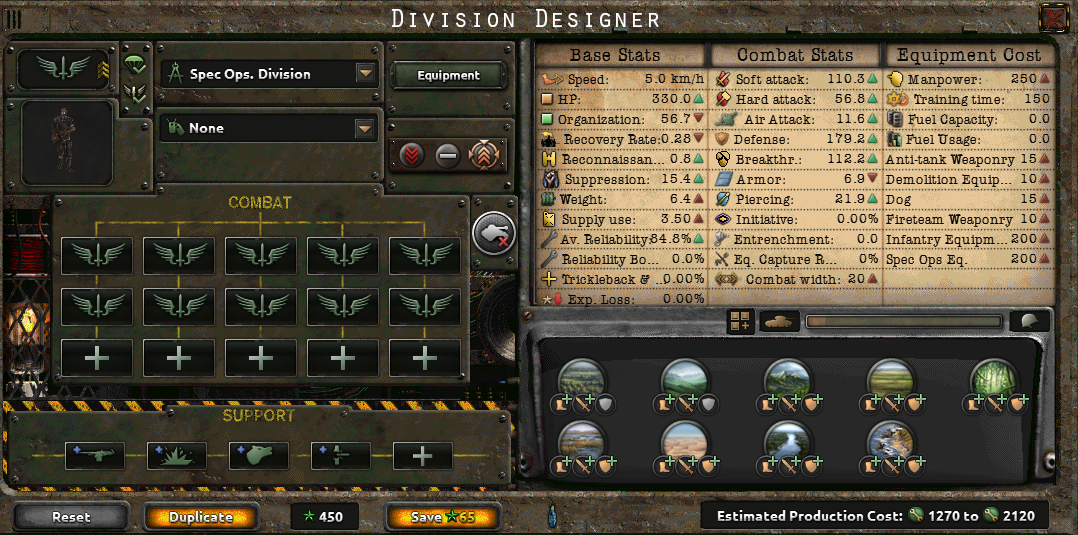
You shouldn't mix Line Fireteams/Demo into Light Special Forces divisions, since this will ruin the limited hardness they have. It'll also make them unable to be paradropped but that doesn't always matter.
This is what the stats are with the Pioneer Kit. Light Special Forces equipment is cheaper, doesn't use energy cells, doesn't take as much scrap metal to produce, and moves much faster than Power Armor. Still, though, if you have PA tech, you should use it...
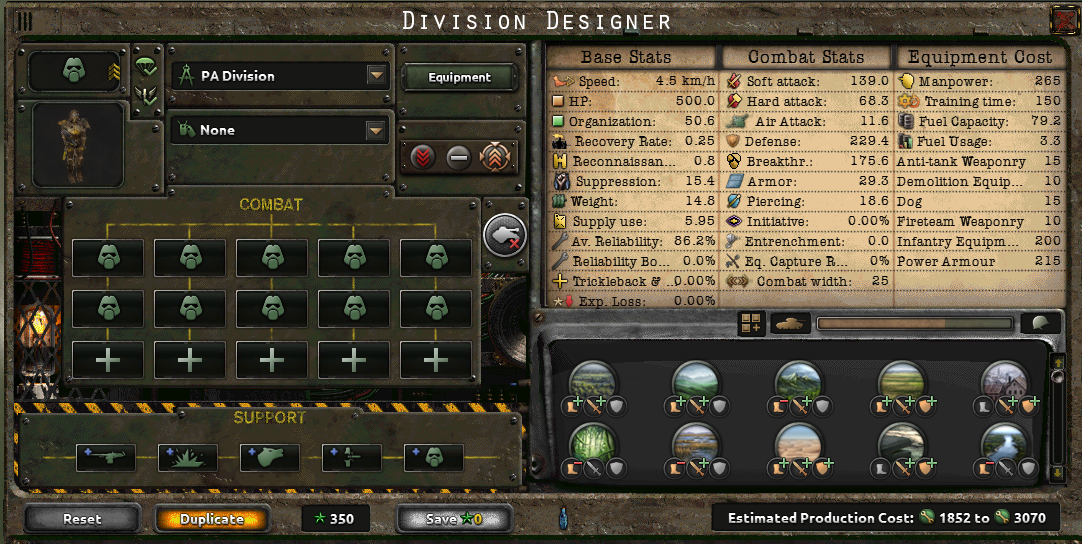
This is what the stats look like with Wasteland-PA (the best you can get with intermediate PA tech).
You should only put maintenance/logistics on a PA division if the situation truly demands it.
Lost Hills get access to Knights and Scribes, which are a mix of logi/maintenance and a mix of chems/recon, respectively. You can do AT, Fireteam, Demo, Knights, and Scribes with them. Remember your research for logistics/maintenance/chems/recon will affect knights/scribes.
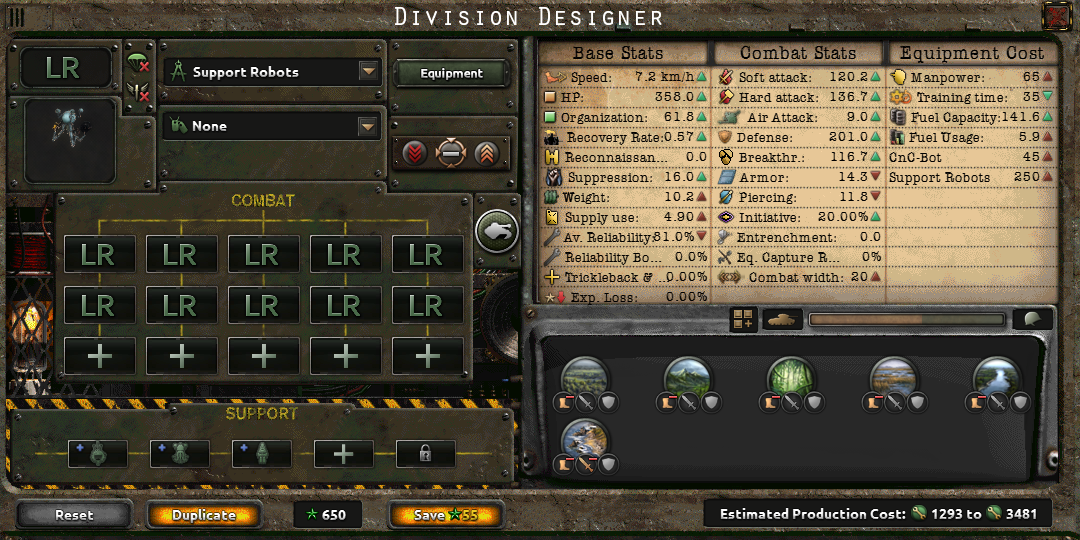
You can add mobile maintenance/logistics if need be.
Robots already have good base soft/hard attack so incorporating fireteams/demo is usually unnecessary.
With the way the game calculates things, chem support has little effect since these divisions proportionally take so little manpower.
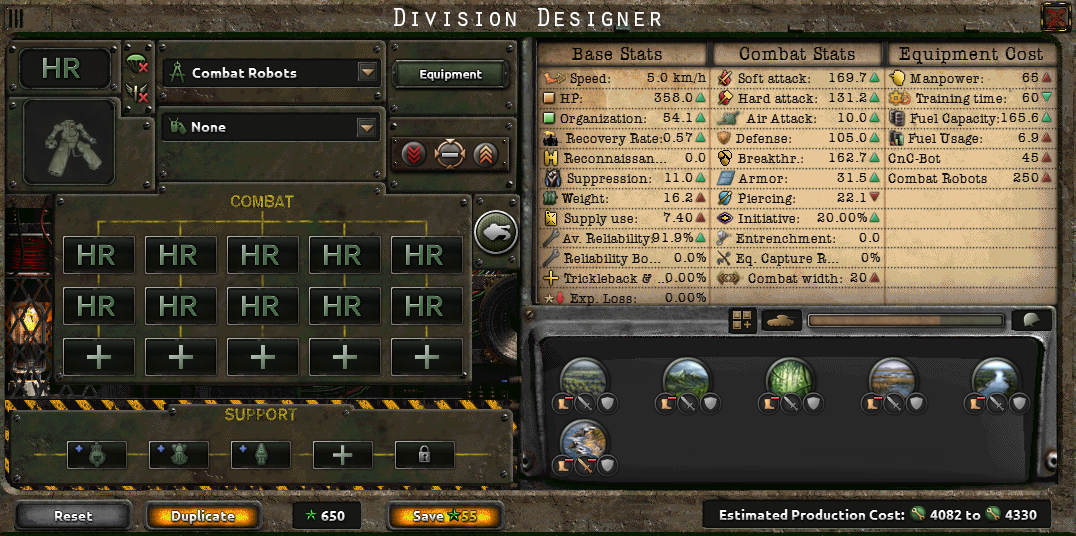
Ludicrously expensive, yes, but they give you a very efficient return on your investment.
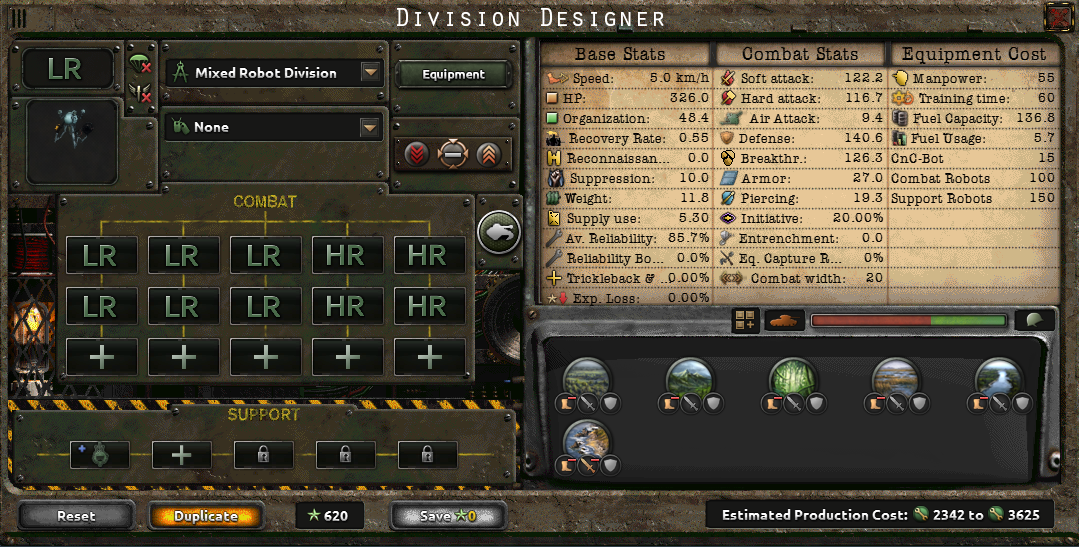
Splits the difference to create a division that still has good stats but is not too expensive.
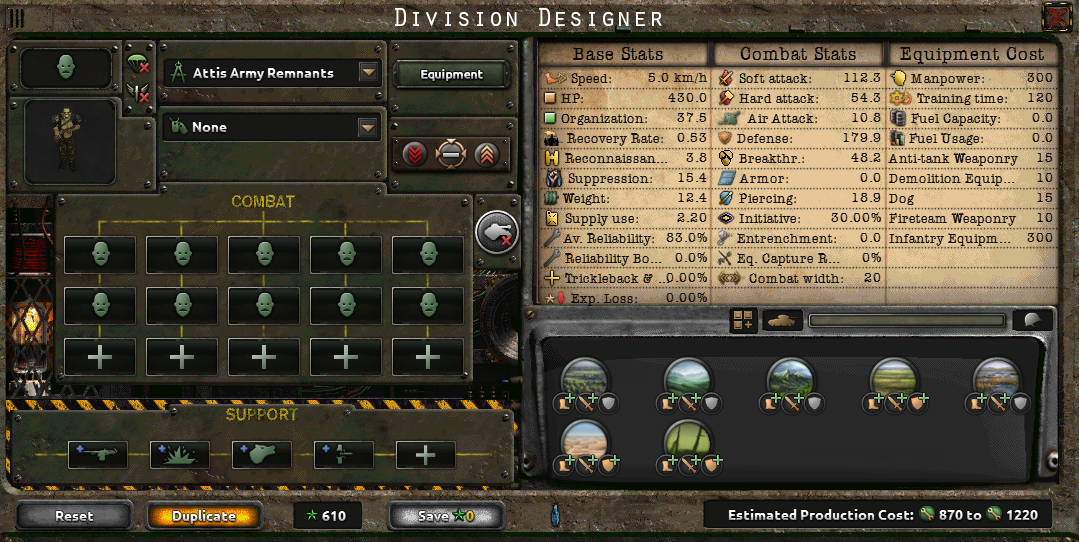
Almost anyone that plays OWB will tell you to do 20 width divisions for good reason. Click any of the tiles on the map and check the combat width of the terrain—notice something? All the terrain types (yes, all of them) have a combat width of 80, which is cleanly divisible by 20. If you attack from multiple angles, it adds another 20.
This also applies to 10 widths, but you may find yourself bottlenecked by their lower stats and by how Reinforce Rate works. I would only recommend 10 widths for nations that are limited by their size, manpower, or Power Armor reserves. (i.e. Lost Hills)
The following screenshots only had the first 4 techs for Conventional Warfare researched and mostly the best Basic infantry/support techs.
Infantry
Early Game 10 Width Infantry
For those that can't do better, or just need to garrison their ports.Early Game Militia
I kinda feel bad putting a frontline militia template in this guide... just look at those stats. Twice the battalions as the one above yet so little improvement.Generic 20 Width Infantry
Bread and butter. Just there to hold the line. More than capable of pushing when given Fireteam/Demo equipment of sufficient quality.Motorized Infantry
Equipped with Scrap Trucks in screenshot.
Motor Chariots
Unique tech for Caesar's Legion. Chariots are disproportionately strong and fast in the early game but do not scale into the late game, just look at that 13 Armor.
Chariots can't get much entrenchment and have severe penalties on rough/urban terrain. They also do not require Infantry Equipment, but they do take quite a bit of Fireteam Equipment.
Because chariots are poor on defense and expensive to replace, nations like Lanius can very quickly run out of steam if they take a lot of losses.
Enforcers
Armored infantry. Not the best choice unless you went Asymmetric Warfare, particularly with Wasteland Tactics, as that buffs your Recovery Rate. Because Enforcers have worse Recovery Rate than regular infantry.
But hey, any helpless nation without AT won't be able to touch you!
Mobile Enforcers
Late game Asymmetric Warfare. Rather expensive to produce, but not nearly as much as Robots.
Garrisons
For keeping resistance down. Not for frontline use! 2 widths + dogs are more manpower efficient for militia. 30 widths + dogs are better for Enforcers.Once you have the Army XP to spare you can upgrade this to 30 width Enforcers to save even more manpower.
You can save a little more manpower with the inclusion of CNC Support Companies.
Special Forces
Thankfully, OWB doesn't make us swap between paratroopers, marines, and mountaineers.Light Special Forces
You shouldn't mix Line Fireteams/Demo into Light Special Forces divisions, since this will ruin the limited hardness they have. It'll also make them unable to be paradropped but that doesn't always matter.
This is what the stats are with the Pioneer Kit. Light Special Forces equipment is cheaper, doesn't use energy cells, doesn't take as much scrap metal to produce, and moves much faster than Power Armor. Still, though, if you have PA tech, you should use it...
Power Armor Special Forces
This is what the stats look like with Wasteland-PA (the best you can get with intermediate PA tech).
You should only put maintenance/logistics on a PA division if the situation truly demands it.
Lost Hills get access to Knights and Scribes, which are a mix of logi/maintenance and a mix of chems/recon, respectively. You can do AT, Fireteam, Demo, Knights, and Scribes with them. Remember your research for logistics/maintenance/chems/recon will affect knights/scribes.
Robots
Screenshots taken with full Automated Warfare left, left doctrine and full intermediate robot tech.Support Robots
You can add mobile maintenance/logistics if need be.
Robots already have good base soft/hard attack so incorporating fireteams/demo is usually unnecessary.
With the way the game calculates things, chem support has little effect since these divisions proportionally take so little manpower.
Combat Robots
Ludicrously expensive, yes, but they give you a very efficient return on your investment.
Mixed Support/Combat Robots
Splits the difference to create a division that still has good stats but is not too expensive.
Mutants
Screenshot taken with Outsider Warfare researched.
Occupation and Resistance
Map-painting is fun, but you do have to deal with the stragglers that are left over.
We're gonna learn this system from scratch. Let's use Caesar's Legion as an example. We've just conquered two of our neighbors, and we need to garrison the territory.
Press Q or click your flag in the top left. Then click on 'Occupied Territories'.
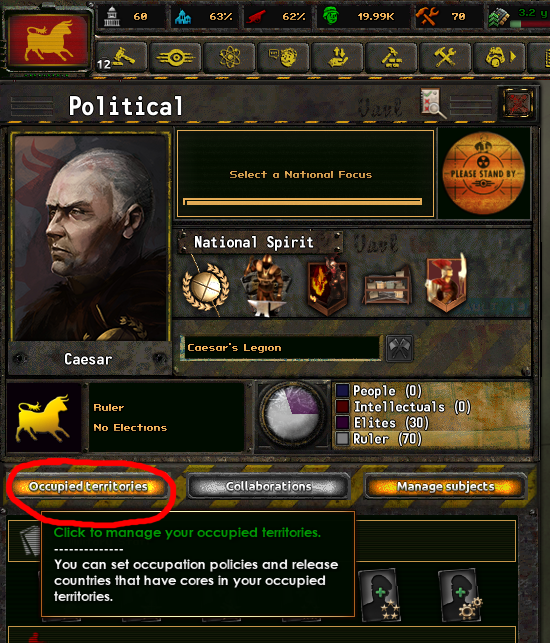
Let's look at the occupation laws. By default, every nation starts on 'Caravan Guards'. This is fine enough for most scenarios.
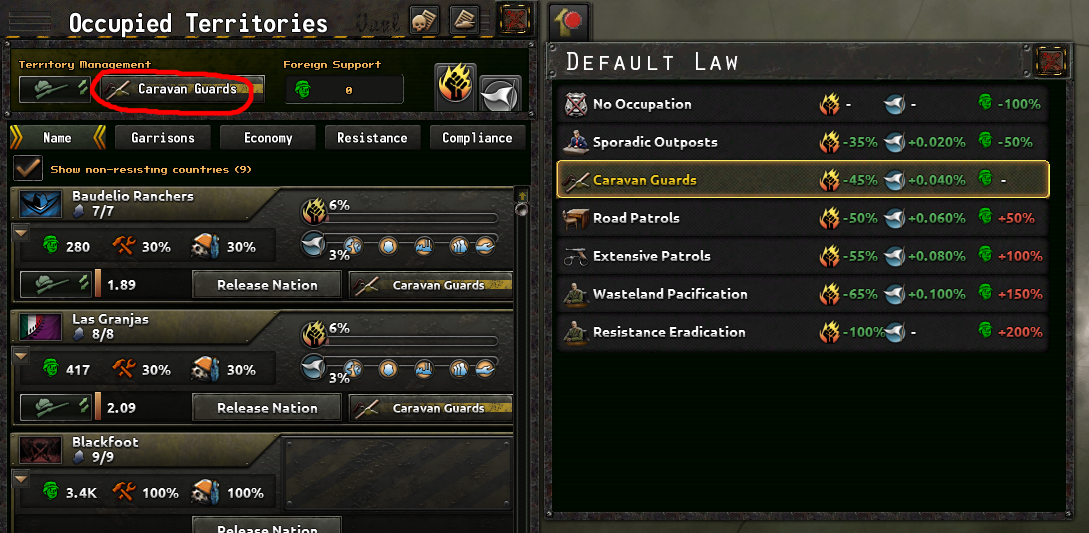
By holding CTRL, we can compare 'Caravan Guards' to the less harsh 'Sporadic Outposts'.
I will keep the original view of the law's stats on the left, and the comparisons on the right.
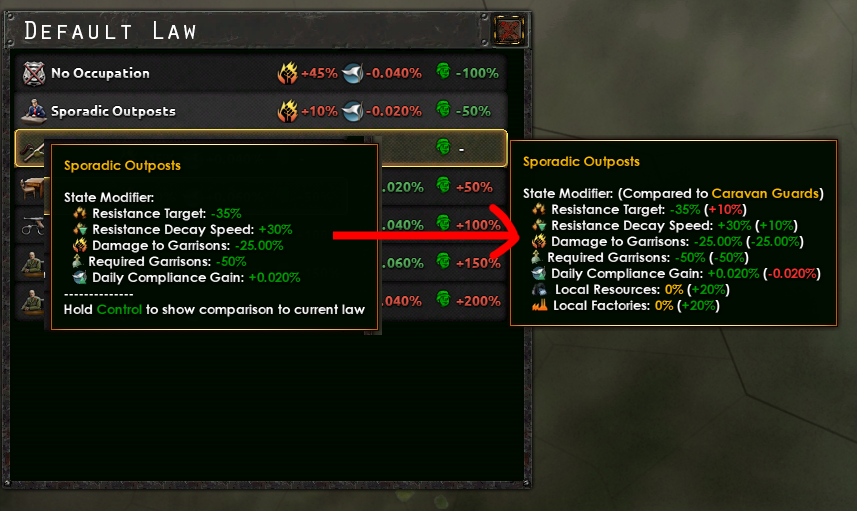
We get the most factories this way, and we save manpower, but compliance gain will be anemic, and resistance will be high.
We could just have 'No Occupation' at all...
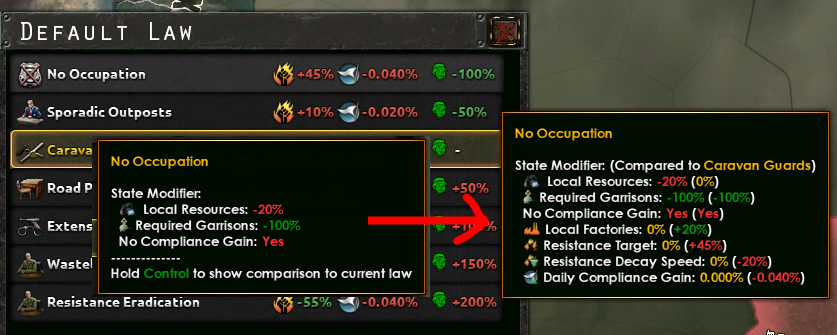
This will understandably cause Resistance to skyrocket, and we won't get any of the local factories. But, we won't spend any manpower/equipment on garrisons, so this can be temporarily useful in emergencies. You can't take garrison casualties if you never garrison in the first place!
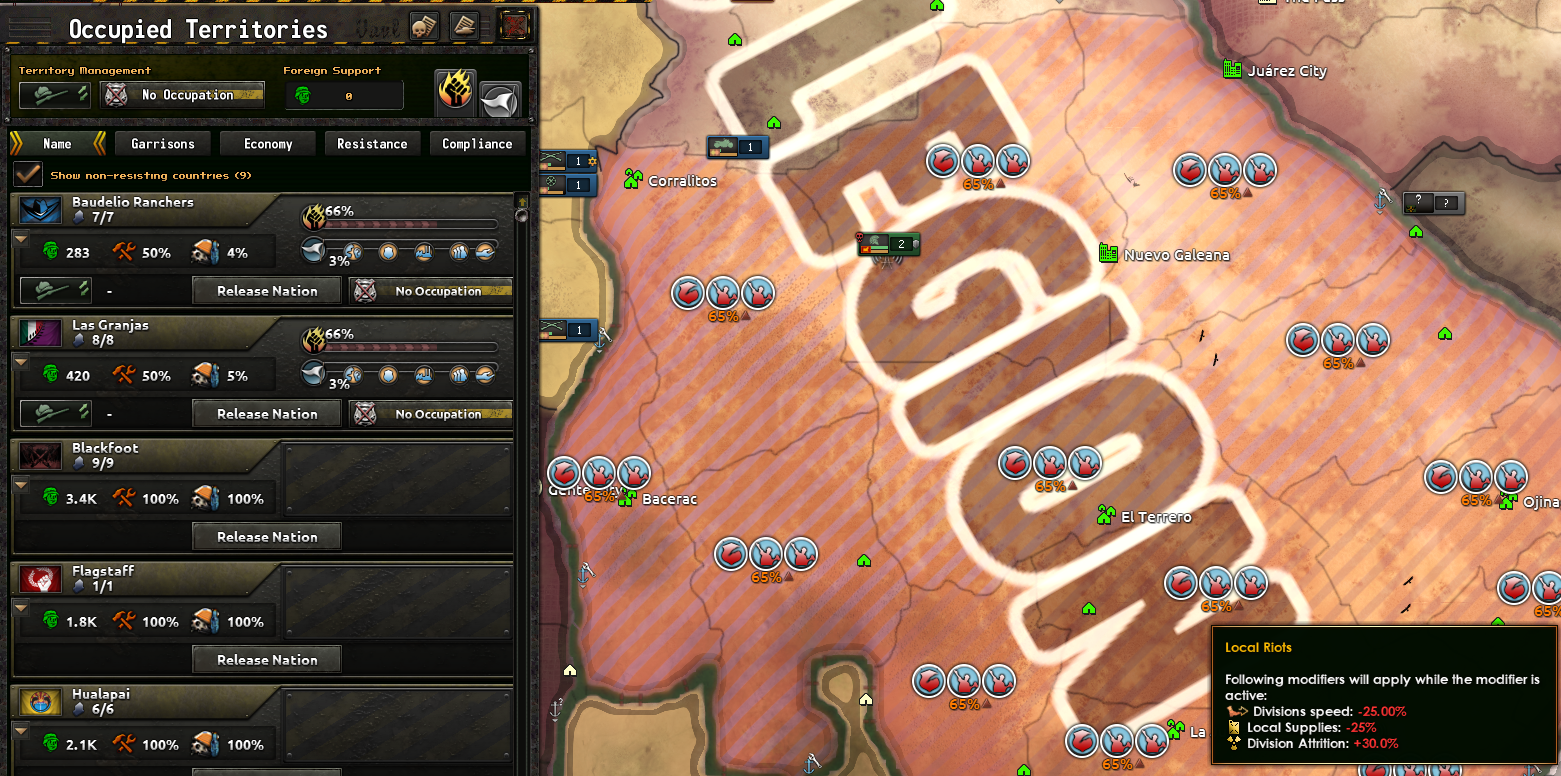
Here are the effects of having 'No Occupation' for a little less than a year: Local Riots are active, giving any divisions in the area 30% Attrition, which means they'll hemorrhage equipment and manpower. Not good!
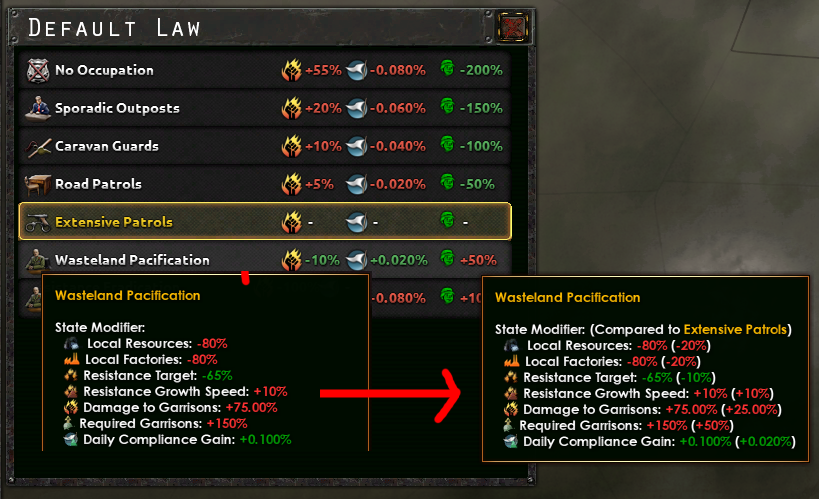
But that's silly. What if we were more harsh and compared Extensive Patrols to Wasteland Pacification?
This is the best choice if you want maximum compliance gain. Your garrisons take the most damage on this law, so you'll probably want them to have some Hardness.
Below it, we have Resistance Eradication, which, as the name implies, focuses on emergency Resistance lowering, at the cost of not giving you any local factories or resources or compliance or manpower.
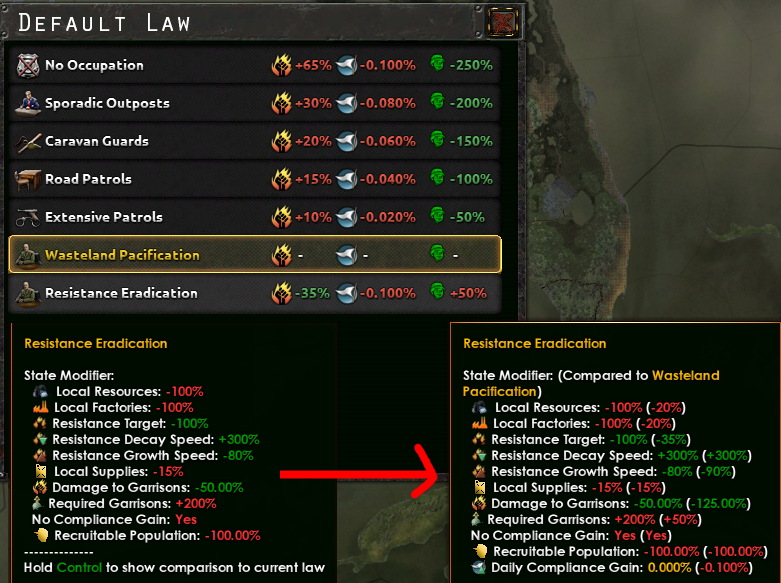
You get less factories the more harsh your occupation is, but you get more compliance.
States with more compliance tend to have less resistance, and vice versa. You can check resistance and compliance on the map by pressing F6 and F7, respectively.
Then press F1 to go back to the normal map view.
Previously in this guide I recommended using Dogs to have 2 width Militia or 30 width Enforcers to use as a garrison template. Let's see why.
Let's compare them to the Legion's starting army templates.
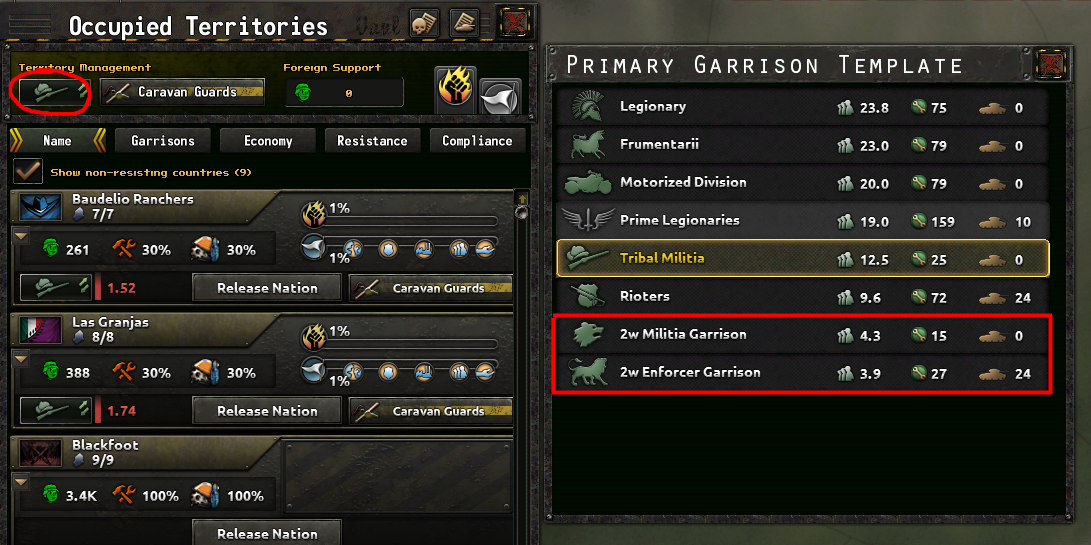
The Legionary and Frumentari have chems and recon respectively, which are worthless in a garrison template. This makes their manpower and production cost per suppression very high.
The Militia Template we start with is much better suited to the task, but not perfect.
Rioters (the default template you get for researching Crowd Control) are better than Militia and have some hardness, but don't save as much manpower as Dogs. They're also quite expensive.
When we take a single Militia battalion and add Dogs to it, it saves us a significant amount of manpower, but there's no Hardness to protect it from Resistance activity.
Combine Rioters with Dogs and you have a division that is three times more efficient for manpower per suppression than the default militia template. We have Hardness to reduce our losses. Plus, the Production Cost (IC) per Suppression is nearly identical. Awesome!
In the event you have access to CNC robots, these have Suppression too, so they can help your manpower.
With the Automated Warfare center doctrine you can have up to 3 CNC robots assisting.

Whenever you change your Occupation Law or Garrison Template, it can be helpful to press I to double-check your stockpile to see if you have enough equipment to garrison everything.
It is very very important that your garrisons have the equipment they need. It is always always always better to have a fully equipped Militia garrison over a half-equipped Enforcer division. The latter will take enormous casualties that you can't get back!
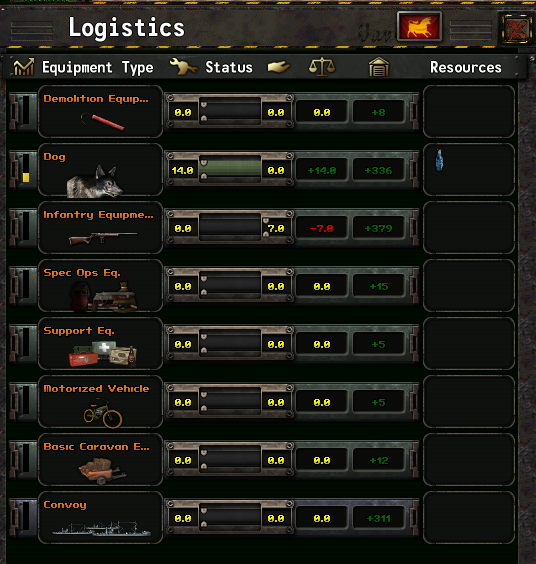
Here we can see we have a couple hundred dogs. If we change our global Garrison Template to use dogs, we might run out.
So, let's set it so that only the Baudelio Ranchers will be garrisoned with the dog template.
We can set a less harsh Occupation Law specifically on them too.
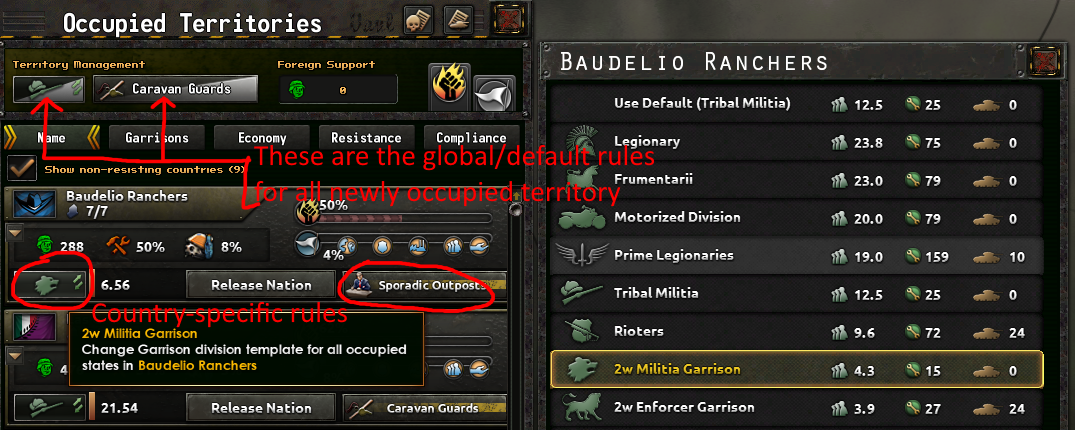
Let's ensure that any manpower and equipment goes to our garrison templates first. Resistance can quickly spiral out of control if garrisons aren't equipped properly.
Press U to open the recruitment menu and give 'Garrisons' high priority.
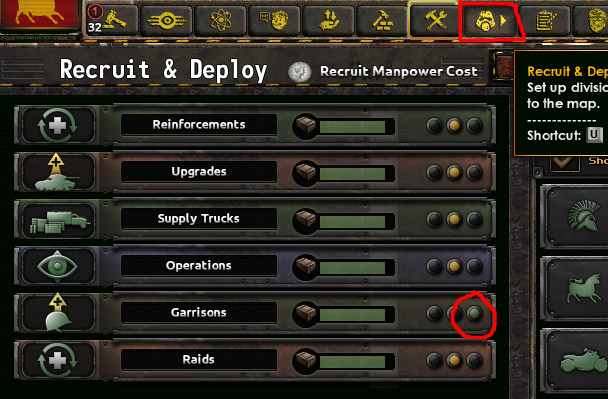
Perfect. Now we just need to let our Compliance get high enough for us to core this land. Consider spending 200k caps on the 'New Citizen Care Package' when you can, take 'Outsider Battalions' for your outsider conscription, and hire any advisors that provide compliance. (For those used to vanilla La Resistance, there are no operations for Collaboration Governments in OWB.)
Your Stability is tied to your resistance target as well, so don't waste your Political Power on things you don't need, you need to keep taking those decisions to raise your stability.
As our manpower and industrial base grows throughout the game we can afford to use harsher occupation laws.
If you can't afford to garrison a country, simply puppet them instead. Once again. If your garrisons are half-equipped, your casualties and resistance will skyrocket and your compliance gain will stall.
Once you have ≥95% Compliance and <20% Resistance in a state that neighbors one of your core states, you can core it. The Uncored States button will have a number over it for each state that qualifies.
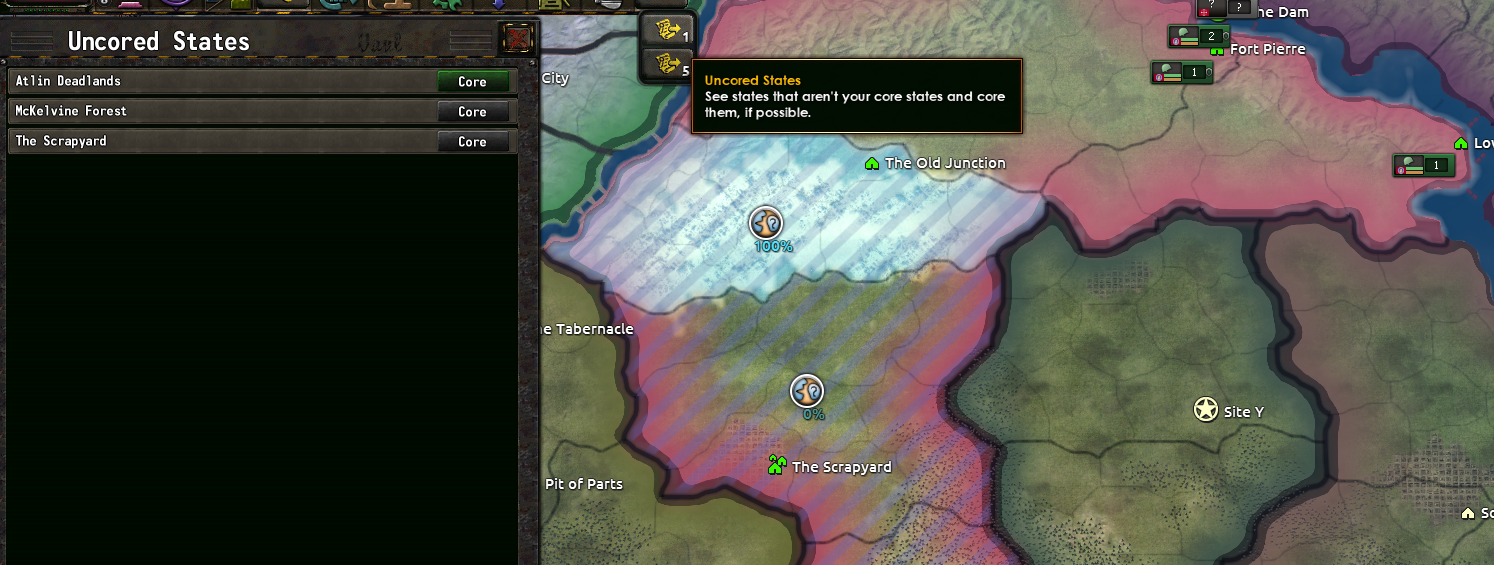
This is the whole raison d'être behind all this: when you core a state, you get all the factories and manpower and resources and you won't have to occupy it again. This lets even the smallest nations become world powers.
Coring costs a decent chunk of Political Power based on how developed the state is, how many states you've already cored, and your Centralization Law.
Some countries can receive a permanent reduction in coring costs, usually at the bottom of their respective focus trees.
We're gonna learn this system from scratch. Let's use Caesar's Legion as an example. We've just conquered two of our neighbors, and we need to garrison the territory.
Press Q or click your flag in the top left. Then click on 'Occupied Territories'.
Let's look at the occupation laws. By default, every nation starts on 'Caravan Guards'. This is fine enough for most scenarios.
By holding CTRL, we can compare 'Caravan Guards' to the less harsh 'Sporadic Outposts'.
I will keep the original view of the law's stats on the left, and the comparisons on the right.
We get the most factories this way, and we save manpower, but compliance gain will be anemic, and resistance will be high.
We could just have 'No Occupation' at all...
This will understandably cause Resistance to skyrocket, and we won't get any of the local factories. But, we won't spend any manpower/equipment on garrisons, so this can be temporarily useful in emergencies. You can't take garrison casualties if you never garrison in the first place!
Here are the effects of having 'No Occupation' for a little less than a year: Local Riots are active, giving any divisions in the area 30% Attrition, which means they'll hemorrhage equipment and manpower. Not good!
But that's silly. What if we were more harsh and compared Extensive Patrols to Wasteland Pacification?
This is the best choice if you want maximum compliance gain. Your garrisons take the most damage on this law, so you'll probably want them to have some Hardness.
Below it, we have Resistance Eradication, which, as the name implies, focuses on emergency Resistance lowering, at the cost of not giving you any local factories or resources or compliance or manpower.
You get less factories the more harsh your occupation is, but you get more compliance.
States with more compliance tend to have less resistance, and vice versa. You can check resistance and compliance on the map by pressing F6 and F7, respectively.
Then press F1 to go back to the normal map view.
So, what do we garrison this territory with?
Three things matter when we look at a garrison template:- Suppression. How efficiently the division can control resistance. The higher this is, the less of this division (manpower and IC) you'll need to fill a garrison. For example, dogs and militia units are particularly good at handling resistance, due to their nature.
- Hardness. How well the division can withstand attacks from resistance. You can and will lose manpower to high resistance if you only ever use Militia.
- Production cost. Can your industry handle making a dozen of these divisions? How about a hundred? Would it be better to just use Militia over expensive Enforcers?
Previously in this guide I recommended using Dogs to have 2 width Militia or 30 width Enforcers to use as a garrison template. Let's see why.
Let's compare them to the Legion's starting army templates.
The Legionary and Frumentari have chems and recon respectively, which are worthless in a garrison template. This makes their manpower and production cost per suppression very high.
The Militia Template we start with is much better suited to the task, but not perfect.
Rioters (the default template you get for researching Crowd Control) are better than Militia and have some hardness, but don't save as much manpower as Dogs. They're also quite expensive.
When we take a single Militia battalion and add Dogs to it, it saves us a significant amount of manpower, but there's no Hardness to protect it from Resistance activity.
Combine Rioters with Dogs and you have a division that is three times more efficient for manpower per suppression than the default militia template. We have Hardness to reduce our losses. Plus, the Production Cost (IC) per Suppression is nearly identical. Awesome!
In the event you have access to CNC robots, these have Suppression too, so they can help your manpower.
With the Automated Warfare center doctrine you can have up to 3 CNC robots assisting.
Whenever you change your Occupation Law or Garrison Template, it can be helpful to press I to double-check your stockpile to see if you have enough equipment to garrison everything.
It is very very important that your garrisons have the equipment they need. It is always always always better to have a fully equipped Militia garrison over a half-equipped Enforcer division. The latter will take enormous casualties that you can't get back!
Here we can see we have a couple hundred dogs. If we change our global Garrison Template to use dogs, we might run out.
So, let's set it so that only the Baudelio Ranchers will be garrisoned with the dog template.
We can set a less harsh Occupation Law specifically on them too.
Let's ensure that any manpower and equipment goes to our garrison templates first. Resistance can quickly spiral out of control if garrisons aren't equipped properly.
Press U to open the recruitment menu and give 'Garrisons' high priority.
Perfect. Now we just need to let our Compliance get high enough for us to core this land. Consider spending 200k caps on the 'New Citizen Care Package' when you can, take 'Outsider Battalions' for your outsider conscription, and hire any advisors that provide compliance. (For those used to vanilla La Resistance, there are no operations for Collaboration Governments in OWB.)
Your Stability is tied to your resistance target as well, so don't waste your Political Power on things you don't need, you need to keep taking those decisions to raise your stability.
As our manpower and industrial base grows throughout the game we can afford to use harsher occupation laws.
If you can't afford to garrison a country, simply puppet them instead. Once again. If your garrisons are half-equipped, your casualties and resistance will skyrocket and your compliance gain will stall.
Once you have ≥95% Compliance and <20% Resistance in a state that neighbors one of your core states, you can core it. The Uncored States button will have a number over it for each state that qualifies.
This is the whole raison d'être behind all this: when you core a state, you get all the factories and manpower and resources and you won't have to occupy it again. This lets even the smallest nations become world powers.
Coring costs a decent chunk of Political Power based on how developed the state is, how many states you've already cored, and your Centralization Law.
Some countries can receive a permanent reduction in coring costs, usually at the bottom of their respective focus trees.
Air Warfare
Air Doctrines
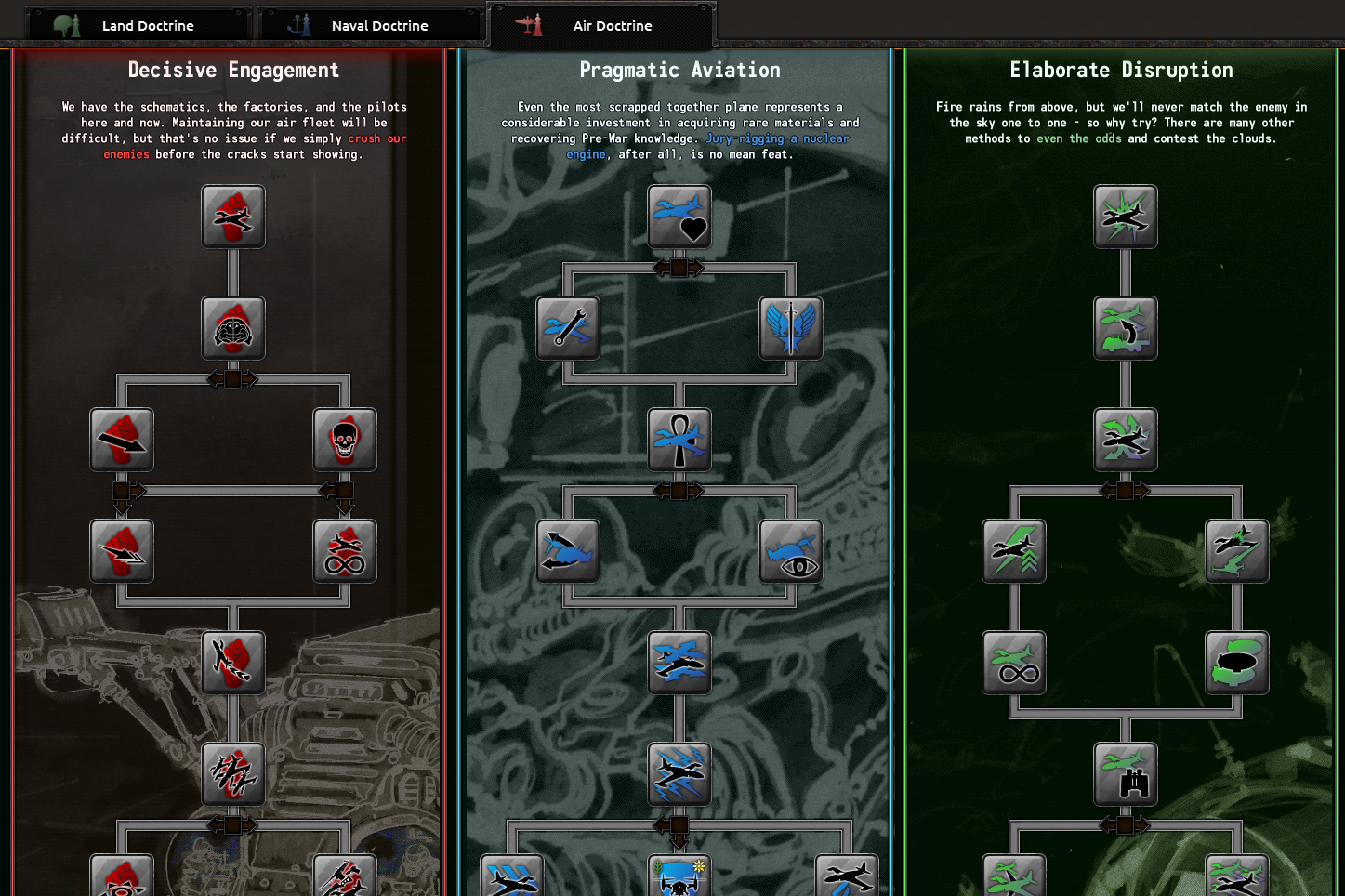
All 3 Air Doctrine trees have 9 doctrines to click that cost 50 XP each.
So, completing a tree costs 450 XP.
While Decisive Engagement has the best raw stats, it has penalties to your air defense and air accidents chance, which can be remedied with advisors and spirits. You will take the most losses with this tree, but it remains a popular pick.
Pragmatic Aviation tries to do everything with no obvious weaknesses. Range, bad weather penalties, research speed and XP gain, and some decent agility and detection.
The first doctrine is the opposite of Decisive Engagement's air defense/accidents chance.
Elaborate Disruption lets weaker nations deny enemy total air superiority, but can't really scale into the late game like the other doctrines can.
The headline of Elaborate Disruption arrives with its second doctrine, making all aircraft 5% cheaper to produce, at the cost of taking 50% more manpower. Ironically, this is a price many smaller nations can't even pay.
Planes
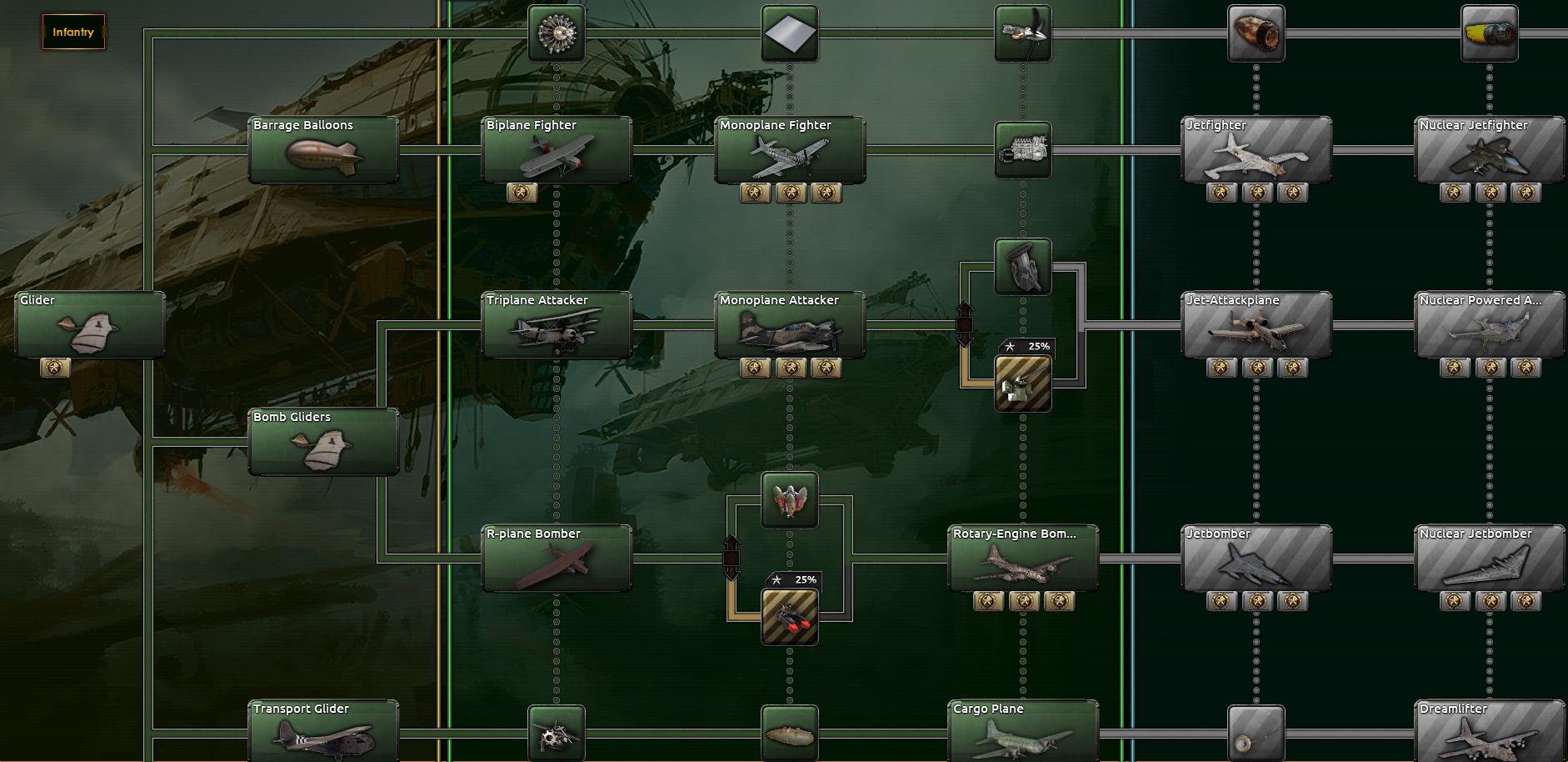
Basic-tech planes have pitiful stats, but it's all some nations can do.
Gliders can still give your divisions the Air Superiority buff, which can be a difference-maker in early conflicts.
While Fighters can be used to provide Close Air Support in OWB, their Ground Attack is pitiful. (we're talking single digit numbers)
Barrage Balloons offer a disposable way for weaker nations to intercept air attacks. They are buffed significantly by right-side Elaborate Disruption.
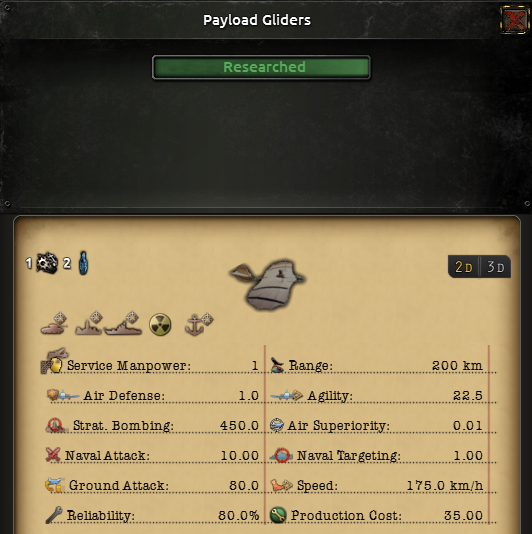
Bomb Gliders are disposable CAS/bombers. Hilariously, they are capable of executing Nuclear Strikes. Don't believe me? Look at the screenshot.
They have 80 Ground Attack. For reference. a Triplane Attacker has 7.5, a Nuclear Powered Attackplane has 33, and a Flying Superfortress has 80. Only just equal.
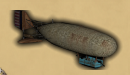
Blimps have enormous range and good stats on paper, but they are incredibly taxing on your factories (roughly twice as expensive as bombers), manpower and resources.
Blimps are very vulnerable to attack when used as CAS. Enemy interceptors can run circles around them: even the humble Glider has 25 agility and 120 speed compared to the Combat Blimp's 100 and 10.
Blimps should be used with nations that receive bonuses to them (i.e. Eagle Rock) or if you have so much manpower and industry their deaths are irrelevant to you.
Air Spirits
If you have No Step Back, there are some Air Spirits to choose from. 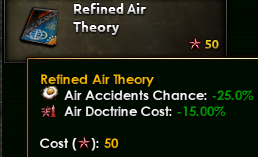
Refined Air Theory might be tempting for the -15% air doctrine cost.
Completing a tree costs 450 XP. If you're saving 15% on each doctrine, you only spend 382.5 XP, meaning you saved 67.5 XP, except you spent 50 XP to get the spirit, so you only saved 17.5 XP.
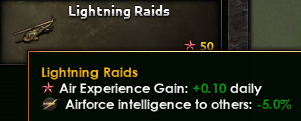
Lightning Raids gives you a ticking 0.10 Air XP every day, which means you'll have paid off your 50 Air XP investment within 500 days. 50 Air XP is also enough to buy an Air Doctrine.
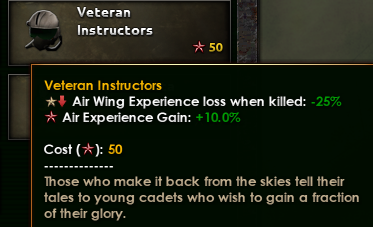
I usually put Veteran Instructors in the other slot. Combined with Lightning Raids you'll get 0.11 Air XP a day, so you'll get 50 XP within 454 days.
The lowered -25% Air Wing Experience Loss is nice too. It stacks nicely with the -25% (-35% on left side) from the Elaborate Distruption tree, or it can counteract the +5% penalty from right side Pragmatic Aviation.
Once you have the XP you need, or if you need bonuses elsewhere, you can use different spirits.
Plane Variants
Thankfully, even if you have By Blood Alone you won't have to worry about designing planes and researching 10 different modules for them. This function is taken up by these little plane variants here.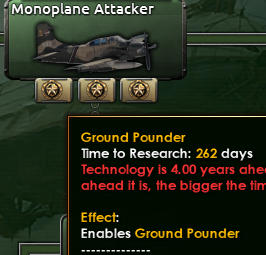
The default planes are usually good enough but in case you want, say, Heavy CAS, Recon Planes, or a Naval Bomber, this is how you get those. These variants don't stack with their originals, which helps you keep them organized.
Believe it or not you can actually spend Air XP on custom plane variants, just like the good old days.
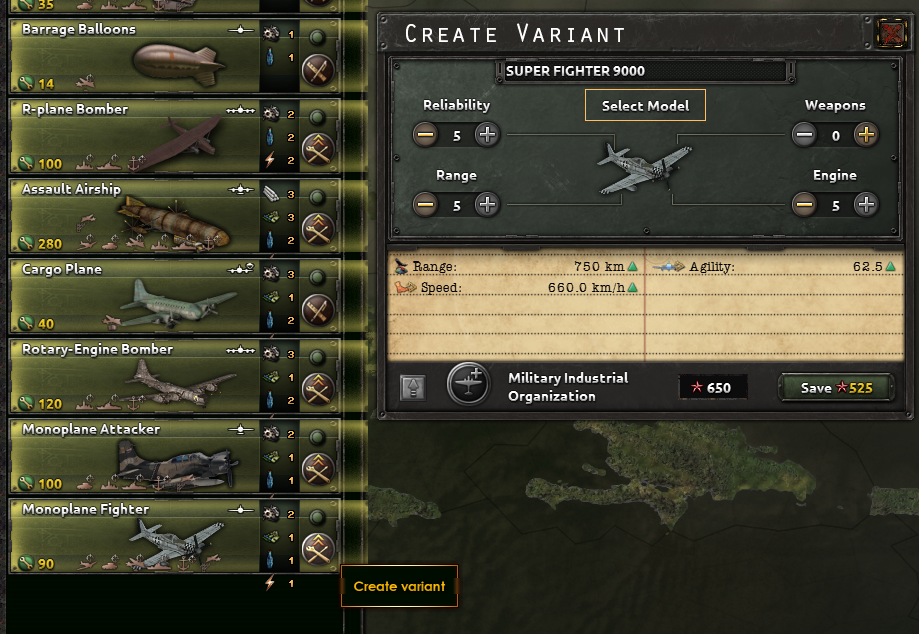
You don't need to be like this screenshot, this one design costs more than a whole air doctrine tree. Level 5 Engine is all you need, but Level 2 Reliability can be nice.
In the case of the monoplane here, it gets 62.5 Agility which is greater than the 60 Agility of a Jetfighter. The neat thing is these variants don't increase the production cost.
You can spend 175 Air XP on 5 Range points on the Long Range Bomber variant of the R-Plane Bomber, which is enough range to bomb anyone on the map if you really wanted to...
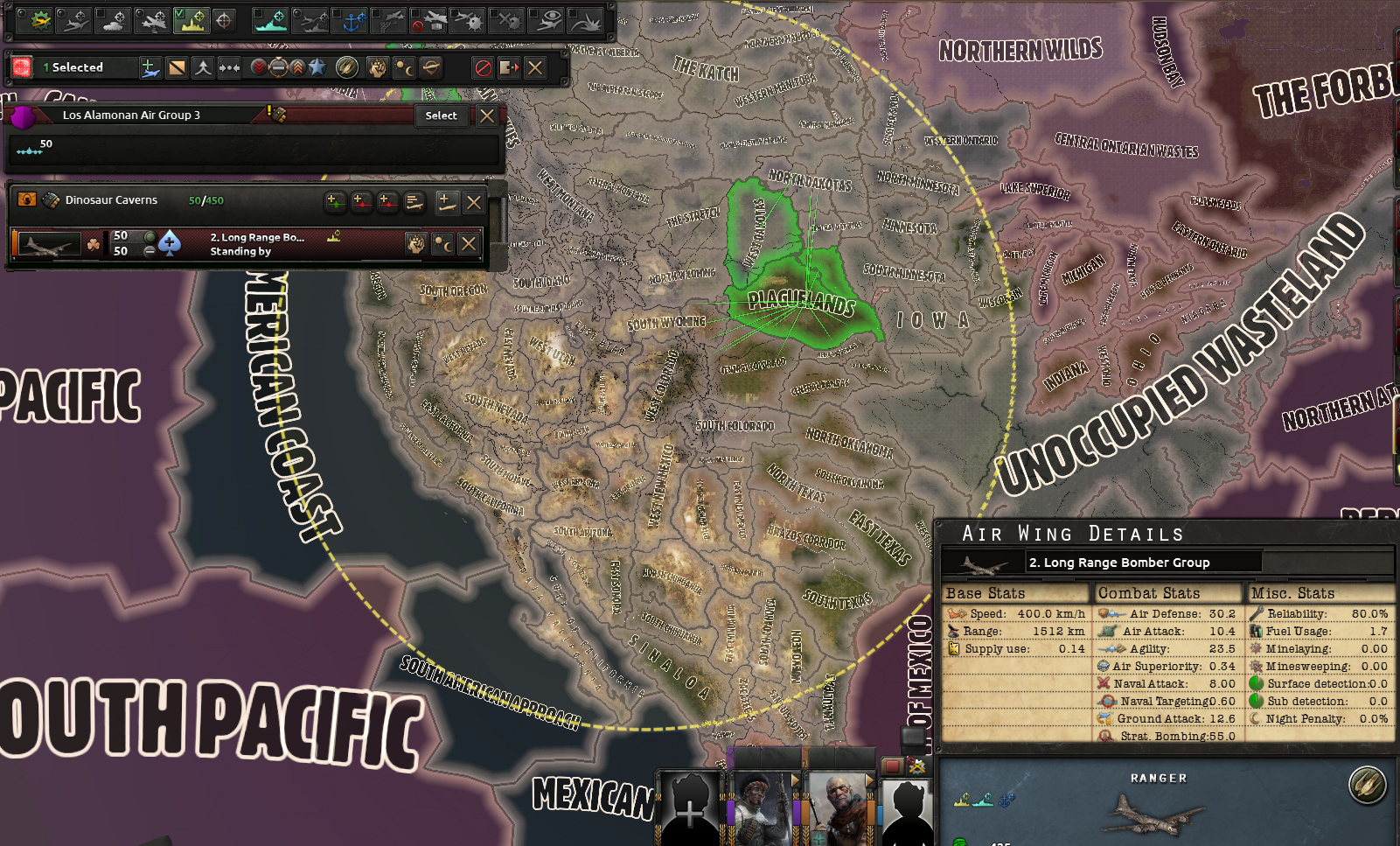
Naval Warfare
Managing your navy isn't necessary for every campaign, but when done right you won't have to worry about getting naval invaded, you can block enemies from river crossings, and you can get shore bombardment to help your guys on land.
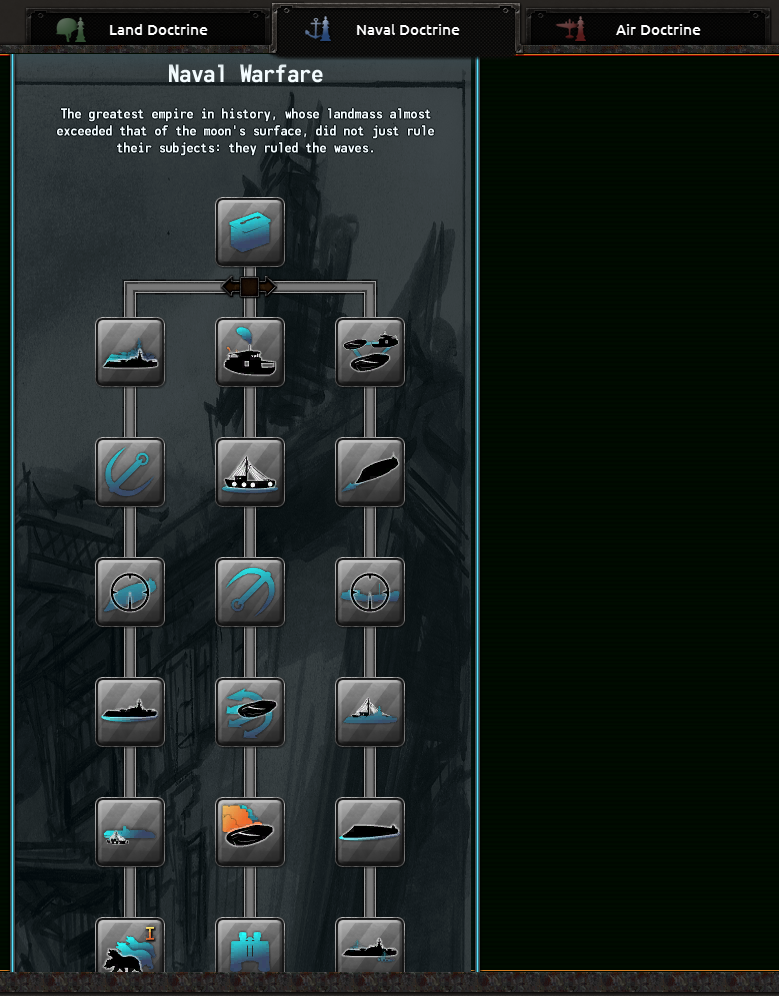
There's only one naval doctrine tree in Old World Blues, but you will have to pick between Capital Ship Doctrine (only benefits Heavy and Superheavy ships)
or Dispersed Formations (mainly benefits screen ships, has 3 bonuses for capital ships)
There are 6 doctrines in the middle, and 8 whether you go left or right, for a total of 14. They cost 50 XP each, so you'll need 700 Navy XP to get them all.
Dispersed Formations seems alright, however screens in OWB die so quickly that it does not usually matter to upgrade them, and you can still upgrade your screens through the middle path. The screen speed buff is nice, though, as large ships can't hit what they can't catch.
Capital Ship Doctrine gives some much needed armor and org buffs to your capital ships.
Whichever path you choose will depend on your nation and your industry. The middle path is not mutually exclusive with any other, and gives benefits to your screen ships.
Regardless, battles between evenly matched navies are decided by who has more training, naval intel, and doctrines. If you have a navy, you should exercise it before throwing it into battle, you need that XP.
When recruiting, you'll want to prioritize admirals with Bold, Battleship Adherent, Naval Lineage, and/or Chief Engineer.
If you have No Step Back, you need to get 35 Navy XP ASAP so you can buy the Naval Expertise Spirit of the Navy.
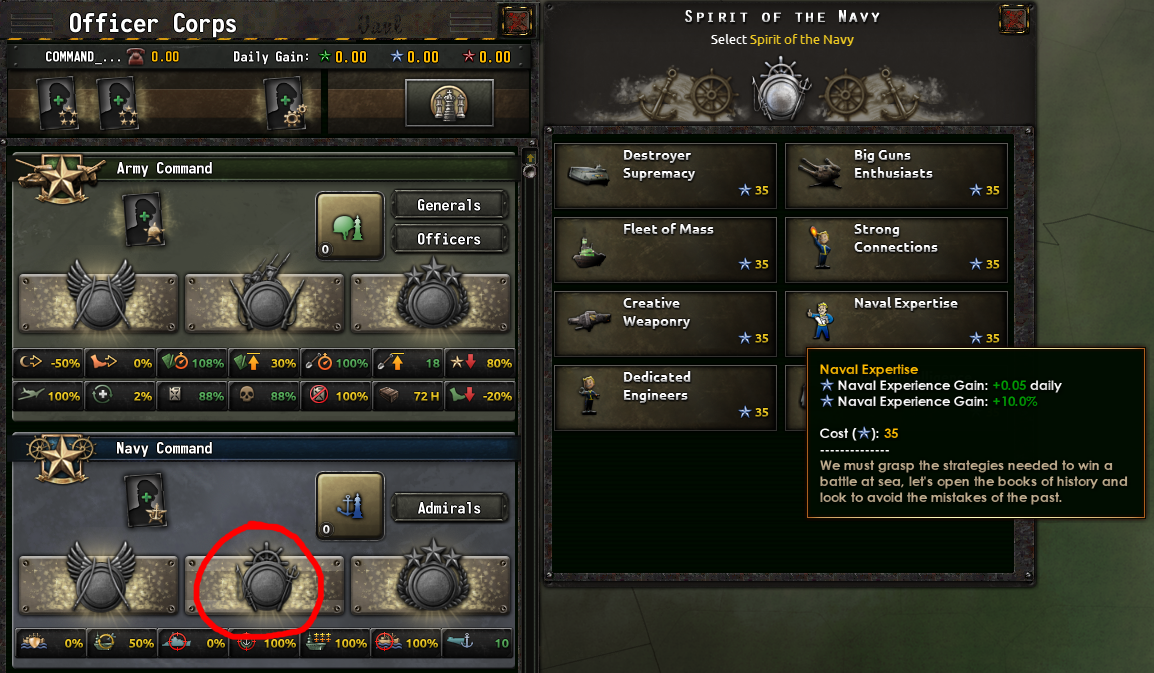
This ticking 0.05 daily Navy XP (really 0.055 with the 10% bonus it also has) pays itself off in 636 days.
It gives you 50 XP, enough for a doctrine, within 909 days.
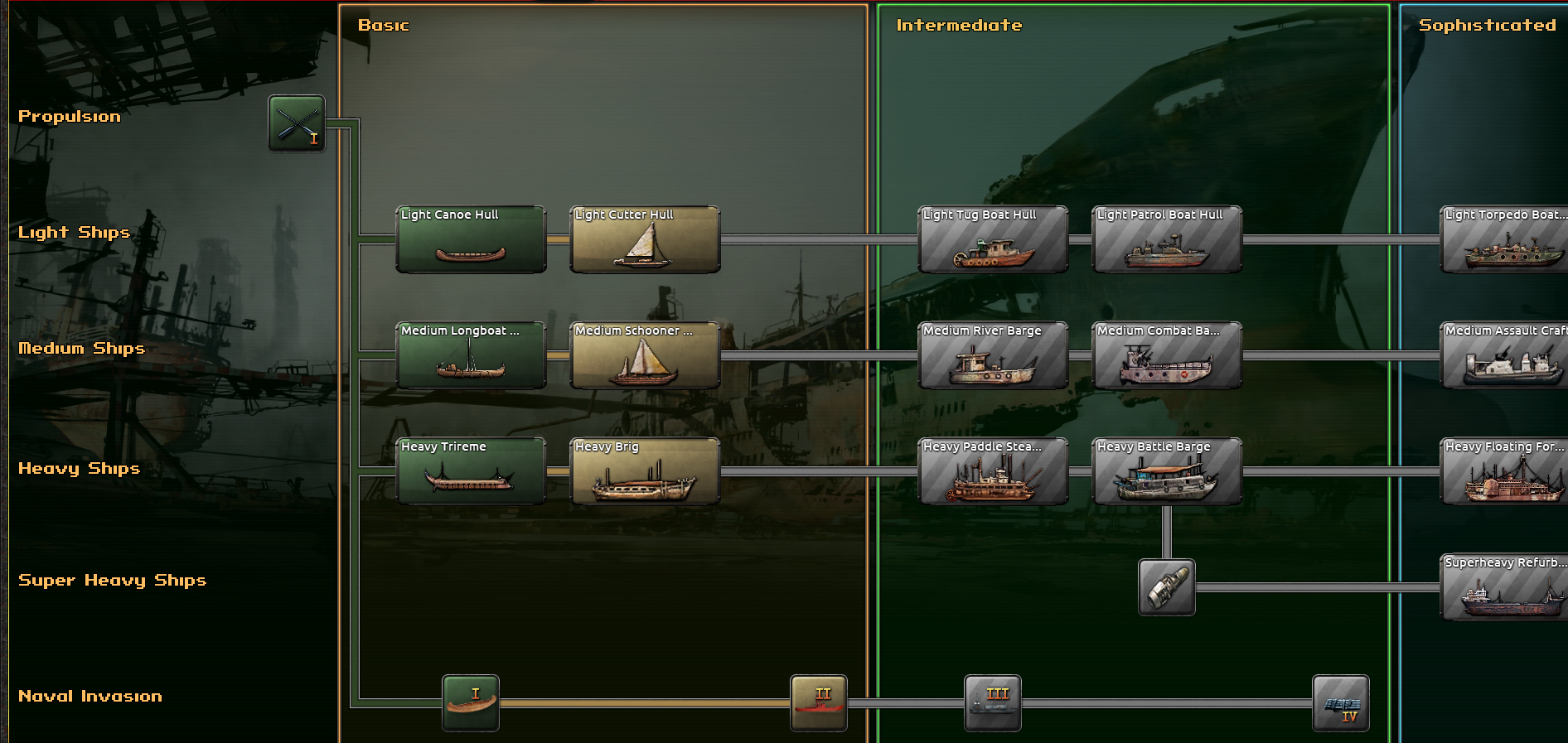
If it is at all possible, you should mainly be producing capital ships until you have a handful of them. Then have some medium and light ships to act as shields for them. Remember, medium ships count as screens.
If you have By Blood Alone, when you capitulate weaker nations you can take their navy in the peace conference. Their navies will act as your screens. Be careful about capturing too many navies, it takes a lot of manpower to staff all those ships.
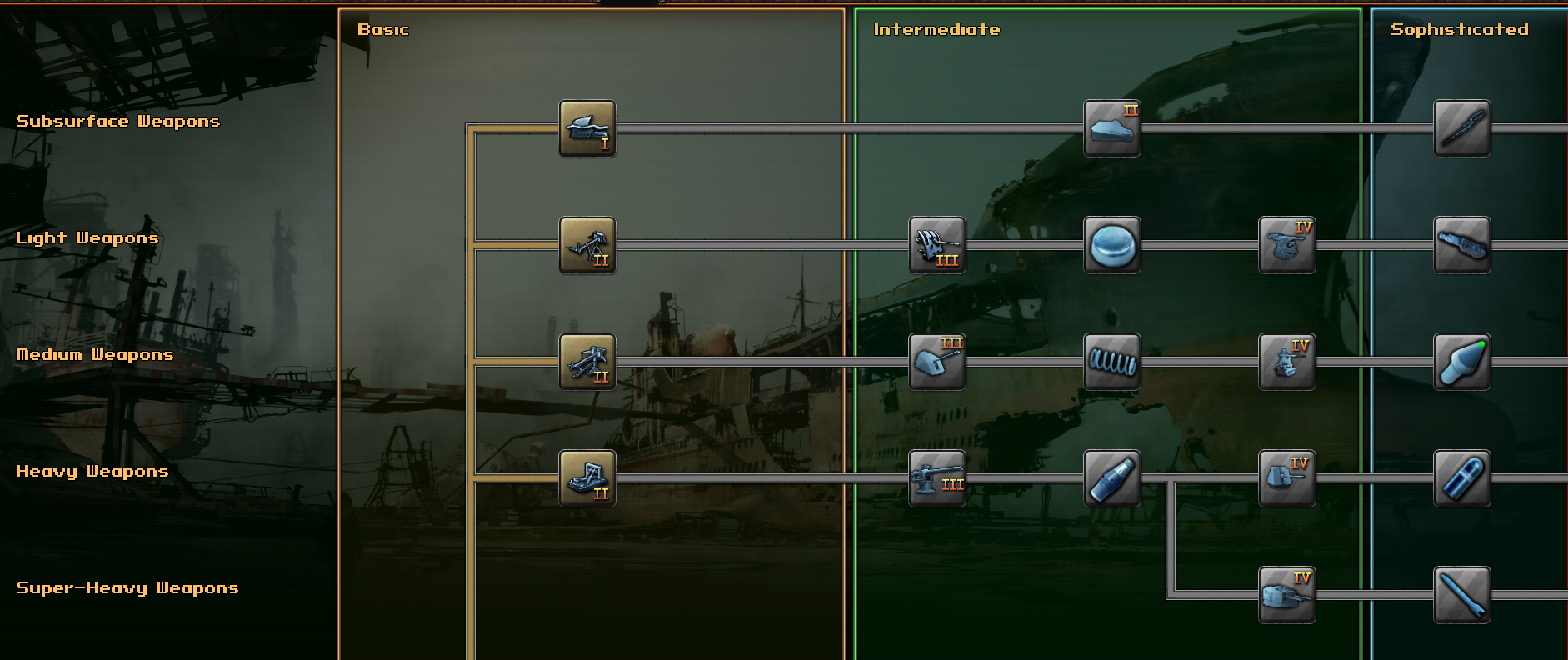
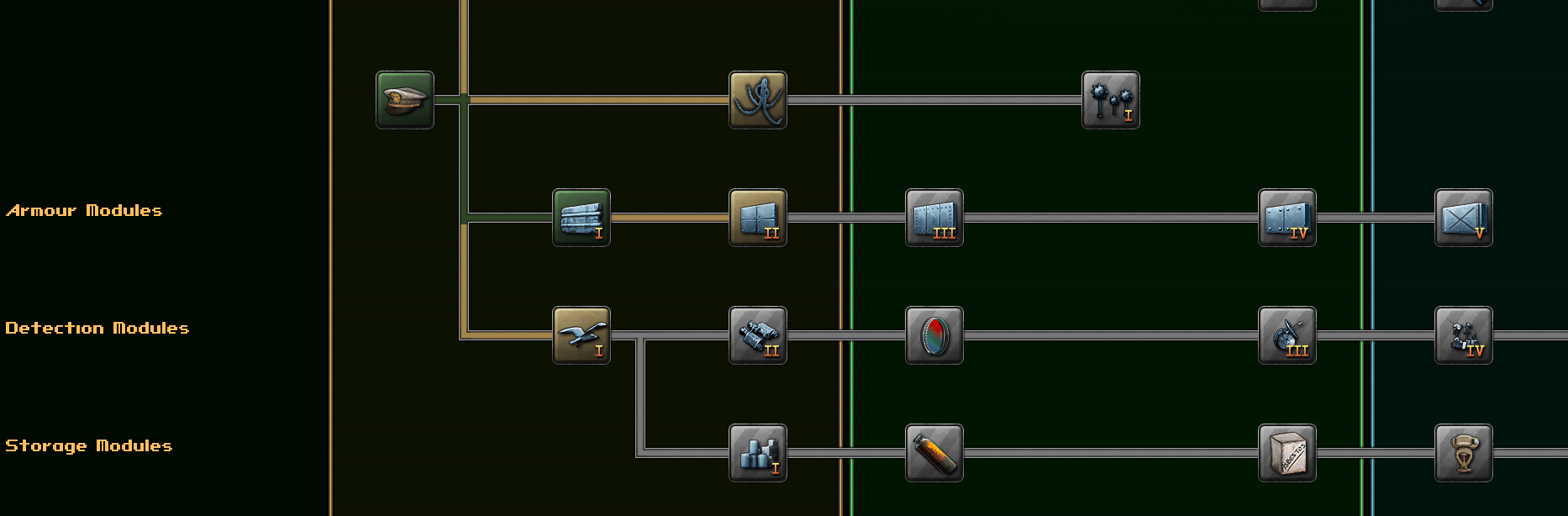
If you have Man The Guns, there are numerous Naval Modules, the bloat is not as bad as vanilla but it can be hard to pick through what is actually useful.
Naval Rams act as low-tech torpedoes, essentially a way for weaker ships to punch up against capital ships.
Screens are extremely fragile without armor upgrades.
Upgrading your heavy weapons is nice to give your capitals the oomph they need.
In the Engineering tree, when you research radio and electronics, you will get better signaling modules for your ships. These are worth retrofitting onto ships you use for spotting.
Naval Doctrine
There's only one naval doctrine tree in Old World Blues, but you will have to pick between Capital Ship Doctrine (only benefits Heavy and Superheavy ships)
or Dispersed Formations (mainly benefits screen ships, has 3 bonuses for capital ships)
There are 6 doctrines in the middle, and 8 whether you go left or right, for a total of 14. They cost 50 XP each, so you'll need 700 Navy XP to get them all.
Dispersed Formations seems alright, however screens in OWB die so quickly that it does not usually matter to upgrade them, and you can still upgrade your screens through the middle path. The screen speed buff is nice, though, as large ships can't hit what they can't catch.
Capital Ship Doctrine gives some much needed armor and org buffs to your capital ships.
Whichever path you choose will depend on your nation and your industry. The middle path is not mutually exclusive with any other, and gives benefits to your screen ships.
Regardless, battles between evenly matched navies are decided by who has more training, naval intel, and doctrines. If you have a navy, you should exercise it before throwing it into battle, you need that XP.
When recruiting, you'll want to prioritize admirals with Bold, Battleship Adherent, Naval Lineage, and/or Chief Engineer.
If you have No Step Back, you need to get 35 Navy XP ASAP so you can buy the Naval Expertise Spirit of the Navy.
This ticking 0.05 daily Navy XP (really 0.055 with the 10% bonus it also has) pays itself off in 636 days.
It gives you 50 XP, enough for a doctrine, within 909 days.
Ship Technology
If it is at all possible, you should mainly be producing capital ships until you have a handful of them. Then have some medium and light ships to act as shields for them. Remember, medium ships count as screens.
If you have By Blood Alone, when you capitulate weaker nations you can take their navy in the peace conference. Their navies will act as your screens. Be careful about capturing too many navies, it takes a lot of manpower to staff all those ships.
Naval Modules
If you have Man The Guns, there are numerous Naval Modules, the bloat is not as bad as vanilla but it can be hard to pick through what is actually useful.
Naval Rams act as low-tech torpedoes, essentially a way for weaker ships to punch up against capital ships.
Screens are extremely fragile without armor upgrades.
Upgrading your heavy weapons is nice to give your capitals the oomph they need.
In the Engineering tree, when you research radio and electronics, you will get better signaling modules for your ships. These are worth retrofitting onto ships you use for spotting.
Technology
So much stuff to research, what to pick?
On day 1, I recommend you begin by researching your Land Doctrine, Industry, and Electronics.
Nations that will be at war within the first year of the game should get Communications techs immediately to increase their Reinforce Rate and Encryption/Decryption.
After the first year it's good to start researching your Support techs. Dogs are a good first pick since you can't buy dogs on the market.
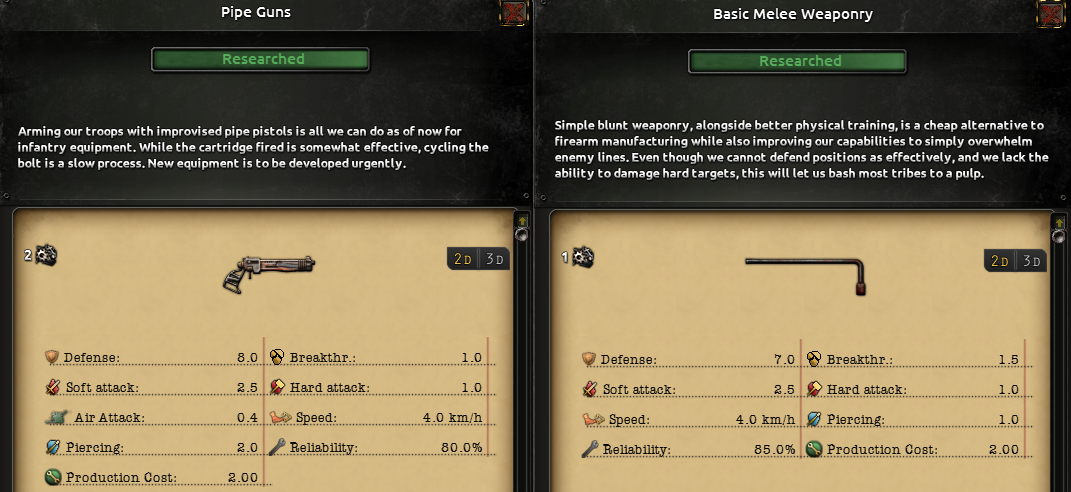
Right as soon as you start you'll have to decide between producing guns or melee weapons.
While melee weapons obviously lack Air Attack and are worse on defense, they have more Breakthrough and Reliability. Plus, your Fireteams will give you your Air Attack.
It's not very intuitive, but Melee Weapons have the same production cost as their firearm equivalents. They do cost less scrap metal resources.
They cap out on Intermediate Tech, where Powered Melee Weapons come in 2 years after Common Weaponry and are, as a result, quite a bit better.
BUT, if your nation can EVER get access to Sophisticated Infantry Tech, you'll get access to Advanced Weaponry, so you shouldn't ever pick Melee then.
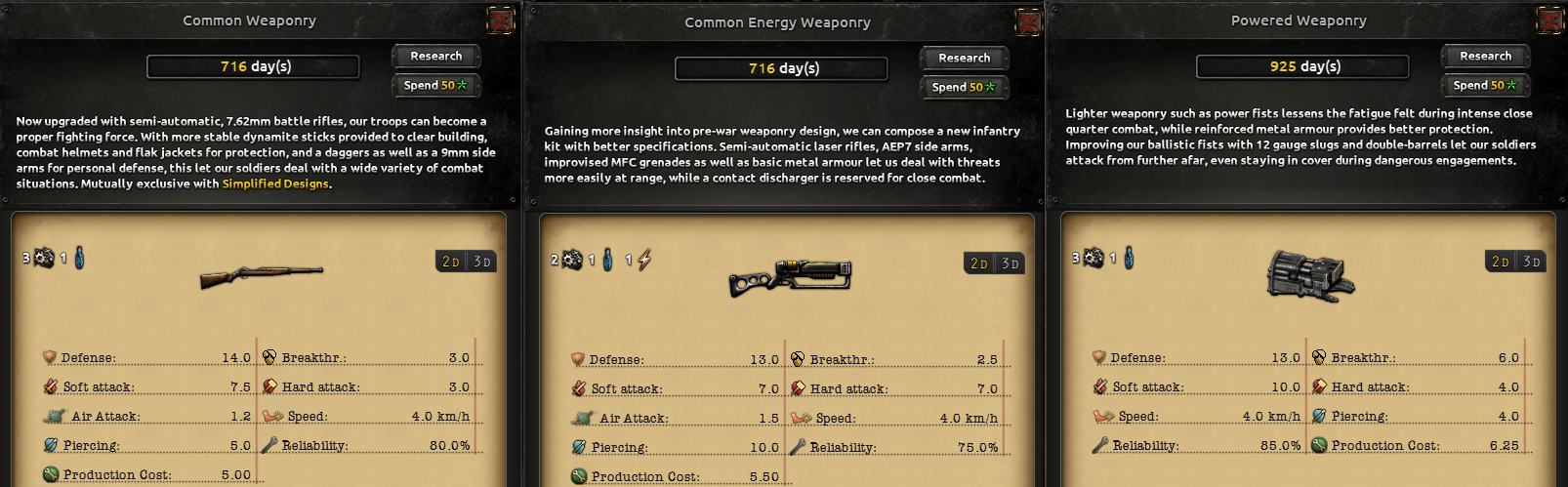
Similar to deciding between LMG's or H-RCW's, the choice between Common Ballistic Weaponry and Common Energy Weapons comes down to Hard Attack and Piercing. But your AT should be giving you the piercing you need, so Common Ballistic Weapons is what I would pick.
Although, it is worth noting you can produce Laser Weapons to sell to the Van Graffs to get their relationship up with you.
Here you can also see the advantages Powered Melee Weapons have over Common Weaponry.
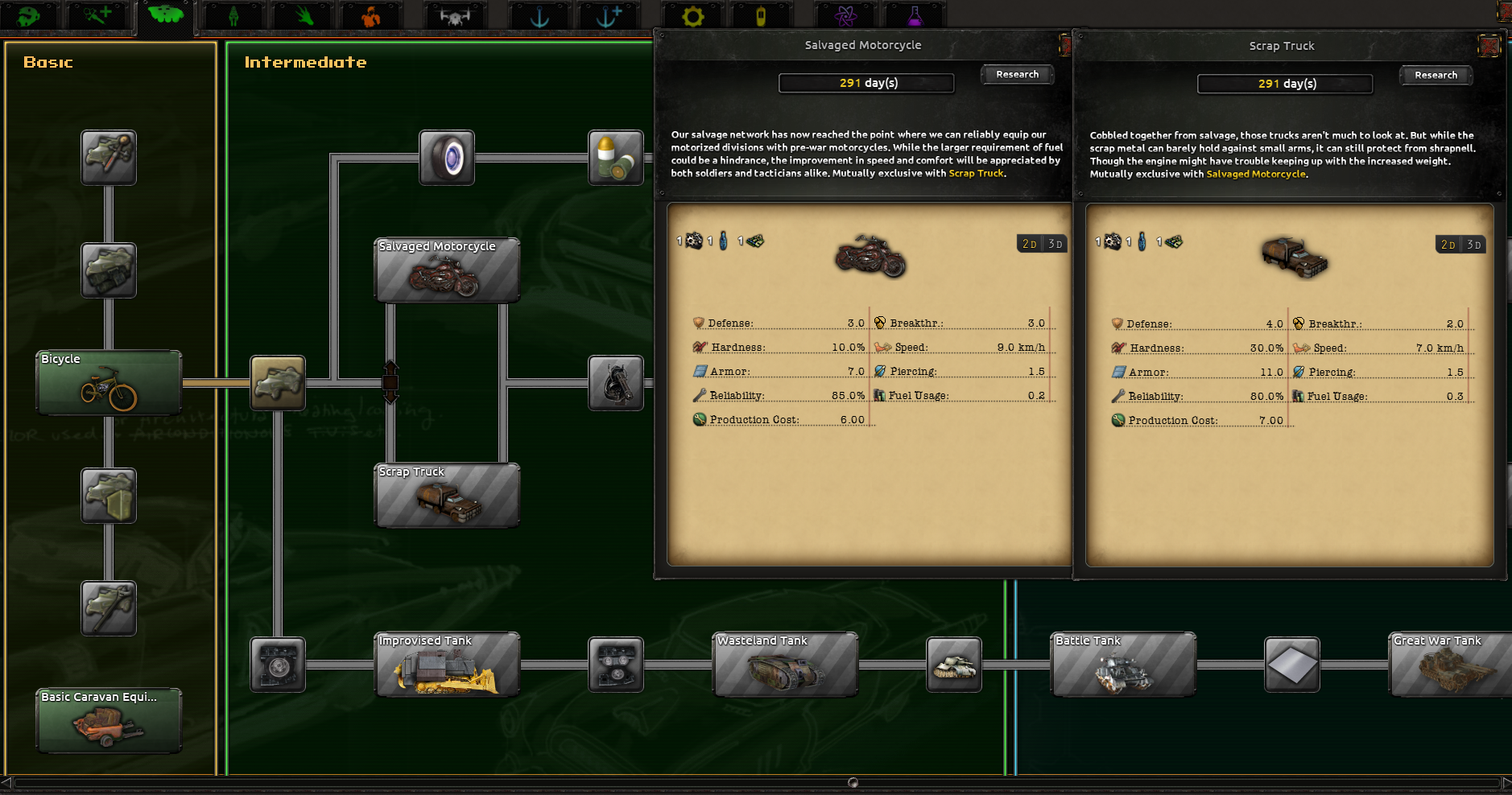
Vehicle-based nations will inevitably have to choose between cars/motorcycles or trucks/APCS.
Comparing the difference between the two Sophisticated variants here should highlight the differences between the two.
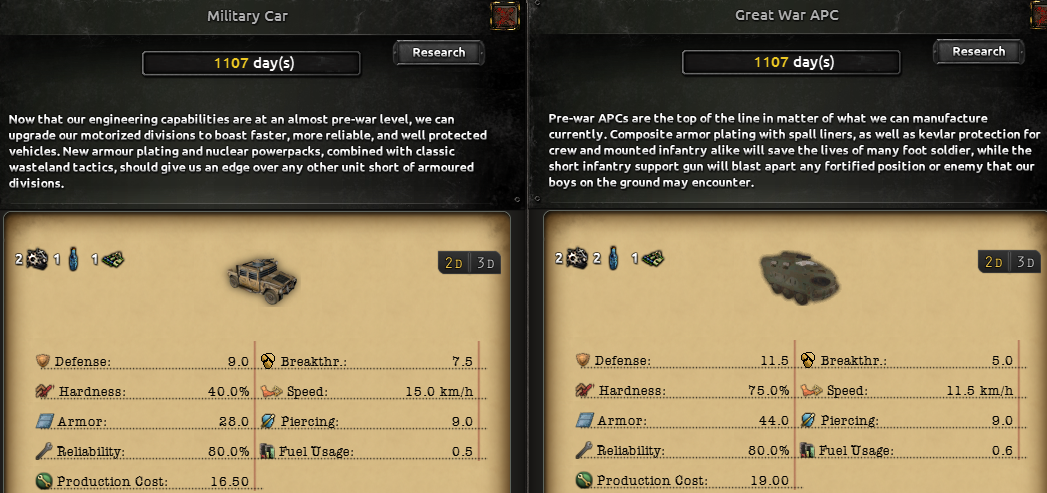
While overrunning people with the fastest vehicles possible is fun, terrain and infrastructure is often so poor that this isn't a very reliable strategy. APCS are often better. Their armor isn't amazing, but it's still enough to severely punish divisions that lack AT.
For everyone else, Improvised.
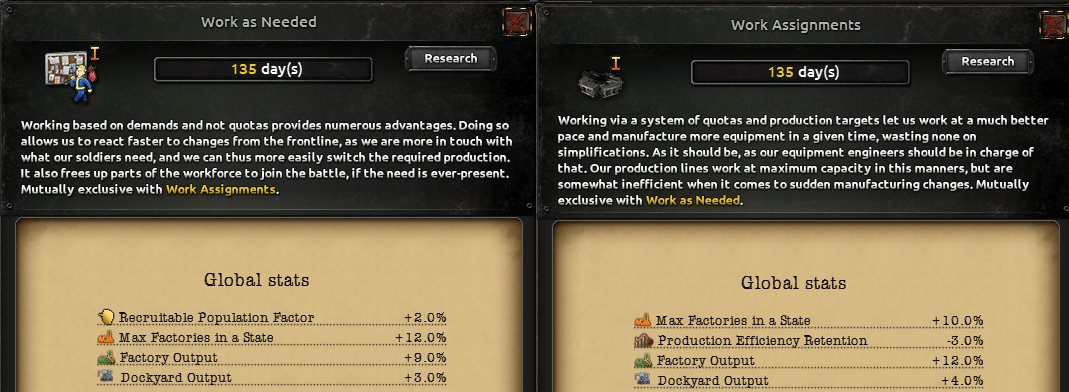
Do you need every last solitary scrap of manpower and/or change your production lines constantly? Work As Needed.
For everyone else, Work Assignments. You can use that factory output to make armor and planes to preserve your manpower.
The difference between them isn't massive, but you do need to research these industry techs as soon as they are available.
Population Nomadicity is how much your population moves around, it's how likely your factories are to be affected by the factory decimation mechanic. Except, that feature is disabled by default in the game rules.
Same goes for Occupation Appeal/Appeal to Refugees. The refugee mechanic isn't enabled by default.
This is one of the last techs in the industry tree you need to research anyway.
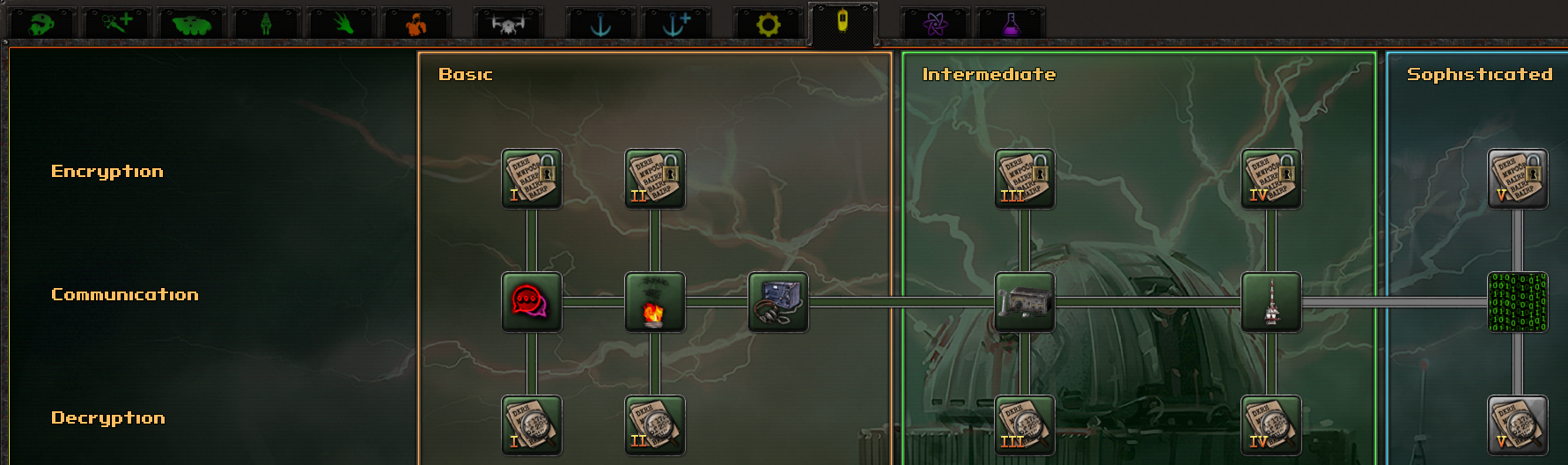
Communications are another very high-priority tech.
Reinforce rate is what determines the chance that a division in the reserves of a battle will fill an empty space every hour. This is important, especially early on when entire wars are decided by who's lucky enough to reinforce a tile.
Ever been so close to pushing a division out of a tile, defeating every division in a combat, only for another to appear at the last moment and reset your progress?
Ever been defending, waiting and waiting as your reserves never actually join the battle?
You got 'reinforce memed', as the community calls it.
The Engineering Tab also has Electronics.

If you didn't already know, researching things that improve your Research Speed is crucial. You should be doing it as early as possible so it pays off, but not while there's an 'ahead of time' penalty.
Some nations receive rather harsh restrictions, but sometimes, working around your limitations is what makes OWB (and real life) fun.
Often, you'll be rewarded with a new tech level in your focus tree. Simply search for the keywords "Basic" or "Intermediate" or "Sophisticated" so you can plan around this.
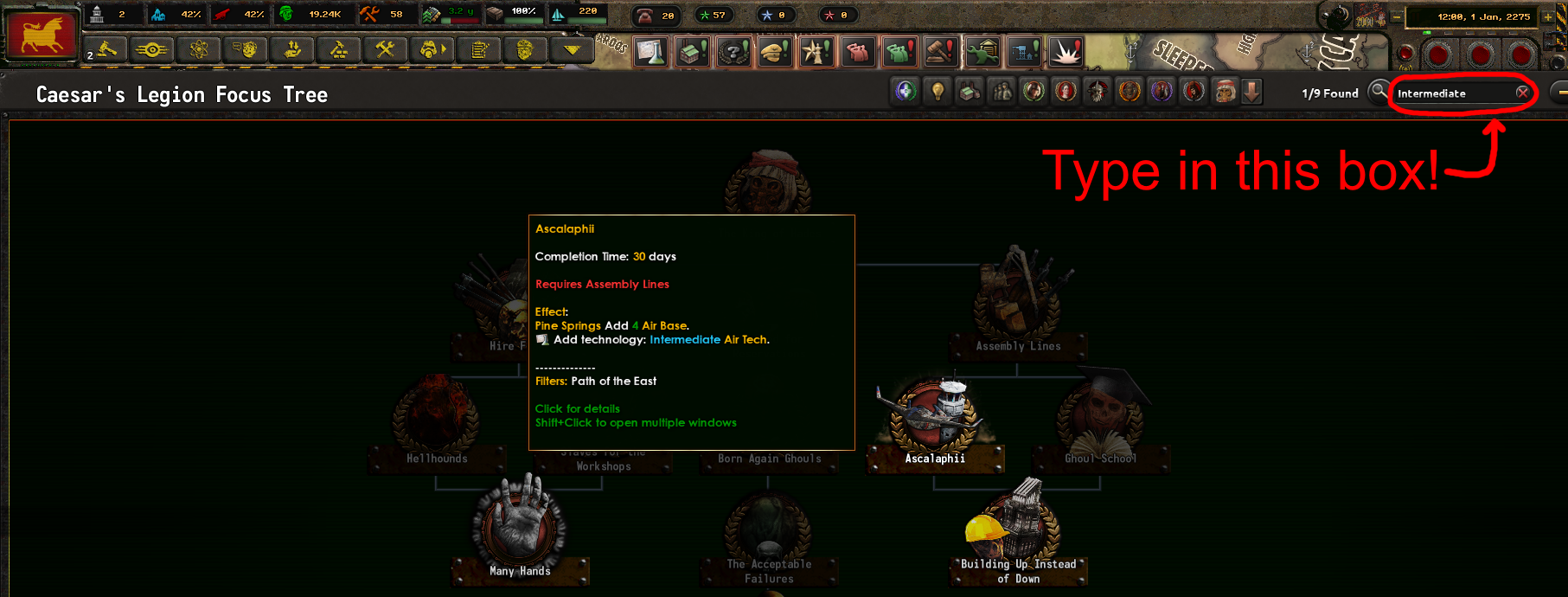
For example, we can see that the Caius Drusus path for Caesar's Legion gets access to Intermediate Air Technology—pretty cool.
(If you enable 'Allow Tech Advancement' in the game rules, you can research Tech Levels. They take over a year, and the mod isn't balanced around it, but you can.)
On day 1, I recommend you begin by researching your Land Doctrine, Industry, and Electronics.
Nations that will be at war within the first year of the game should get Communications techs immediately to increase their Reinforce Rate and Encryption/Decryption.
After the first year it's good to start researching your Support techs. Dogs are a good first pick since you can't buy dogs on the market.
Infantry
Right as soon as you start you'll have to decide between producing guns or melee weapons.
While melee weapons obviously lack Air Attack and are worse on defense, they have more Breakthrough and Reliability. Plus, your Fireteams will give you your Air Attack.
It's not very intuitive, but Melee Weapons have the same production cost as their firearm equivalents. They do cost less scrap metal resources.
They cap out on Intermediate Tech, where Powered Melee Weapons come in 2 years after Common Weaponry and are, as a result, quite a bit better.
BUT, if your nation can EVER get access to Sophisticated Infantry Tech, you'll get access to Advanced Weaponry, so you shouldn't ever pick Melee then.
Similar to deciding between LMG's or H-RCW's, the choice between Common Ballistic Weaponry and Common Energy Weapons comes down to Hard Attack and Piercing. But your AT should be giving you the piercing you need, so Common Ballistic Weapons is what I would pick.
Although, it is worth noting you can produce Laser Weapons to sell to the Van Graffs to get their relationship up with you.
Here you can also see the advantages Powered Melee Weapons have over Common Weaponry.
Vehicles
Vehicle-based nations will inevitably have to choose between cars/motorcycles or trucks/APCS.
Comparing the difference between the two Sophisticated variants here should highlight the differences between the two.
While overrunning people with the fastest vehicles possible is fun, terrain and infrastructure is often so poor that this isn't a very reliable strategy. APCS are often better. Their armor isn't amazing, but it's still enough to severely punish divisions that lack AT.
Industry
Scavenged or Improvised Tools?
Does your nation literally only ever get access to Basic Industry? If so, Scavenged. For everyone else, Improvised.
Work As Needed, or Work Assignments?
Do you need every last solitary scrap of manpower and/or change your production lines constantly? Work As Needed.
For everyone else, Work Assignments. You can use that factory output to make armor and planes to preserve your manpower.
The difference between them isn't massive, but you do need to research these industry techs as soon as they are available.
What's this junk? Nomadicity?
Population Nomadicity is how much your population moves around, it's how likely your factories are to be affected by the factory decimation mechanic. Except, that feature is disabled by default in the game rules.
Same goes for Occupation Appeal/Appeal to Refugees. The refugee mechanic isn't enabled by default.
This is one of the last techs in the industry tree you need to research anyway.
Engineering
Communications are another very high-priority tech.
Reinforce rate is what determines the chance that a division in the reserves of a battle will fill an empty space every hour. This is important, especially early on when entire wars are decided by who's lucky enough to reinforce a tile.
Ever been so close to pushing a division out of a tile, defeating every division in a combat, only for another to appear at the last moment and reset your progress?
Ever been defending, waiting and waiting as your reserves never actually join the battle?
You got 'reinforce memed', as the community calls it.
The Engineering Tab also has Electronics.
If you didn't already know, researching things that improve your Research Speed is crucial. You should be doing it as early as possible so it pays off, but not while there's an 'ahead of time' penalty.
Tech Levels
Determines what your nation is good at, essentially. Some nations receive rather harsh restrictions, but sometimes, working around your limitations is what makes OWB (and real life) fun.
Often, you'll be rewarded with a new tech level in your focus tree. Simply search for the keywords "Basic" or "Intermediate" or "Sophisticated" so you can plan around this.
For example, we can see that the Caius Drusus path for Caesar's Legion gets access to Intermediate Air Technology—pretty cool.
(If you enable 'Allow Tech Advancement' in the game rules, you can research Tech Levels. They take over a year, and the mod isn't balanced around it, but you can.)
Recommended Mods
Modifier Icons
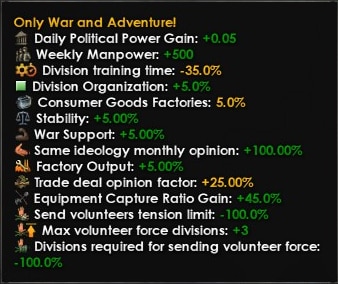
Wonder what all those icons were in my screenshots? This is that mod!
Adds little icons to modifiers. Looks awesome and I never leave home without it.
Ironman compatible so you can join a host that doesn't have this mod and vice versa.
optional instand wargoal
Another mod I never leave home without. Don't think post-apocalyptic nations should waste 200 days fabricating war goals? Just declare war in 10 days! Yes it ruins balance, but it's quite fun.
My friends love to poke fun at the typo in the name. This mod, and its title, have not been updated since 2019, yet the mod has never stopped working in the years I've used it.
OWB: ♥♥♥♥♥ Formables
Rather interestingly-named mod that adds some formable nations to OWB, giving some goals to strive towards for nations that lack them.
OWB Create And Leave Faction
Allows any human-controlled nation to create/leave a faction at the click of a button. Still works in 2025. Use the below mod if you want to have a faction with a name other than "Player Faction 1."
Rename Factions (with keyboard!)
Rename the faction you're in to whatever you want! Hasn't been updated since 2020 but still works in 2025.
FPS Map
Save some frames by lowering the graphics beyond what the settings will let you do normally. Colors the buttons (optional). You just might prefer the look of this map. Ironman compatible.
Coloured Airforce Updated
Color-codes your planes.
OWB: Lost Hills Expanded
One of the best submods, Lost Hills is already one of the best nations in OWB but this mod makes it even better.
"Where's Enclave Reborn?"
(beep) Connection terminated. I am sorry if you wanted tips or a more in-depth review. But it's not quite what I have in mind for my guide. Enclave Reborn is fun for a power fantasy run or two, but that's it imo. If you want a world conquest try Lost Hills or Cerberus (play as Shale's Army then accept everything Calix asks).
The issue, which does not lie with the mod's creator, is that Enclave fans are so used to engaging in fanon mods, fics, and Tiktok edits that they forget canon, where the Enclave lost to a random tribal (2) and then a 19 year old kid from a vault (3). There shouldn't even be many remnants left but Bethesda keeps bringing them back.
This creates a problem for the OWB team, where fans demand more and more Enclave even though the mod already has well-written Enclave content (Macarthur, Pioneer Company, Eureka). These demands get to the point where the team has to remove New Reno's Enclave path because people were only playing New Reno for the Enclave and ignored everything else.
This creates another problem for my guide, because Enclave fans just CTRL+F search for Enclave and ignore everything else. This is a general OWB guide. It doesn't really go into detail for specific nations.
It's okay to like the Enclave if you like playing as the 'bad guys' in games. I do too. The issue is where people genuinely try to argue for their beliefs. They were never written like that. Again we run into the fanon vs. canon problem. The Enclave is not morally grey. Their cartoonish evilness is on pair with the Raiders. They just have a 'patriotic' coat of paint.
The Enclave does not exist to rebuild America, nor is it the country's legal successor. It exists to protect the money and power of all the elites within itself. They were basically the shadow government puppeteering the US pre-war inching them towards nuclear war, and they took power through an illegal coup. The Enclave turned the pre-war Fallout USA into a totalitarian, jingoist oligarchy that suppressed civil liberties... you know... the OPPOSITE of core American values.
But they managed to trick well-meaning people through patriotic propaganda. Opening cutscene of Fallout 1? Unarmed prisoner being shot in the head on national television by US soldiers, who then laugh and wave at the camera. What about in Fallout 3, that old guy in Megaton who sang the Enclave's praises... what ended up happening to Nathan? Oh right he was captured and imprisoned.
And no, I'm not a Brotherhood fan. I'm not a NCR fan or a House fan or a Legion fan or whatever. I have played all the Enclave content in OWB and found it fun, because there's nuance to it. Ever played the Pioneer Company's Enclave path? They have to give up and betray everything for the Enclave. That's nuance. Not a power fantasy. I'm satisfied with that. I don't need any more.
So TL;DR uh... no TL;DR, read it or don't. Enclave fans, this is not an attack on you. If you're a hardcore Enclave bootlicker, it is. Luckily for us they can't read.
Wonder what all those icons were in my screenshots? This is that mod!
Adds little icons to modifiers. Looks awesome and I never leave home without it.
Ironman compatible so you can join a host that doesn't have this mod and vice versa.
optional instand wargoal
Another mod I never leave home without. Don't think post-apocalyptic nations should waste 200 days fabricating war goals? Just declare war in 10 days! Yes it ruins balance, but it's quite fun.
My friends love to poke fun at the typo in the name. This mod, and its title, have not been updated since 2019, yet the mod has never stopped working in the years I've used it.
OWB: ♥♥♥♥♥ Formables
Rather interestingly-named mod that adds some formable nations to OWB, giving some goals to strive towards for nations that lack them.
OWB Create And Leave Faction
Allows any human-controlled nation to create/leave a faction at the click of a button. Still works in 2025. Use the below mod if you want to have a faction with a name other than "Player Faction 1."
Rename Factions (with keyboard!)
Rename the faction you're in to whatever you want! Hasn't been updated since 2020 but still works in 2025.
FPS Map
Save some frames by lowering the graphics beyond what the settings will let you do normally. Colors the buttons (optional). You just might prefer the look of this map. Ironman compatible.
Coloured Airforce Updated
Color-codes your planes.
OWB: Lost Hills Expanded
One of the best submods, Lost Hills is already one of the best nations in OWB but this mod makes it even better.
"Where's Enclave Reborn?"
(beep) Connection terminated. I am sorry if you wanted tips or a more in-depth review. But it's not quite what I have in mind for my guide. Enclave Reborn is fun for a power fantasy run or two, but that's it imo. If you want a world conquest try Lost Hills or Cerberus (play as Shale's Army then accept everything Calix asks).
The issue, which does not lie with the mod's creator, is that Enclave fans are so used to engaging in fanon mods, fics, and Tiktok edits that they forget canon, where the Enclave lost to a random tribal (2) and then a 19 year old kid from a vault (3). There shouldn't even be many remnants left but Bethesda keeps bringing them back.
This creates a problem for the OWB team, where fans demand more and more Enclave even though the mod already has well-written Enclave content (Macarthur, Pioneer Company, Eureka). These demands get to the point where the team has to remove New Reno's Enclave path because people were only playing New Reno for the Enclave and ignored everything else.
This creates another problem for my guide, because Enclave fans just CTRL+F search for Enclave and ignore everything else. This is a general OWB guide. It doesn't really go into detail for specific nations.
It's okay to like the Enclave if you like playing as the 'bad guys' in games. I do too. The issue is where people genuinely try to argue for their beliefs. They were never written like that. Again we run into the fanon vs. canon problem. The Enclave is not morally grey. Their cartoonish evilness is on pair with the Raiders. They just have a 'patriotic' coat of paint.
The Enclave does not exist to rebuild America, nor is it the country's legal successor. It exists to protect the money and power of all the elites within itself. They were basically the shadow government puppeteering the US pre-war inching them towards nuclear war, and they took power through an illegal coup. The Enclave turned the pre-war Fallout USA into a totalitarian, jingoist oligarchy that suppressed civil liberties... you know... the OPPOSITE of core American values.
But they managed to trick well-meaning people through patriotic propaganda. Opening cutscene of Fallout 1? Unarmed prisoner being shot in the head on national television by US soldiers, who then laugh and wave at the camera. What about in Fallout 3, that old guy in Megaton who sang the Enclave's praises... what ended up happening to Nathan? Oh right he was captured and imprisoned.
And no, I'm not a Brotherhood fan. I'm not a NCR fan or a House fan or a Legion fan or whatever. I have played all the Enclave content in OWB and found it fun, because there's nuance to it. Ever played the Pioneer Company's Enclave path? They have to give up and betray everything for the Enclave. That's nuance. Not a power fantasy. I'm satisfied with that. I don't need any more.
So TL;DR uh... no TL;DR, read it or don't. Enclave fans, this is not an attack on you. If you're a hardcore Enclave bootlicker, it is. Luckily for us they can't read.
Glossary

AA = Anti-Air.
AI = Any nation not controlled by a human.
APC = Armored Personnel Carrier. Trucks, the bottom path for vehicles in OWB's tech tree. A fighting vehicle that has some armor to protect from small-arms fire.
Armor = Decreases the number of soft and hard attacks made against the division by up to -50% if the enemy has less than 50% piercing.
Asym = Asymmetric Warfare.
AT = Anti-Tank. Equipment with high hard attack and piercing, meant to take down armored targets like Power Armor, Robots, and, well, tanks.
Battalion = The units that make up your division templates. Divisions have to have at least one battalion. They fill up a 5x5 grid, so a division can have up to 25 battalions.
Breakthrough = How many attacks a division can avoid while attacking. Higher helps it sustain an offensive for longer.
CAS = Close Air Support. Planes that specialize in assisting units on the ground by dealing direct damage to their Organization and HP.
Civs = Civilian Factories, which are called Civilian Workshops in OWB.
Combat Width = Represents the room that the division takes up while fighting at the front line. In order to fit into battle, the division needs to fit into the combat width provided by the battlefield, which varies by terrain. Fielding more divisions than the battlefield combat width supports will result in penalties. When this happens, the Battle Interface will automatically put these extra divisions into reserve.
"The max OWB width on a single tile is 80 (not counting attacking from another direction that adds another 20). As such, attacking with 20 width divisions means that you can attack with 4 divisions while the rest sit in reserve.
A 30 width division would only have 3 units able to attack as 4 30 widths would go over the 80 width limit. The combination of 4 20 width units outstats 3 30 width units or 2 40 width divisions." -3.21869kilometres in the OWB Discord
Defence = How many attacks a division can avoid while defending. Higher helps it hold the line longer with less casualties.
Demo = Demolitions.
Division = The units you see on the map.
Entrenchment: Represents the ability of a unit to build temporary defensive structures like trenches and pick favourable defensive positions like hills, to better defend against an enemy attack. Entrenchment affects both attack and defence stats of divisions. Divisions build up entrenchment daily when not engaged in combat and stationary (not moving). Divisions will lose all their entrenchment if they are attacking. Conventional Warfare gives the best bonuses to entrenchment.
F:NV = Fallout: New Vegas, the greatest game ever made.
Hard attack = How many attacks per hour are made against the hard part of an enemy division, targets with high hardness like tanks and enforcers and robots.
Hardness = Represents what proportion of the division is made up of battalions which are hardened and protected. It is the proportion of hard attacks to soft attacks that an incoming unit receives. Units with more hardness will take less soft attack and more hard attack, while units with less hardness will take more soft attack and less hard attack.
HP = Hit Points. The orange bar on a division, its strength. Stats are reduced proportionally when this goes down. A higher max HP lets a division take fewer losses to its manpower and equipment. When HP reaches 0 it's destroyed entirely. Usually divisions retreat to a nearby tile before this happens, but if they are encircled (surrounded by enemy territory) they are destroyed.
HOI4 = Hearts of Iron IV.

IC = Industrial Capacity. Was basically your total Factory Output in older HOI games, but now it is synonymous with Production Cost.
Initiative = A stat that speeds up battle planning speed and reinforce rate. Each 1% Initiative increases Reinforce Rate by 0.25%.
LSF = Light Special Forces. The divisions that take Spec Ops equipment.
Micro = Micromanaging. Controlling individual units instead of letting the battle plan automatically do it all for you. Sounds crazy at first but you get better at it over time.
Mils = Military Factories, which are called Arms Workshops in OWB.
Org = Organization. The green bar that determines how long a division can stay in combat. Not to be confused with HP. Units with no organization can't fight. Units drain organization as they move, some land doctrines mitigate this.
OWB = Old World Blues.
PA = Power Armor. Heavy special forces.
PC = Production Cost. The green wrench icon on equipment. How expensive a thing is to produce.
Piercing = If this value is higher than an enemy divisions armor value, you don't suffer any penalties for fighting it. Piercing is not a zero-sum game, though, divisions deal -20% damage with at least 75% of the necessary piercing, -35% damage with at least 50% piercing, and -50% damage otherwise. This is why it's necessary to have at least have some piercing. Build AT.
Recovery Rate = All divisions recover their organization at a fixed rate, some factors give added Recovery Rate on top of that.
Reinforce Rate = The chance that a reserve division will join an ongoing battle.
Soft attack = How many attacks per hour are made against the soft part of an enemy division, targets with low hardness like infantry.
SF = Special Forces. Includes Light Special Forces, Power Armor, Nightkin, Behemoths, etc....
Tile = Just another word for Province. It's the areas that divisions occupy.
Vanilla = The unmodded Hearts of Iron IV experience, a World War 2 scenario starting in 1936 or 1939 until about 1948.
XP = Experience. The stars at the top of the screen.
Learned something new from my guide? Show some support! :3